
A 355 mm portable cut-off saw at 3800 r/min no-load speed and 2200 W rated input is the mainstream abrasive cutoff package appearing in current manufacturer catalogs, typically shipped as a 110/220 V 50/60 Hz dual-voltage unit for global site deployment [S4].
For a process engineer, "installation" on this class of machine is less about bolting it to a bench and more about wheel-speed verification, guard integrity, electrical supply matching, and coolant or dust-extraction routing — the same four gates that show up on every CE/UL conformity checklist for rotating abrasive machinery [S1][S2].
Defining the cut-off machine class and where it sits in the shop
A cut-off machine is a rotary abrasive or blade tool whose sole purpose is severing a workpiece at a defined length — not grinding a surface, not milling a feature [S1]. On a mid-2026 DirectIndustry index, 32 manufacturers list 48 products under the "universal cutting machine" family, spanning rotary blade, abrasive waterjet, fiber laser, knife and tube-cut architectures [S1]. The portable bench-top abrasive cutoff is the lowest-cost and most common variant: one 2200 W, Ø355 mm model ships at 51 × 29 × 40 cm carton dimensions, 20 kg gross / 18 kg net, with 460 units per 20' container packing density [S4][S5].
Heavier swing-frame cut-off/grinder combinations such as the Rema PS 350/500/600 series run at 60 m/s or 80 m/s peripheral wheel speed and are column-mounted on slewing jib cranes for grinding of large workpieces [S2]. Floor-standing wet cut-off units like the Qcut 500 A add X/Y/Z travels of 420/280/200 mm for metallographic sample preparation [S1]. Picking the right family up front — portable dry abrasive, swing-frame grinder, wet abrasive, or non-thermal knife/laser — is the first installation decision, because the electrical, coolant and exhaust interfaces differ by an order of magnitude.
Selection criteria: motor power, blade diameter, voltage and duty cycle
Four specs drive 80% of the installation envelope: blade diameter (Ø), no-load rpm, rated input watts, and supply voltage [S4]. A Ø355 mm / 3800 r/min / 2200 W portable head matches a 1.6–3.0 mm abrasive wheel rated for that peripheral speed, and runs on either 110 V or 220 V at 50/60 Hz without rewiring, which simplifies multi-region site rollouts [S4]. Smaller Dremel-style 38 mm cut-off wheels use a 3.2 mm shank and a maximum 35,000 r/min rating — the same "max-rpm" rule applies, just scaled to a different speed class [S3].
Continuous-duty motors with full-copper windings extend acceptable working time between cool-down pauses; this matters on a fabrication line where the saw runs 30–60 minutes per shift, not 5-minute intermittent cuts [S4]. Swing-frame and pedestal cut-off/grinders add a two-step speed adjustment to compensate for wheel wear — the operator can drop from 80 m/s to 60 m/s as the wheel diameter erodes, keeping peripheral speed in the safe band without changing the wheel [S2]. For an installation engineer, "rated input power" is the spec that sets the breaker size, the cable cross-section, and whether a 16 A or 32 A outlet is required on the wall.
Who a portable cut-off saw is for — and who should pick something else

The 355 mm portable abrasive cutoff is the right tool for steel service centers, rebar fab shops, structural-steel erection crews, and maintenance teams that need to drop a 100 × 100 mm square bar or a 4" pipe on a job site [S1][S4]. It is the wrong tool for thin-wall stainless tube (work-hardening and heat tint), for food-grade or medical clean rooms (sparks and dust), and for any cut that needs ±0.05 mm length tolerance — those jobs go to a wet abrasive cut-off, a cold saw, or a fiber laser [S1].
For high-volume thin-wall conduit and wire cutting, a tube-cut machine like the JWD-E3860 (1–36 mm tube diameter, 850 mm length, 520 mm width) replaces the abrasive saw and removes the spark/dust problem entirely [S1]. For non-metallic PE/PP pipe at 25–2000 mm diameter, knife-style TPK-series cutters sever without material removal — no dust, no chips, no noise — and that is the correct install for a plastic-pipe fab shop [S1]. The portable Ø355 mm saw is, by contrast, a general-purpose ferrous cutoff: cheap, robust, and forgiving, but always a spark source.
Installation gates: wheel speed, guarding, electrical and extraction
Five physical installation steps are common to every abrasive cut-off machine and should be checked before first power-on. First, confirm the wheel's maximum rated rpm is greater than or equal to the spindle no-load rpm — a Ø355 mm wheel rated for 3800 r/min on a 3800 r/min spindle leaves no margin; a 35,000 r/min Dremel wheel on the same spindle would explode [S3][S4]. Second, verify the wheel diameter marked on the blotter matches the installed wheel, and that the blotter is present and legible. Third, check the adjustable protective guard — CE-marked portable cut-offs ship with a guard that closes to within a few millimetres of the workpiece; do not lock it open [S4].
Fourth, confirm the supply matches the nameplate: 110 V or 220 V at 50/60 Hz, with the motor's full-copper winding sized for continuous duty at that voltage [S4]. A 2200 W motor at 220 V draws roughly 10 A; at 110 V it draws roughly 20 A and needs a heavier cord and a 25 A breaker. Fifth, route dust extraction or, for wet cut-offs, the coolant nozzle — wet abrasive units like the Qcut 500 A integrate a recirculating coolant tray and the supply line must be connected before the spindle runs [S1]. For bench-mount installs, M10 or M12 anchor bolts into a 25 mm steel plate or a 100 mm concrete footing are typical; for swing-frame units, the column must be grouted and the slewing jib crane aligned to the workpiece swing radius [S2]. A consistent field practice, also covered in the wider abrasive-tool accessory chain, is to plan dust extraction before the first cut: see the disc and accessory map in Angle Grinder Types: Disc Size, Power and Accessory Map for matching extraction shrouds.
Cut-off wheel compatibility: abrasive bond, diameter and the 35,000 r/min rule
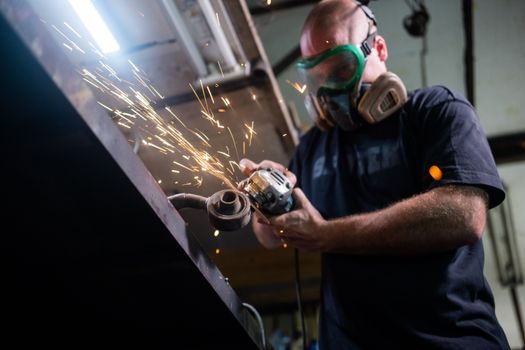
Cut-off wheels for rotary tools follow the same bond-and-grain logic as grinding wheels — aluminium oxide for mild steel, silicon carbide for stainless and non-ferrous, diamond or CBN for hardened tool steel and carbide [S3]. A fiberglass-reinforced 38 mm Dremel cut-off wheel rated 35,000 r/min works on everything from glass-fibre-reinforced plastic and brick through to stainless steel and cast iron, with a 3.2 mm shank that fits the collet on the 3000, 4000, 7700, 8200 and 8220 Dremel multi-tool platforms [S3].
The peripheral-speed rule is the same at every scale: never overspeed a wheel. The Rema PS-series swing-frame cut-off accepts 60 m/s or 80 m/s wheels and the operator selects the speed step to match the wheel's rated peripheral speed, not the spindle rpm [S2]. When a wheel erodes from 400 mm to 350 mm diameter, peripheral speed drops proportionally — the two-step gearbox exists exactly to compensate without forcing a wheel change [S2]. For an installation sign-off, log the wheel diameter, the rated max-rpm, and the calculated peripheral speed on the commissioning sheet; this is the same documentation pattern used across Deburring Machine Price & Cost Guide, where abrasive spec traceability is the audit gate.
Standards, guarding and the maintenance plan that keeps it installed
Portable abrasive cut-off machines sold into the EU carry a CE mark and conform to the Machinery Directive with respect to rotating-tool guarding, two-handed control, and wheel-burst containment. The shaft, the guard adjustment range, and the wheel-blotter requirement are harmonised across that directive family, even where individual national standards differ on creepage and noise [S2][S4]. For Rema-style swing-frame grinders, the manufacturer lists "maintenance-free spindle bearing and belt drive" and "low-vibration handles" as engineered-in operator-safety features rather than accessories, which is the modern expectation for CE-marked industrial grinders [S2].
After installation, a 200-hour first-inspection should re-torque the spindle nut, verify guard closure, and check the wheel for runout greater than 0.05 mm — the same tolerance band used for sample-prep wet cut-offs and well within the capability of a standard dial indicator [S1]. For plants running the Ø355 mm portable head on a 2-shift pattern, disc spend dominates the 5-year cost stack, exactly as the angle-grinder TCO model shows in Angle Grinder TCO: 5-Year Cost Stack, Disc Spend and Motor-Class Levers — track wheel consumption per shift and replace the guard return spring at the same interval. Custom-cut screw-machine and turned parts that feed the cut-off station, such as those handled by Screw Machine Part Price 2026 suppliers, often arrive with a length tolerance tight enough to skip a re-measure step; document that incoming tolerance so the cut-off operator can stop cross-checking and start cutting.
Limitations, failure modes and what the spec sheet will not catch

The published spec sheet covers continuous-duty input power, no-load rpm and shipping weight, but it does not capture wheel-burst energy, guard-closure hysteresis, or vibration at the handle — all of which are the real failure modes in service [S2][S4]. A 2200 W motor paired with a thin economy wheel will stall and burn the work; a quality fiberglass-reinforced wheel on the same saw will cut cleanly at the same feed rate [S3][S4]. Wheel selection is therefore an installation decision, not a procurement afterthought.
Wet abrasive cut-offs add coolant-mix ratio, pump flow, and tank-sediment cleaning to the maintenance list, and they are the only cut-off class that can be installed next to a metallographic lab without sparking the dust-extraction system [S1]. Dry portable cut-offs must never be installed in an area with a Class II combustible dust atmosphere; that is a job for a non-sparking knife cutter or a waterjet — both of which appear in the 2026 universal-cutting-machine catalog index alongside the abrasive saw [S1]. The cheapest installed cut-off is not the cheapest one to own.
Any drift on those three numbers is an early indicator of wheel glazing, guard-spring fatigue, or motor-bearing wear — and each one is cheaper to fix in week one than in month six.
For component-level specifications, see linear guide, crossed roller guide, and coding machine.