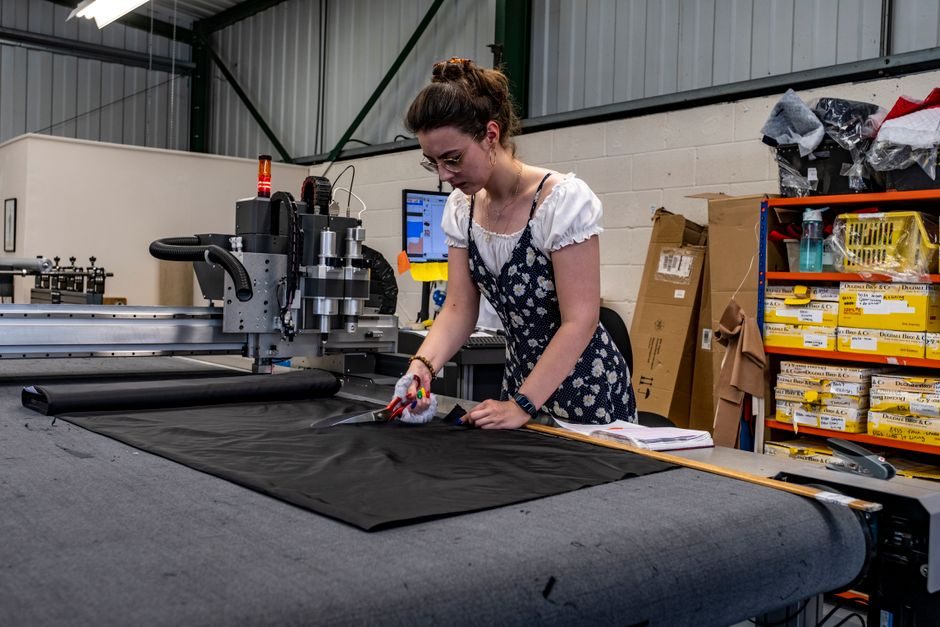
Cut-off machine selection on a 2026 industrial quote is dominated by five hard gates: drive type (electric or pneumatic), blade technology (rotary vs. abrasive), cutting wheel diameter, motor power, and swing-frame geometry for foundry or steelmill duty [S1][S4][S5]. Rotary-blade swing-frame units are commonly rated for 60 m/s peripheral speed, with an 80 m/s option available for harder workpieces [S1].
Portable steel-cutting cut-off machines in current catalogues ship with a 355 mm blade at 2200 W rated input, 3800 r/min no-load speed, and dual 110/220 V / 50/60 Hz voltage capability — a baseline that anchors the lower end of the selection window [S7]. Higher-power bench-class units, exemplified by the J1G-ODL-MT240 pattern, push to 2000 W and above in the 240 mm wheel class, with 300-piece MOQ supply typical from Zhejiang OEM channels [S4].
Drive Architecture: Electric vs. Pneumatic
Electric cut-off machines dominate the 2026 portable and bench category because power-density per kilogram has overtaken pneumatic in most workshops: a 355 mm portable model at 2200 W is now a stock SKU on industrial sourcing platforms, paired with a full-copper motor for continuous-duty operation [S7]. The Maktec MT240-class portable cuts in the 240 mm wheel class at 2000 W, an envelope sized for rebar, conduit, and small section-steel work in the field [S4].
Pneumatic cut-off machines retain a niche in foundries and explosion-risk areas where brushless electric motors are restricted. Where a permanent-magnet electric motor is acceptable, the electric path wins on controllability and on-board protection circuits. For background on how cutting and material-removal machines integrate with adjacent process equipment, see the cutting machine reference page.
Blade Technology and Peripheral Speed
Rotary-blade cut-off machines in foundry swing-frame configuration run at 60 m/s as the standard peripheral speed, with an 80 m/s high-speed option used for harder workpiece materials [S1]. The Fox 2-C swing-frame cut-off machine uses this geometry to provide a full 90° clockwise and 75° counterclockwise swing arc — the geometry that lets an operator index the wheel into a casting and separate gates, risers, or runner-tied castings without moving the workpiece [S5].
Selection rule: pair 60 m/s wheels with general-grade abrasive or HSS blades on cast iron and non-ferrous risers; reserve 80 m/s for high-hardness tool-steel gates and clean separation cuts. For wider context on how cut-off machines relate to general-purpose cutting platforms, the cutting machine encyclopedia page maps the machine family tree.
Wheel Diameter, Power, and Duty Cycle
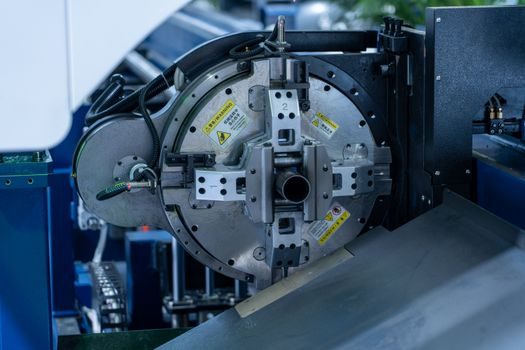
Wheel diameter is the single spec that locks the machine's maximum workpiece section. The 355 mm portable class cuts up to roughly 120 mm round bar in a single pass at 2200 W input and 3800 r/min no-load speed [S7]. Step down to 240 mm wheels and the realistic envelope drops to about 60–70 mm round bar at 2000 W — the Maktec MT240-compatible model J1G-ODL-MT240 sits in this band [S4]. Swing-frame foundry units step up again to 500–600 mm wheel classes for heavy cross-section riser removal, as catalogued in the PS 350/500/600 swing-frame line [S1].
Comparison of the three main options on four decision criteria: (1) Portable 240 mm, 2000 W, electric — best for field rebar/conduit, MOQ 300 units, low cost; (2) Portable 355 mm, 2200 W, electric — best for shop steel cutting, 110/220 V dual-voltage, 3800 r/min; (3) Swing-frame rotary 350–600 mm, electric — best for foundry gate/riser removal, 60 or 80 m/s peripheral, 90°/75° swing arc. The same matrix logic that frames stainless steel vs copper selection criteria applies here: lock the spec to the work envelope first, then to power supply and duty cycle.
Swing-Frame Geometry and Foundry Fit
Swing-frame cut-off machines are not a general shop tool — they are specified for casting-dressing lines where the casting is fixed and the wheel must swing into the cut. The Fox 2-C delivers the foundry-class envelope with a 90° clockwise / 75° counterclockwise swing and is positioned as a fast, economical means of removing gates and risers, or separating castings tied by runner systems [S5]. When the riser lands on a flat surface, the cut can be made close to the casting body, minimizing subsequent grinding [S5].
For steel-mill billet separation and heavy forging crop, swing-frame geometry scales up into the 500–600 mm wheel class at 60 m/s peripheral, again with 80 m/s available on the high-speed option [S1]. Where the workpiece is too large to swing past, the alternative is to invert the relationship and bring a coding machine or other fixed-position tool to the line — but for the cut-off step itself, swing geometry remains the foundry default.
Power Supply, Voltage, and Site Constraints
Dual-voltage 110/220 V at 50/60 Hz is the dominant portable cut-off configuration, and the 355 mm / 2200 W units ship with this rating as a default catalog spec — site-switchable for export jobs without a transformer change [S7]. OEM supply chains out of Zhejiang and Guangdong publish 30–45 day delivery on 300-piece MOQ orders for the 240 mm wheel class, with L/C and T/T as the standard payment terms [S4].
For sites with three-phase 380 V or 480 V feed, single-phase portable 220 V units are not a fit — the specifier must step up to a bench or floor model with the matching motor. The same five-gate logic that drives stainless steel selection criteria — material, environment, supply, duty, and code — applies to power-supply selection for the cut-off step.
Safety, Codes, and Operator Envelope
Cut-off machines are guarded by a wheel-guard and a spark-deflector specification: portable 355 mm models in current production include a redesigned protective cover specifically to allow extended operation under higher debris loads [S7]. The operator-side spec to verify before quote approval is the wheel-guard opening angle, the dead-man switch, and the no-volt-release on power restoration after a drop-out. CE conformity and GB/T safety standards are baseline; foundry swing-frame units additionally require abrasive-wheel certification per ISO 610.
Continuous-duty ratings on portable 2200 W machines are stated as "longer continuous working time" — the limiter is thermal, not mechanical, and the published spec is achieved with a full-copper motor winding [S7]. Specifying engineers should treat that wording as "thermal-limited, not rated for indefinite 24/7 duty" and derate cycle time by 20–30% on shift handover.
Selection Decision Flow
The 2026 selection flow runs in five fixed gates: (1) workpiece section → wheel diameter (240 / 355 / 500–600 mm); (2) material and required surface → blade technology (abrasive / HSS / diamond) and peripheral speed (60 or 80 m/s); (3) supply → electric (110/220 V portable, 380 V bench) or pneumatic; (4) duty cycle → motor power (2000 / 2200 W and up) and thermal margin; (5) site geometry → portable vs. swing-frame (90°/75° arc, 350–600 mm wheel class for foundry gate/riser work) [S1][S4][S5][S7].
Where the workpiece is a rebar or conduit run in the field, the 240 mm / 2000 W portable is the specifier's pick. Where the workpiece is a fabricated steel section in a workshop, the 355 mm / 2200 W portable with 3800 r/min no-load speed is the right envelope. Where the workpiece is a casting on a dressing line, the swing-frame 350–600 mm class at 60 or 80 m/s peripheral is the only geometry that fits. For adjacent tool spec work, the angle grinder buying guide 2026 covers the smaller-diameter cousin used for surface finishing after the cut-off step.
Trackable signals to watch over the next reporting window: (1) adoption of 80 m/s peripheral speed on 240 mm portable units — currently a swing-frame option, not yet a portable option in the catalogued data [S1]; (2) higher-density battery-electric 355 mm portable units with 54 V brushless drives, presently absent from the major OEM catalogues sampled [S7]; (3) CE-marked 380 V three-phase portable units for export to EU steel service centres — the current dual-voltage 110/220 V spec covers most of the market but not industrial three-phase sites [S4][S7].
For component-level specifications, see core machine.