
A 355 mm blade / 2200 W portable electric cut-off machine running at 3800–4000 r/min no-load is the de-facto baseline for cutting rebar, light channel and thin-wall pipe on steel-construction sites, with a published max cutting capacity of 115 mm on the KD4355T-class machine [S7].
For fabrication-shop work on carbon steel sections, stationary TCT cut-off saws in the 350–500 mm blade range spin slower (around 1100 r/min on steel) and feed the blade upward into the workpiece, accepting larger cross-sections than a portable can reach [S2].
Portable vs Stationary: Duty-Cycle Match
Portable 355 mm / 2200 W machines are rated for 110/220 V at 50/60 Hz, 3800 r/min no-load, and a 115 mm max cutting capacity, which covers rebar up to ≈32 mm and light steel mesh in single passes [S7]. The same form factor at 355 mm / 2200 W is the standard portable cited across Chinese OEM listings, with no-load speed in the 3800–4000 r/min band and a full-copper motor marketed for longer continuous-work time [S6].
Stationary automatic cut-offs in the Caral-series class use a 350 or 400 mm TCT blade with a 30 mm bore, a 1.5 HP / 2800 r/min three-phase motor (Tri 230/400 V), and pivot from 0° to 80° for mitre work; spindle speed on steel is dropped to 1100 r/min versus 2850 r/min on aluminium [S2]. That speed swap is the key reason a fabrication shop picks a TCT cut-off over a portable abrasive machine: blade life on carbon steel sections improves dramatically once peripheral speed is matched to the tooth geometry.
Blade Diameter, Bore and Material Cut
Abrasive cut-off wheels on portable machines are specified by outside diameter only, with 355 mm being the dominant size for steel work; smaller bench-top abrasive cut-off saws cover round stock from 75 mm (3 in) up to 150 mm (6 in) diameter [S1]. The 75–150 mm window is the typical metallographic-lab and small-fabrication range where a dry abrasive wheel replaces a bandsaw to avoid coolant contamination of the sample.
TCT (tungsten-carbide-tipped) circular blades for steel need a defined bore to mate with the machine spindle: 30 mm is the standard bore published for the 350–400 mm TCT blade used on the Caral automatic cut-off [S2]. When selecting a TCT blade, tooth count and hook angle matter more than diameter for finished-cut quality on stainless steel — but those numbers are blade-maker-specific and should be pulled from the blade datasheet, not the machine brochure.
Power, Speed and Voltage Envelope

The 2200 W input-power number is consistent across at least three independent portable-OEM datasheets covering the 355 mm class: the KD4355T lists 2200 W at 220–230 V / 50–60 Hz, 4000 r/min no-load, 115 mm max cut [S7]; a separate 355 mm / 2200 W portable from another China-based supplier lists 3800 r/min at 110/220 V, 50/60 Hz [S6]. That cross-vendor convergence is the strongest signal that 2200 W is the working point that balances cut speed, weight and thermal headroom for hand-held steel cutting.
For the bench-top / lab class, 1.5 HP (~1.1 kW) at 2800 r/min motor input with the spindle geared down to 1100 r/min on steel is the published Caral configuration [S2]. Lower spindle speed on steel is not a performance penalty — it is how blade peripheral speed is held in the 30–50 m/s window that TCT tooth geometry expects. A buyer who tries to push a TCT blade at abrasive-wheel rpm will burn the carbide in minutes.
Coolant, Dust and Site Constraints
Dry abrasive cutting is the default on construction sites because no water means no slurry, no electrical-ground fault and faster repositioning; the Caral machine includes a pneumatic mist spray specifically because TCT blades on steel want cutting fluid, and the difference in blade life between dry and wet TCT is large enough that the OEM builds the spray in [S2]. For stainless work, wet cutting is also the practical answer to controlling hexavalent-chromium dust and keeping the cut zone below the heat-affected discoloration threshold.
On a dusty steel-erection deck, a portable 355 mm cut-off paired with the correct reinforced abrasive wheel (fiberglass-reinforced, edge-only cut, not a grinding wheel) is the safer combination; a thin cut-off wheel cuts only along its edge, while a depressed-centre grinding wheel loaded into the same machine will grab and shatter [S5]. The reinforced cut-off wheel is rated for cutting bolts, screws, slots in rusted fasteners, and — relevant to steel construction — thin-gauge sheet, angle and light channel where the abrasive edge cuts faster than a TCT tooth.
Selection Criteria Comparison
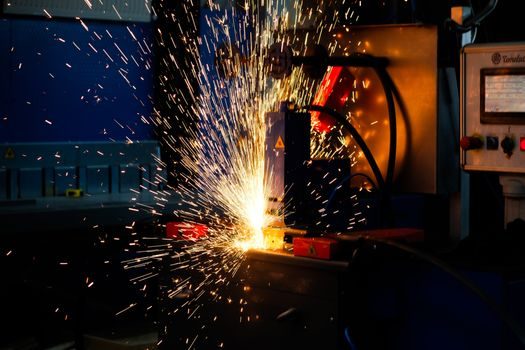
Match the cut-off class to the work, not the other way around: portable 355 mm / 2200 W abrasive for site rebar and light section, max 115 mm capacity, 3800–4000 r/min, 110/220 V [S7]; bench-top abrasive 75–150 mm round-stock capacity for lab and small-part work [S1]; stationary automatic TCT 350–400 mm blade, 30 mm bore, 1100 r/min on steel (2850 r/min on alu), 1.5 HP, 0–80° pivot, pneumatic vice, pneumatic mist, CE-marked, for fabrication-shop throughput on alloy steel and stainless steel sections [S2].
Use this decision rule on site: if the workpiece moves with the worker, specify portable 355 mm / 2200 W; if the workpiece sits on a bench and the cut repeats, specify a stationary TCT or dry-abrasive cut-off with a vice and a mist or downdraft extraction. Anything outside the 75–500 mm blade window is a specialist machine (metallographic, high-production billet, etc.) and belongs in its own selection workflow.
Standards, Markings and What to Verify on the Nameplate
The Caral-series automatic cut-off ships with CE conformity declared on the OEM product page, and the 230/400 V three-phase motor plus pivoting-head / pneumatic-vice / pneumatic-mist configuration is consistent with the safety expectations of EN ISO 12100 (machinery safety) and the European Machinery Directive — but verify the actual declaration of conformity and the harmonised standards cited on the nameplate, because "CE" on a listing is not the same as the DoC that ships in the crate [S2].
For portable machines, the key electrical ratings to check are input power (W), no-load speed (r/min), rated voltage (V) and rated frequency (Hz) — the four numbers the KD4355T datasheet prints on the first line, and the same four numbers a site electrician needs to confirm generator compatibility (a 2200 W cut-off on a 2 kVA genset will brown out the moment the blade bites) [S7]. Wheel diameter, max cutting capacity and rated speed are the three mechanical numbers; never up-speed an abrasive wheel above its printed maximum, even if the spindle can.
For cross-reference on adjacent cutting-tool selection, the Cut-Off Machine Selection for Concrete Work spec map lines up abrasive-wheel diameter and power against masonry duty cycles, and the Angle Grinder Selection Map for HVAC Sheet-Metal Installation covers the thin-gauge sheet end of the steel-construction cutting spectrum where a cut-off machine is over-spec.
Track two signals over the next procurement cycle: whether Chinese portable OEMs standardise on a published no-load speed (3800 vs 4000 r/min for the same 355 mm / 2200 W class), because the 200 r/min gap is a real blade-temperature difference on continuous work [S6][S7]; and whether TCT blade makers publish a minimum-quantity-order peripheral-speed window for 350–500 mm blades on alloy steel sections, since today's listings only give diameter and bore, not the speed-matching data a buyer actually needs [S2].