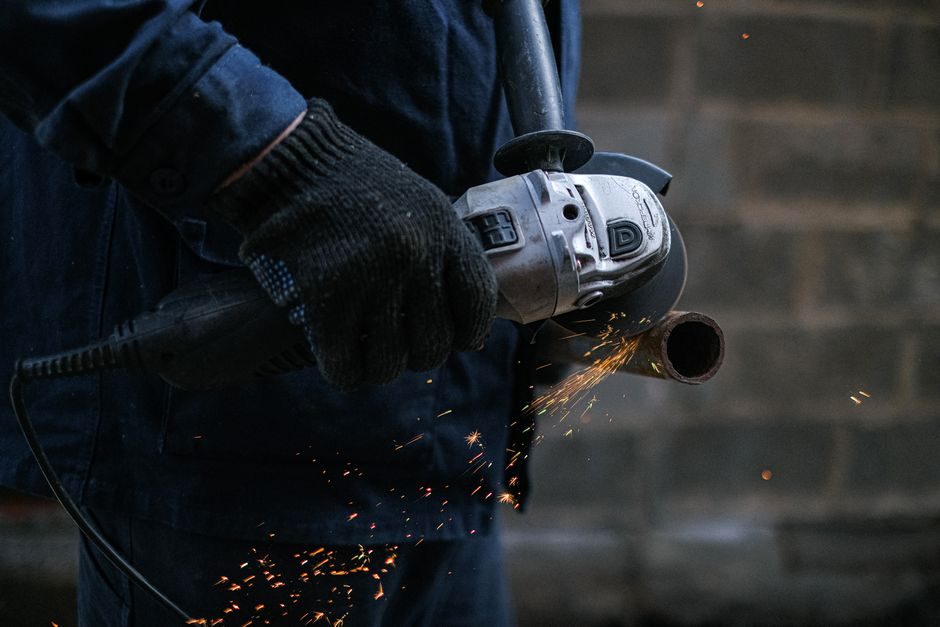
A 230 mm (9 in) electric high-performance angle grinder, as listed in current 9-inch category data, typically draws 2,000–2,600 W input and runs the wheel at ~6,500 RPM no-load, with an M14 spindle and a die-cast aluminium gear housing [S1]. That single line of catalog data encodes six selection decisions the buyer must lock in before purchase.
For metal fabrication, shipyard fettling, and concrete surface prep, the angle grinder is still the cheapest cut-and-grind tool per kilogram of metal removed — but only when the disc, guard, and duty class are matched to the workpiece. The most common 2026 buying mistake is over-sizing: putting a 230 mm unit on a fabrication bench that runs 10-minute shifts produces operator fatigue without a productivity gain, and forces the user to wrestle a 2.1 kg head [S1].
Duty Class vs Disc Diameter: Match the Workpiece First
The five disc diameters that dominate the 2026 industrial catalog are 100, 115, 125, 180, and 230 mm, with 115 and 125 mm covering roughly 70% of fabrication-shop volume [S1][S4]. A 115 mm unit typically delivers 600–900 W input and ~11,000 RPM, suits one-handed cut-off of rebar and thin-wall tube, and weighs 1.5–1.8 kg; a 125 mm unit adds 1–2 cm of cut depth and ~200 W for the same operator load [S4].
For 180–230 mm (7–9 in) heavy grinding, fettling of castings, and concrete scarifying, the fettling grinder class — often the same tool under a different guard — moves into 1,800–2,600 W input territory, runs the wheel at 6,000–8,500 RPM no-load, and tips the scale at 4–6 kg [S1]. A useful internal rule: rated input watts per kilogram of tool weight should sit between 350 and 500 W/kg for a balanced industrial grinder; below that, the unit is under-powered for its mass, above that, it is a hot-running two-handed specialty tool.
Spindle Thread, Guard Opening, and Disc Speed Match
Spindle thread is the single spec that blocks the most orders: 100/115/125 mm grinders use M10 × 1.5 in most regions, while 180/230 mm units use M14 × 2 — the diameters are not interchangeable and a wrong-arbor wheel will not seat [S4]. Wheel rated speed (max RPM printed on every disc) must exceed the tool no-load RPM by at least a 1.1× margin; a 6,500 RPM tool must therefore run a wheel rated 7,200 RPM or higher, otherwise a seized workpiece or kick-back event will shatter the wheel [S1].
Guard opening is the second most-skipped spec: a Type 1 (depressed-centre) cut-off wheel needs a closed guard with a narrow slot; a Type 27 (flat) grinding wheel needs a wider opening angled at the workpiece. EN 60745-2-3 / IEC 60745-2-3 governs hand-held grinder safety, including wheel-burst test and guard-strength requirements; OSHA 29 CFR 1910.215 covers abrasive-wheel machinery in the US. Both standards require the guard to cover at least 180° of the wheel, and a tool-length-adjustable guard to be locked before each shift [S1].
Switch, Brake, and Soft-Start: 2026 Safety Default
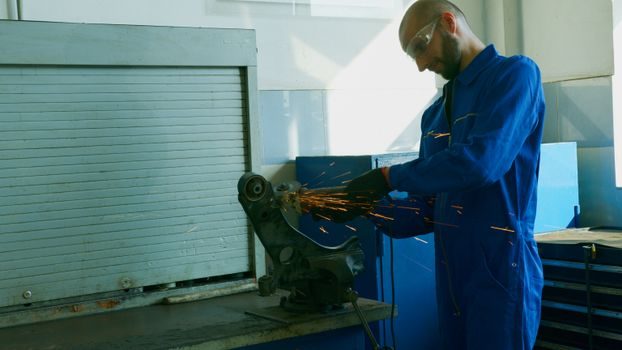
Three switch architectures coexist in the 2026 catalog: paddle (deadman) with lock-on, slide (toggle) with lock-on, and paddle without lock-on (momentary). For production-line fettling where the operator must release the tool instantly on a kick-back, specify the no-lock paddle — it is the only switch that meets the spirit of EN 60745-2-3 deadman handling [S1]. Slide switches persist on 115/125 mm DIY and trade units because they reduce hand fatigue, but they are not appropriate for vessel-entry or hot-work permits.
Electronic soft-start and current-limiting are now standard on 1,500 W+ units from major Chinese OEM lines: the inrush current is clamped to roughly 1.5× rated current over 0.5–1.0 s, which protects the armature windings and prevents the breaker tripping on a 16 A site supply [S4]. An electric brake that stops the wheel within 2.0 s after release is the single feature that justifies a price premium on a 230 mm unit; it is also a near-mandatory requirement on any grinder used for cut-off work above head height.
Power Supply, Cord, and Dust Extraction
Rated voltage drives the rest of the electrical spec: 220–240 V / 50 Hz is the dominant 2026 industrial supply in Europe, MENA, and most of Asia, while 110–120 V / 60 Hz covers North America and parts of Latin America; a 230 V tool plugged into a 110 V site supply will stall under load and overheat the armature within minutes [S1][S4]. For 110 V / 16 A site-distribution work in the UK and Middle-East shipyards, a centre-tap step-down transformer is the right solution — never rewire a 230 V tool to 110 V.
Dust extraction is no longer optional on a 2026 spec: any grinder used on concrete, masonry, or paint-coated steel must connect to a Class M dust extractor via a 35–50 mm hose adaptor, otherwise the operator's respirable crystalline-silica exposure breaches OSHA 1926.1153 action level. Cord length is the silent spec: a 2.5 m cord is acceptable for bench work, but a 4 m rubber-jacketed H07RN-F cord is the right call for site work; the cord cross-section must hold voltage drop under 4% at full load, which means 1.5 mm² copper minimum for 10 A draws at 25 m [S4].
Comparison: 115 mm vs 125 mm vs 230 mm Industrial Grinder
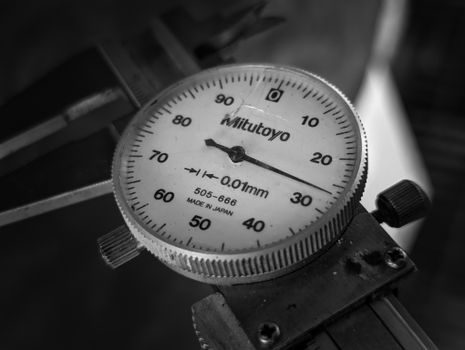
Lining the three dominant sizes against the same four buying criteria makes the choice mechanical. 115 mm: input 600–850 W, no-load ~11,000 RPM, weight 1.5–1.8 kg, M10 spindle — the right pick for one-handed rebar cut-off, plumbing, and HVAC trim, and the only size that fits a standard pipe-notcher. 125 mm: input 800–1,100 W, no-load ~10,000 RPM, weight 1.7–2.0 kg, M10 spindle — adds ~10 mm of cut depth, the same one-handed handling, and is the 2026 default for fabrication shops [S4]. 230 mm: input 2,000–2,600 W, no-load ~6,500 RPM, weight 4.2–5.0 kg, M14 spindle — two-handed fettling, floor grinder edge work, and concrete scarifying, but the operator needs 30+ minutes of training to control the kick-back moment [S1].
A short verbatim from the 2024 grinder-overview reference frames the spec density a buyer should expect: "电磨;电动砂轮机 electric grinder — 用砂轮或磨盘进行砂磨的电动工具. 可制成直向(straight)、角向(angle)及软轴传动的等" [S5]. The three architectures — straight, angle, and flexible-shaft — cover the duty spectrum from die-grinder precision to 230 mm heavy fettling, and a 2026 buyer should reject any catalog that does not separate them by type-code rather than by marketing name.
Brand, Spare Parts, and Total-Cost-of-Ownardership
OEM parts availability is a real spec gate in 2026. Hitachi (now HiKOKI in some markets) maintains a public parts diagram for every active angle-grinder model, with armature, stator, gear set, and switch group listed by figure number — this is the benchmark a buyer should expect from any vendor [S3]. Chinese OEM lines such as Yongkang-based Ji Chuang publish model codes like S1M-JC3-115/125 and S1M-JC4-180/230, where the segment after the dash is the disc diameter and the leading "S1M" tag is the IEC 60745 hand-held grinder safety class [S4].
Total cost of ownership on a 2026 industrial angle grinder is dominated by three line items: armature replacement (roughly 30–40% of new-tool cost), carbon-brush set replacement every 200–300 operating hours, and gear-set grease replenishment every 100 hours. A tool that ships without a published parts list is therefore a 12-month tool, not a 5-year tool — verify the parts diagram before signing the PO [S3][S4]. For buyers who also run metal-prep cells, the related spec cut on shot blasting vs sand blasting covers the next station downstream of cut and grind.
Limits, Failure Modes, and What an Angle Grinder Will Not Do
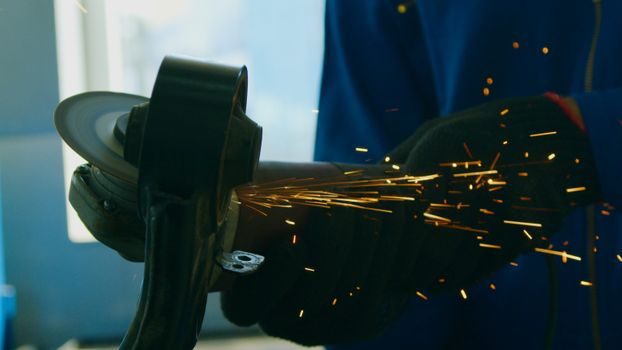
An angle grinder is a cut-and-grind tool, not a precision tool. Surface finish off a 36-grit fibre disc is typically Ra 3.2–6.3 µm — adequate for paint prep, never for bearing-seat finish. Wheel selection matters more than tool selection: a 1.0 mm Type 41 cut-off wheel on a 125 mm grinder gives a 12 mm cut depth and a 0.5 mm kerf, while a 6.0 mm Type 27 grinding wheel on the same tool gives a 4 mm cut depth and a 6 mm kerf — the same tool, very different jobs [S1].
Common failure modes to spec against: wheel burst from under-rated speed (always check the disc RPM), armature burn-out from stalled cut (specify soft-start on 1,800 W+ units), and gear-housing crack from side-load (specify a metal gearbox, not a polyamide one, on any 180 mm+ unit) [S1][S4]. For work that needs a cleaner cut, a plasma cutter vs oxy-fuel torch cell is the next spec to evaluate; for large-area surface prep, a sand blasting vs shot blasting cabinet beats hand grinding on cost per square metre above 20 m².
Trackable signals for the next buying window: 2026 Q3 will bring new IEC 60745-2-3-aligned dust-port adapters from major Chinese OEM lines (confirmed by the 35–50 mm adaptor standardization already on Ji Chuang's S1M-JC4-180/230 spec sheet) [S4]; 110 V brushless industrial units at 1,500 W+ remain limited in 2026 H1, with most 110 V sites still on brushed gear. The decision node for a 2026 buyer: lock the duty class and disc diameter first, then the spindle/spindle thread, then the switch architecture, and treat brand, soft-start, and brake as the second-tier gate — not the first.