
Cycloidal reducers land in pulp and paper applications because they tolerate shock loads that would score a helical gear set, and the cycloidal pinwheel arrangement shares load across roughly two-thirds of the reduction components at any instant [S2].
Efficiency for a cycloidal unit sits in the 85 to 95 percent band, behind helical gearing at 96 to 99 percent per stage but ahead of worm drives on most ratios [S1]. Pulp mills accept that trade because of the shock overload headroom on drives feeding refiners, chippers, and agitators.
Why Cycloidal Wins in Pulp Mill Drive Trains
Cycloidal reducers operate on an eccentric cam and pinwheel engagement, so the same input torque is distributed across a large percentage of teeth in simultaneous contact rather than concentrated on a single line of action [S1]. The Sumitomo Cyclo 6000 architecture shares load across 2/3 of the reduction components simultaneously, and the manufacturer rates the platform for up to 500% shock overload capacity without catastrophic failure [S2].
That tolerance is what makes a cycloidal reducer the default pick for refiner conveyors, pulp agitators, and bleach tower mixers where a log jam or stock surge multiplies instantaneous torque. Cycloidal units are also commonly applied in construction machinery and equipment where the same shock logic drives the selection.
Service Factor and Sizing Discipline for Mill Duty
Malloy Electric's selection guide is explicit: specify for the worst case the gearbox will actually see, not the nameplate horsepower of the upstream motor, and apply service factors that reflect the real loading profile including starts per hour, shock loading, and direction reversals [S1]. Pulp and paper refiner drives are a textbook case where this rule bends otherwise well-sized units.
For a typical 4-pole AC motor on a 50 Hz line, the maximum motor power rating against which a Sumitomo or Hansen gearbox is sized is strictly bounded by that electrical input; oversizing the motor without re-checking the gearbox mechanical rating is a common commissioning error [S2]. A spec basis document, recording service factor, ambient, mounting, and lubrication interval, is the cheapest insurance a mill can buy [S1].
Moisture, Steam, Washdown, and Lubrication

Pulp mill ambient conditions include steam venting from digesters, hot stock at 80 to 95 degrees Celsius in some process loops, and periodic washdown that pushes plain water and alkaline process liquor onto exposed hardware. Cycloidal units accept these conditions reasonably well because the housing is a sealed oil bath, but the seal program and breather location decide whether the unit survives ten years or three [S1].
For agitator and reaction tank service the vertical-mounted CYCLO drive is a standard offering from Sumitomo, sized for stirring, mixing, and reaction tanks in chemical and pulp duties [S2]. Plan maintenance access at the specification stage: gearboxes that cannot be inspected or oil-sampled do not get inspected or oil-sampled, and the failure shows up as bearing spall or housing crack at a mounting boss after resonance cycles accumulate [S1].
Mounting and Layout in a Paper Mill
Right-angle shaft gearmotors such as the Sumitomo HYPONIC and Hansen P4 series with hollow shaft and flange-mounting solid shaft options are routinely used where the motor and driven shaft sit on perpendicular axes, a layout that saves floor space in crowded machine rooms and basement pulper pits [S2]. Where vertical output is required, the Hansen P4 multistage-vertical configuration and single-stage P4 platform cover agitator and reactor mounting.
Bevel-helical buddybox gearmotors fit paper-machine calender and reel drum positions where right-angle drive plus compact envelope is the priority. Cycloidal pinwheel units cover refiner, chipper, and agitator positions where the shock load is the controlling parameter, not layout density.
Comparison: Cycloidal vs Helical vs Worm on Pulp Mill Criteria
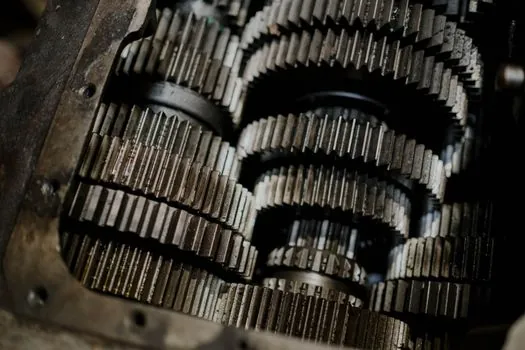
On four criteria that matter to a pulp mill project engineer, the comparison is direct. Efficiency per stage: helical 96 to 99 percent, worm 50 to 90 percent, cycloidal 85 to 95 percent [S1]. Shock overload tolerance: helical modest, worm poor, cycloidal up to 500 percent of rated for the Sumitomo Cyclo 6000 architecture [S2]. Right-angle mounting: helical via bevel stage, worm native, cycloidal native via pinwheel. Lubrication tolerance to wet/steam ambient: helical fair, worm fair, cycloidal good with sealed oil bath.
The trade is therefore clear: pay 4 to 14 percentage points of efficiency to gain the shock headroom and the inherent right-angle geometry. For refiner and chipper drives that run heavy cyclic loads, that is the correct trade. For calender reel and winder drives running near-constant torque, helical remains the efficiency-correct answer.
Limits and Failure Modes Specific to Cycloidal in Mill Service
Cycloidal units are not the right call everywhere. Where the duty is continuous, the ambient is clean, and the layout is straightforward, helical gearing wins on efficiency and on simpler bearing replacement. A cycloidal unit that has been undersized for the actual duty, or that has been started and reversed more times per hour than the service factor assumed, will still fail: bearing spall, housing crack at a mounting boss, or scored cam from inadequate lubrication [S1].
The selection rule that holds across every mill position is to document the service factor basis, the ambient, the mounting, and the lubrication interval, and to size to worst case rather than nameplate [S1]. A related application pattern for high-shock aggregate and cement duties is documented in cycloidal reducer selection rules for cement plants, where the same shock-overload logic applies, and in cycloidal reducer selection for steel mills for high-heat ambient duty.
For a pulp mill project, the trackable next node is a sealed mill-specific selection sheet capturing motor kW at 50 Hz, ratio, output rpm, service factor for the specific refiner or agitator duty, ambient temperature and steam exposure, and mounting orientation [S1][S2]. Watch the published Sumitomo Cyclo 6000 and Hansen P4 catalogs for updated torque ratings on vertical and right-angle configurations when sizing drives above 75 kW.
The underlying component specifications are covered under lamps and light fittings.