Cold plate liquid cooling holds more than 55% share of the data center liquid cooling segment in 2026, valued at over US$ 3.1 billion, making it the dominant topology by revenue for new build-outs and retrofits [S2].
Adoption on the ground, however, lags the type-share: a 2026 industry survey reports only 19% of respondents are running liquid cooling today, with most operators planning deployment within 12-24 months as rack densities above 30 kW become the new normal [S7].
2026 Market Size: Four Models, Four Numbers
The headline market figures diverge by methodology. Mordor Intelligence sizes the data center liquid cooling market at US$ 6.77 billion in 2026, rising to US$ 18.79 billion by 2031 at a 22.65% CAGR [S4]. Persistence Market Research sets 2026 revenue at US$ 5.7 billion, climbing to US$ 29.2 billion by 2033 at a 26.4% CAGR, with solutions commanding over 73% of 2026 spend at more than US$ 4.2 billion [S2]. Grand View Research anchors a 20.1% CAGR from 2026 to 2033 toward a US$ 29.5 billion terminal value [S1]. Stratview Research tracks a near-term demand step from US$ 1.3 billion in 2024 to US$ 2.2 billion in 2025, a 68.2% year-on-year jump driven by AI buildouts [S9]. The wider data center cooling market (air + liquid) is projected to grow from US$ 21.0 billion in 2026 to US$ 54.4 billion by 2034 per Fortune Business Insights, and from US$ 13.23 billion in 2026 to US$ 37.62 billion by 2033 at 16.1% CAGR per MarketsandMarkets [S6][S8].
Technology Mix: Direct-to-Chip Leads, Immersion Closes Fast
Direct-to-chip captured 42.85% of 2025 liquid cooling market share and remains the retrofit-friendly default because it slides into existing rack frames; two-phase immersion is projected to grow at 26.62% CAGR through 2031 as operators push past 30 kW per rack [S4]. By coolant, single-phase hydrocarbon fluids held 45.37% of 2025 spend while two-phase fluorocarbon fluids are set to expand at 25.64% CAGR, the efficiency ceiling where heat flux and dielectric safety both get priced in [S4]. On the broader cooling stack, PUE 1.02-1.2 is the new performance band for both cold plate and immersion, with single-phase immersion quoted at roughly 80% higher energy efficiency than air baselines and PUE 1.02-1.03 [S2]. For a spec-side view of how monitoring fits into high-density racks, see the flow meter page.
Who Is Buying: Hyperscale Leads, Edge Is the Fastest Curve
Hyperscale sites accounted for 38.92% of 2025 liquid cooling revenue; edge and micro data centers are set for the highest CAGR at 24.98% over 2026-2031 as latency-bound AI inference proliferates [S4]. AI and machine learning workloads represented 34.84% of 2025 spending and are projected to grow at 25.98% CAGR through 2031, which is the single largest demand pull on the segment [S4]. Large facilities above 10,000 square feet hold more than 64% of 2026 liquid cooling value at over US$ 3.6 billion, while small and medium sites grow at a 28% CAGR on edge computing demand [S2]. For a sense of how adjacent power-chain instrumentation is being specced alongside these builds, genset selection for AI data centers maps the parallel decision on backup power sizing.
Drivers, Quantified: Why Air Cannot Keep Up
Mordor Intelligence's driver-impact table assigns the largest single lift to surging rack densities above 30 kW at +6.20% on the CAGR forecast, followed by Nvidia and AMD liquid-ready reference designs at +5.40%, and hyperscale net-zero roadmaps at +4.80% [S4]. OEM warranty coverage of direct-to-chip loops adds +3.10%, and EU Taxonomy-aligned green DC incentives add +2.90% on the long-term horizon [S4]. The wider 2026 cooling market growth is anchored by the same AI buildout plus stricter energy regulation, with the air-plus-liquid market moving from US$ 19.5 billion in 2025 to US$ 22.81 billion in 2026 at a 17% CAGR per Rack Solutions' April 2026 summary [S3]. Operators running these sites lean heavily on pressure transmitters for coolant loop monitoring, and on data loggers for thermal drift trending across CDU skids.
Regional Map: North America First, APAC Fastest
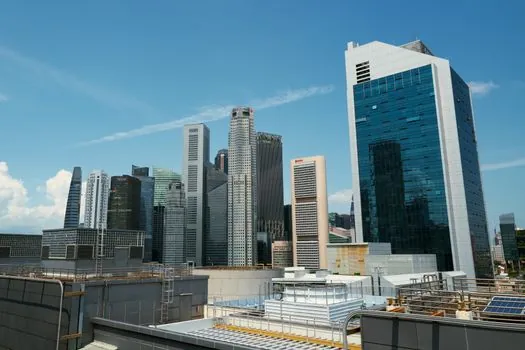
North America leads the 2026 liquid cooling market with more than 36% share, valued at over US$ 2.1 billion, and is projected to exceed US$ 8.7 billion by 2033 driven by AI/GPU workloads and defense modernization programs [S2][S4]. Asia-Pacific is the fastest growing regional market through 2031, pulling ahead of Europe on greenfield hyperscale capacity additions [S4]. Mordor flags medium market concentration in 2026, meaning no single vendor owns the architecture, and that fluid is intentional given the difference between direct-to-chip and immersion reference designs [S4]. For operators mapping plant-side instrumentation, the PLC architecture and the industrial valve selection on coolant manifolds tend to be the first things to lock once a topology is picked.
Limits and Failure Modes Spec Teams Should Plan For
Liquid cooling adoption is not a free swap: deployments typically require redesign of racks, piping, and safety mechanisms, and a single leak path can take a high-density rack offline in minutes if leak detection and dielectric coolant choice are not coordinated up front [S2]. The 19% installed-versus-55% type-share gap is largely a retrofit bottleneck rather than a buying-intent gap, with survey respondents citing existing air-cooled floor layouts and CDM commissioning as the principal drags [S7]. Warranty gating also matters: until OEM cover of direct-to-chip loops standardized in 2024-2025, retrofit risk sat with the operator, which is why Mordor's driver model adds a discrete +3.10% CAGR contribution for OEM warranty coverage now expanding from North America and Europe into APAC [S4]. Standardization work, including ASHRAE TC 9.9 thermal guidelines and OCP liquid cooling specifications, is the documentation layer most spec teams underweight.
Trackable signals into Q4 2026: the 2026-2031 CAGR band converging toward 22-27% across Mordor, Grand View, and Persistence; the installed-base share moving through 19% toward the 30%+ band as 12-24 month survey plans convert; and APAC's regional share rising as Singapore, India, and Japanese metro-edge builds lock in their coolant topology choices. Operators weighing full immersion versus cold plate should watch two-phase fluorocarbon coolant cost curves and direct-to-chip reference-design pricing from the major GPU vendors as the next gating inputs.