AI scale-out Ethernet revenue is forecast to pass $100B by 2030, up from a single-digit-billion base in 2024, as hyperscalers and neocloud operators rebuild fabrics around 800G and 1.6T switches rather than InfiniBand [S2].
The data center switch market, sized at $19.16B in 2025, is projected to reach $20.81B in 2026 and $43.72B by 2035 at an 8.6% CAGR, with the 800 GbE-and-beyond bandwidth class growing at roughly 10% CAGR through 2035 [S4]. North America holds around 42.7% of that spend, while Asia-Pacific is the fastest-growing region at a 10.3% projected CAGR on Chinese, Indian, and Japanese sovereign-cloud buildouts [S4].
Scale-Out Architecture: Ethernet vs InfiniBand vs UALink vs NVLink
Scale-out networks horizontally stitch racks of accelerators using low-latency east-west traffic, and Ethernet is taking the majority of that growth: the Ultra Ethernet Consortium roadmap, open platforms such as SONiC, and a mature optics supply chain all favour it over proprietary fabrics [S1][S2]. InfiniBand still ships into NVIDIA-heavy training clusters, but the incremental dollars are going to Ethernet, with pluggable 800G and 1.6T optics plus emerging co-packaged optics (CPO) expected to exceed 50% of annual switch revenue by 2030 [S2].
Scale-up, the tightly coupled GPU-to-GPU memory semantic fabric, is a different problem. NVLink currently serves almost the entire installed base, but UALink from the UALink Consortium (AMD, Intel, and others) and Broadcom's Scale-Up Ethernet (SUE) are the two credible open alternatives, with PCIe-like fixed-frame semantics and Ethernet transport respectively [S2]. For a more grounded comparison, the four options line up against decision criteria as follows. NVLink: highest bandwidth per GPU, NVIDIA-only, captive. UALink: open consortium, fixed-size frame semantics, multi-vendor GPU/XPU support, still pre-ramp. SUE: leverages Ethernet PHY and switch silicon, fits operators already running SONiC, lower peak per-link rate than NVLink today. InfiniBand: scale-out only, mature NDR/XDR, but no scale-up story. [S1][S2].
Speed Migration: 400G Today, 800G Floor by 2027, 1.6T in Volume
Dell'Oro's published 2025 forecast stated that by 2027 almost all ports shipped into AI back-end networks will run at a minimum of 800 Gbps, with 1.6T ramping through 2027–2028 and 3.2T as the next horizon [S10]. That speed curve is well ahead of front-end networks, where 100G and 400G still dominate, because AI training jobs keep larger gradient-sync payloads in flight for longer per iteration. Port-speed segmentation tracked by analysts now spans <100 / 200 / 400 / 800 Gbps / 1.6T / ≥3.2T buckets to model this split [S1].
At the ASIC level, switching silicon roadmaps are pushing 51.2 Tbps per chip to 102.4 Tbps, and SerDes roadmaps at 100G/112G per lane are the gating items, with co-packaged optics positioned to extend reach and cut power per bit once 1.6T optics volumes arrive [S1][S2]. Modern industrial switch designs in adjacent OT settings share the same SerDes constraints, though their port counts and environmental hardening (IEC 60079-class explosive atmospheres, extended temperature) are a different problem set.
Vendor Landscape: NVIDIA Takes the #1 Ethernet Slot
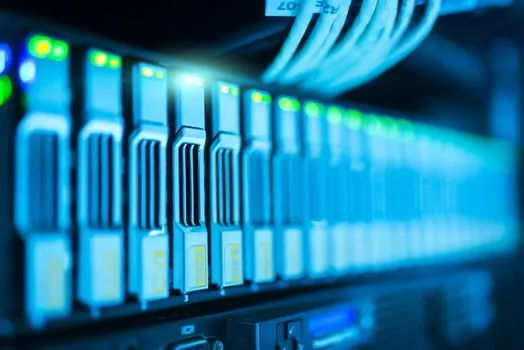
NVIDIA became the #1 vendor in datacenter Ethernet switching in 1Q26, pushing the broader Ethernet switch market to $15.4B that quarter, up 39.8% year over year, per IDC's 1Q26 tracker [S8]. That milestone is structural, not a one-quarter anomaly: the company is selling its Spectrum-X Ethernet platform directly into the same hyperscaler accounts that previously standardised on Arista or Cisco for AI pods.
The competitive set is now four-horse at the AI back-end tier: NVIDIA Spectrum-X, Arista 7800R/7700R, Cisco Silicon One on the N9000 series, and Broadcom Tomahawk-based ODM/white-box designs running SONiC [S1][S6]. Cisco's N9000 line integrates programmable Silicon One for AI workloads, and Broadcom's Tomahawk 5 and the in-development Tomahawk 6 are the merchant silicon behind much of the white-box and hyperscaler-internal designs. Huawei remains the dominant non-US supplier, particularly inside China, where the Top 3 China Cloud segment is tracked separately by Dell'Oro [S1].
Optical Layer: Pluggable First, Co-Packaged Optics by 2026
Pluggable optics at 800G (OSFP and QSFP-DD800) are in volume today, with 1.6T modules following on the same form factors through 2026 and 2027, and co-packaged optics expected to start shipping in scale-out in meaningful volume in 2026 per 650 Group [S2]. The drivers are per-bit power and signal-integrity loss in long-reach copper and pluggable links at 1.6T and above; integrating optical engines next to the switch ASIC drops power per bit and recovers reach lost to channel loss at 100G/112G SerDes [S2].
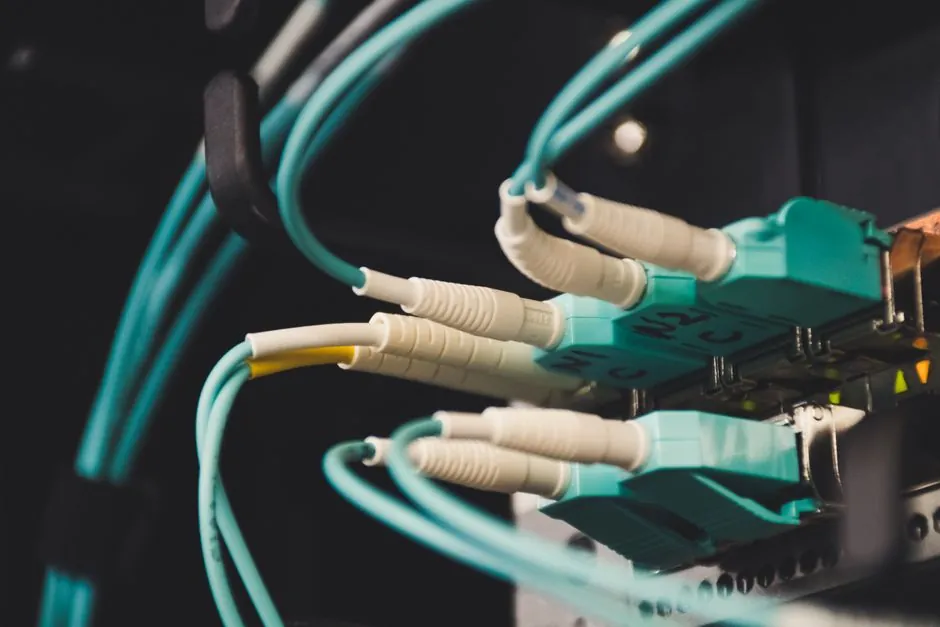
For a fibre plant reference, the practical difference between an LC patch cord and a shielded copper run is covered in LC fiber patch cable selection: at AI back-end speeds, the LC/MPO optical path is what actually carries the 800G and 1.6T, and copper disappears inside the rack. The supply side is also tight: 650 Group estimates optics could account for over half of annual switch revenue by 2030, which is why semiconductor buyers are pre-booking ASIC wafer capacity 18 months out [S2][S4].
Adjacent Switching Domains: Where OT and Front-End Differ
Front-end networks (north-south traffic, user-to-server, storage) are a different market with different speeds and buyers, tracked separately by Dell'Oro's Data Center Switch – Front-end Networks report at a lower per-port speed mix and a vendor list that does not yet include NVIDIA's Spectrum-X as a top-3 player [S7]. The Q3 2025 front-end data point, more than $8B in data center Ethernet switch sales, was already inflecting upward as AI back-end demand pulled overall switch revenue with it, and IDC's 1Q26 total of $15.4B for the entire Ethernet switch market is the higher number because it spans front-end, back-end, and spine tiers together [S3][S8].
Outside the hyperscale tier, OT-grade switching in plants and substations is a different spec class. An isolating switch in a 400 V motor centre is about visible-break load interruption under IEC 60947-3, not SerDes speed, but operators consolidating IT/OT often reuse the same vendor for both, which is why converged vendors like Cisco, HPE, and Huawei sell both data centre and industrial lines. At the rack level, a load switch governs PDU-side power rather than packets, but the procurement rhythm (long lead-time on 51.2 Tbps ASICs) is the same one squeezing mid-market enterprise buyers documented in the broader switch forecast [S4].
Forecast Caveats and Sourcing Standards
Forecasts diverge by source. 650 Group sees AI scale-out Ethernet alone above $100B by 2030 and total data center networking potentially above $200B a year by the end of the decade [S2]. GM Insights sizes the broader data center Ethernet market at $69.2B in 2025 growing at 13.8% CAGR through 2035, and The Business Research Company sizes the AI-specific networking segment at $12.80B in 2026, growing to $30.17B by 2030 at 23.9% [S5][S9]. The spread reflects scope (all Ethernet vs AI-only vs back-end-only) and methodology, not disagreement on the direction.
Trackable signals for the next quarter: Dell'Oro's Q3 2026 AI back-end tracker for Ethernet share movement against InfiniBand, UALink Consortium member announcements on first switch-ASIC tape-outs, and IDC's 2Q26 Ethernet switch market value (the 1Q26 print of $15.4B at +39.8% YoY is the current high-water mark) [S1][S8]. connector lead times into 1.6T OSFP and QSFP-DD1600 production are a leading indicator for whether the 2026 back-end spend prints match the 8.6% to 13.8% market CAGRs, or run hot, like IDC's 1Q26.