
US data center electrical equipment spend is on track to roughly triple, from about $20 billion in 2026 to $65 billion by 2030, as facility capacity rises from approximately 24 GW to 110 GW and accounts for 68% of total new US load growth [S1][S6]. The growth is not uniform: it is concentrated in three equipment categories that share the same factory queues, namely medium-voltage switchgear, large power transformers, and prefabricated busway assemblies.
The new load profile is the variable that broke the old supply model. Average new data center capacity moved from about 25 MW per site in 2020 to nearly 80 MW in 2025, a 3.2x jump in a single five-year window, and AI training racks now pull 40 to 100+ kW each versus 5 to 8 kW for traditional enterprise loads [S2][S5]. That step-change in per-site and per-rack power density is what is pulling switchgear, industrial UPS modules, and busway into the same constrained manufacturing capacity that already serves utility transmission upgrades.
Switchgear: AI-spec subsegment outgrows the parent market fourfold
The AI data center switchgear subsegment is sized at USD 2.26 billion in 2026 and is forecast to reach USD 9.02 billion by 2034, an 11.8% CAGR, versus a 7.9% CAGR for the broader data center power market that is projected to climb from USD 13.4 billion in 2025 to USD 28.6 billion by 2035 [S2][S3]. The AI subsegment is therefore growing roughly 1.5x faster than the parent market, a gap that reflects the premium content inside AI halls: medium-voltage switchgear, arc-resistant breaker lineups, busway-integrated intelligence, and digital relays with power-quality analytics.
Scope of the AI switchgear category covers medium and low-voltage switchgear, circuit breakers, protective relays, transfer switches, busway-integrated systems, and intelligent power monitoring, applied across utility connections, electrical rooms, distribution networks, and backup power interfaces [S3]. Transfer switches and switchgear as a combined category are tracked separately at a 9.50% CAGR through 2035, an indicator that the ATS and STS layers are scaling in lockstep with main switchgear rather than being absorbed into it [S8]. Digital features are no longer optional: vendors are adding sensors, remote monitoring, predictive maintenance, and power-quality analysis as baseline rather than optional extras, which is forcing new specifications to write monitoring and analytics into the bill of materials rather than treating them as a separate SCADA package [S3].
UPS, transformers, and the shared factory queue
UPS modules, large power transformers, and medium-voltage switchgear are now competing for the same factory slots, copper, and engineering capacity, with US power transformer lead times extending to roughly four years in constrained regional markets and switchgear lead times acting as the binding delivery constraint for 2026 builds [S4][S6]. The typical equipment package for a hyperscale campus now bundles utility transformers, medium-voltage switchgear, pad-mounted transformers, UPS systems, breakers, protective relays, busway, and backup generation interfaces, all of which must be ordered as a coordinated set rather than as independent line items [S4].
The supply squeeze has a specific cause: large power transformers need specialized electrical steel, copper winding capacity, engineered insulation systems, and factory acceptance testing, and adding new capacity takes years rather than quarters [S4]. Three demand forces are landing in the same window, namely AI campus buildouts, utility transmission and distribution upgrade cycles, and industrial electrification, and there is no quick manufacturing flex point between them. For developers, the practical result is that transformer and switchgear procurement has moved from a post-design purchasing detail to a front-end feasibility input, with order deposits often committed before zoning, lease, or entitlement certainty is complete.
Prefabrication and modular e-houses as the speed-to-power answer
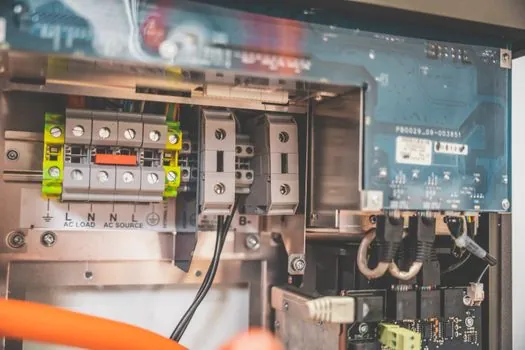
Prefabricated switchgear, e-houses, and factory-assembled power modules are emerging as the main countermeasure to long lead times, with the UK government announcing plans in 2026 for four 41,000 m² data center buildings, each with prefabricated electrical buildings housing switchgear and transformers [S3]. Standardizing the platform and digitally validating the power system reduces engineering complexity, commissioning risk, and the on-site labor footprint, which is the practical answer when a transformer slot is 24 to 48 months out and the developer still needs to energize inside a tenant delivery window [S3][S4].
The procurement shift is visible in the equipment list itself. A 2026 spec package is more likely to include factory-built e-houses with pre-installed switchgear and busway, skid-mounted UPS modules, and pre-engineered medium-voltage feeder assemblies than the traditional stick-built electrical room [S4]. This is also driving a parallel shift in the construction machinery and equipment supply chain, since prefabricated modules require heavier lift capacity, oversized transport corridors, and staged site assembly, which is a separate constraint layer on top of the electrical queue.
Hyperscale buildout: 80 MW sites and 100+ kW racks
Hyperscale data centers now number about 900 sites globally, representing 37% of total installed capacity in 2023, and a single hyperscale campus commonly draws 30 to 150 MW, comparable to a small city load [S2][S5]. The site-size and rack-density step-change directly sets the equipment specification: medium-voltage service at 13.8 kV to 138 kV depending on utility interface, main switchgear with arc-resistant breaker lineups, and busway runs rated for thousands of amps feeding AI halls where each rack can pull more than 100 kW.
The reliability driver has not changed, but the bar has. The Uptime Institute's 2024 Global Data Center Survey reported that 55% of operators experienced at least one significant outage in the prior three years, with power failures as the leading cause, which is why a Tier III site still mandates at least two independent power paths and why AI campuses layer UPS, transfer switches, and busway redundancy on top of utility A+B feeds [S5]. Higher rack density also raises the cost of any single failure, since a 100 kW rack trip takes more compute offline than an entire row of legacy 5 kW cabinets.
Selection criteria: which equipment class belongs in the 2026 spec
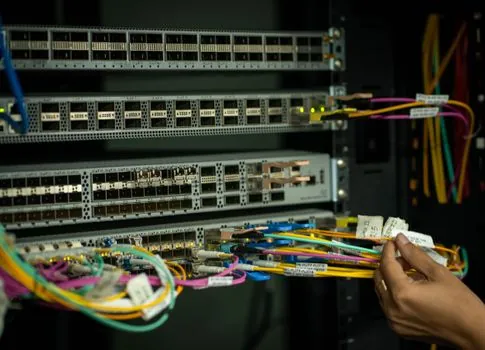
Across switchgear, UPS, and busway, the 2026 decision criteria have converged on four variables: lead time, monitoring depth, modularity, and compliance with AI-grade fault clearing. AI data center switchgear must deliver medium-voltage protection, arc-resistant or arc-flash-mitigated breaker lineups, integrated digital relays with power-quality analytics, and busway-integrated intelligence as a single coordinated package, which is the configuration forecast to grow at 11.8% CAGR [S3].
UPS modules for AI campuses are selected on double-conversion efficiency, battery technology (lithium-ion versus VRLA), modular scalability in 100 kW to 1 MW increments, and dynamic grid-support functions, while busway selection is driven by ampere rating (typically 800 A to 6,000 A for hyperscale halls), tap-off density for high-rack-count rows, and integrated metering at every plug-in position [S5]. For developers, the binding constraint is no longer which product is best on paper; it is which product can be ordered, factory-accepted, delivered, and energized inside the tenant window, which is why lead time and modularity now sit above pure efficiency in the spec hierarchy.
Limitations, failure modes, and where the data thins
The data center electrical equipment market has clear demand-side visibility but weaker supply-side granularity. Market sizing for AI switchgear at USD 2.26 billion in 2026 and USD 9.02 billion by 2034 is well documented, but specific factory throughput, nameplate capacity, and regional slot allocation for medium-voltage switchgear and large power transformers are not consistently disclosed, and reported lead times of 24 to 48 months vary widely by manufacturer and region [S3][S4].
The two structural failure modes to watch are transformer-and-switchgear grid bottlenecks, where utility-side equipment queues delay site energization even after developer procurement is secured, and capital-at-risk exposure from early equipment deposits committed before full entitlement certainty [S3][S4]. For projects targeting energization before mid-2028, the practical decision is whether to commit deposits on 24 to 48 month lead-time equipment now, or accept later delivery slots in exchange for lower capital-at-risk; there is no scenario in which both short lead time and deferred commitment are achievable in the 2026 to 2028 window.
Trackable signals for the next 90 to 180 days: the next FERC quarterly data center capacity update, the next CBRE North America Data Center Trends vacancy and absorption print, and any disclosed expansions of domestic large-power-transformer and medium-voltage-switchgear manufacturing capacity, since these are the variables that will move lead times off the current 24 to 48 month ceiling. For a deeper look at the genset, battery, and gas-turbine side of the same supply squeeze, see the 2026 backup power comparison; for the construction-spend context behind the equipment wave, see Data Center Construction Overtakes Office and Retail Spend in 2026; and for the parallel connector and cable supply tightness, see Connector Lead Times 2026.