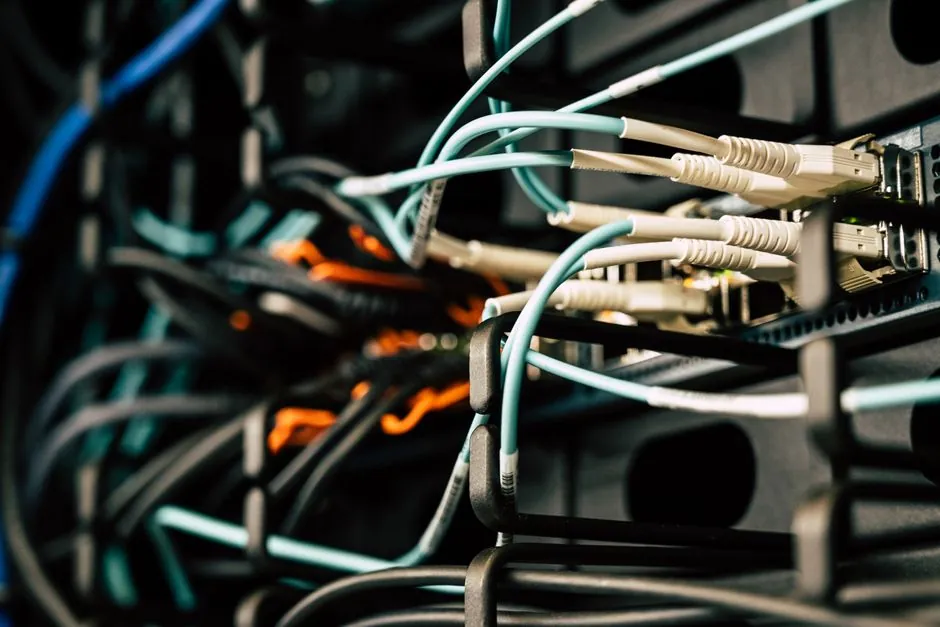
Double-conversion on-line UPS systems held 41.06% of the data center UPS type segment in 2026, while large data centers accounted for 44.10% of total 2026 revenue [S2].
The data center UPS market is one of the most watched slices of the broader industrial UPS category, with 2026 size estimates spanning USD 4.48B (Mordor Intelligence) to USD 8.2B (Grand View Research) depending on whether adjacent battery and service revenue is included [S1][S3]. Hyperscale build-outs, AI-driven rack density, and lithium-ion battery adoption are the three forces pushing that share higher through 2031.
2026 Market Sizing: Six Estimates, One Direction
2026 data center UPS market estimates range from USD 4.48B (Mordor) to USD 8.2B (Grand View), with Precedence Research at USD 4.79B, Fortune Business Insights tracking the segment inside a broader UPS market, Straits Research at USD 6.62B, and Market.us at USD 6.8B starting from a 2025 base [S1][S2][S3][S4][S6][S7]. The dispersion reflects different inclusion rules for service contracts, batteries, and modular parallel systems rather than disagreement on direction.
Grand View Research projects the segment grows from USD 8.2B in 2026 to USD 15.5B by 2033, a 9.4% CAGR [S1]. Market.us models a 7.9% CAGR through 2035 to roughly USD 14.4B [S4], while Mordor Intelligence tracks a 7.59% CAGR to USD 6.46B by 2031 [S3]. The CAGR cluster between 7.5% and 9.5% is a more reliable planning input than any single point estimate.
Double-Conversion Dominance and Capacity-Class Shift
The technology isolates the load from input anomalies through continuous rectifier-inverter operation, which is the reference architecture inside any industrial UPS specification tied to concurrent maintainability.
Systems above 200 kVA captured 52.23% of 2025 data center UPS market size, growing at 8.56% CAGR to 2031 [S3]. Modular scalable configurations are advancing faster than centralized platforms at 8.72% CAGR versus 46.21% centralized share in 2025 [S3]. The 50-250 kW modular segment is the clearest product-design response to AI rack densities above 20 kW per rack, a driver Mordor pegs at +1.8% on the CAGR forecast [S3].
Data Center Size, Tier, and Customer-Type Breakdown
Large data centers led 2026 share at 44.10% (Fortune Business Insights) and 38.88% in the Mordor 2025 base, while hyperscale campuses are the fastest-growing size band at 9.11% CAGR [S2][S3]. Colocation providers held 45.86% of 2025 demand, with hyperscalers and cloud service providers accelerating at 9.21% CAGR, the highest growth rate in the customer-type cut [S3].
Tier 3 facilities accounted for 54.45% of 2025 demand, and Tier 4 is the fastest-growing tier at 9.06% CAGR, reflecting Uptime Institute outage-cost data where 57% of 2025 respondents reported their most recent major outage exceeded USD 100,000 [S3][S4]. Tier IV concurrent maintainability, with concurrently active distribution paths, is the engineering specification that drives the double-conversion topology preference described above.
Battery Chemistry: VRLA Still Leads, Lithium-Ion Closing In
Valve-regulated lead-acid (VRLA) batteries commanded 61.76% of 2025 data center UPS battery share, yet lithium-ion solutions are growing at 8.29% CAGR through 2031 [S3]. Mordor attributes +1.2% of CAGR impact to the lithium-ion total-cost-of-ownership advantage in UPS systems above 500 kVA, where cycle life and weight savings offset higher upfront cost [S3].
A 25% U.S. Section 301 tariff on Chinese lithium-ion batteries not used in electric vehicles took effect in 2026, adding measurable cost and sourcing pressure for U.S.-based UPS deployments [S4]. The IEA projects data centers could install 20-25 GW of battery storage globally by 2030, expanding the UPS supplier role beyond short-duration backup into grid-interactive services [S4].
Product Architecture Signals: 1.5 MW, 97.5%, 32% Smaller
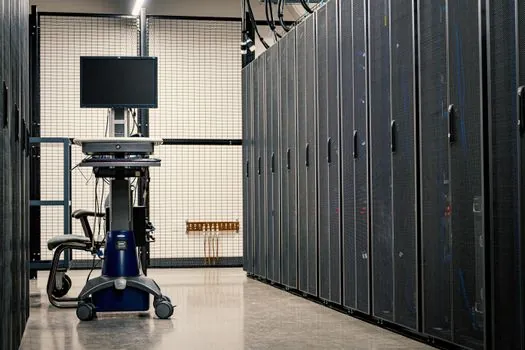
Eaton's 9395XR delivers up to 1,500 kW of UPS capacity with up to 99% efficiency in Energy Saver System mode, a megawatt-scale modular platform positioned for AI, hyperscale, and high-density sites [S4]. Vertiv's PowerUPS 9000 ships in 250-1,250 kVA/kW ratings built from 125 kVA modules, occupies 32% less floor space than the prior generation, and reaches 97.5% double-conversion efficiency with up to 99% in dynamic online mode [S4].
Schneider Electric's Galaxy V-series demonstrated operation from 1% to 100% load during 40°C testing, with 125% overload for 10 minutes and 150% overload for 1 minute based on hyperscale customer load profiles [S4]. The same vendor's Easy UPS 3-Phase Modular targets 50-250 kW applications using 50 kW power modules, configurable as 4+0 for capacity or 3+1 for redundancy [S4]. These three reference platforms bracket the 2026 capacity, efficiency, and modularity envelope that data center UPS buyers are now benchmarking against.
Geography and AI Load Drivers
North America led the data center UPS market with 39.43% share in 2025, while Asia-Pacific is the fastest-growing region at 9.02% CAGR [S3]. U.S. data centers consumed 176 TWh of electricity in 2023, up from 58 TWh in 2014, and Berkeley Lab projects 325-580 TWh by 2028, a load curve that requires continuous UPS-protected backup rather than legacy generator-dominated schemes [S4].
Global data center electricity consumption increased 17% in 2025, and AI-focused data center electricity use jumped 50% over the same window, with capital expenditure from five major technology companies exceeding USD 400 billion in 2025 [S4]. Roughly 1 in 3 data center owners and operators were already performing some AI training or inference as of the Uptime Institute 2025 AI Infrastructure Survey of 1,062 respondents [S4]. These AI workload metrics are the upstream signal driving UPS vendors toward silicon-carbide inverter stages and wider operating temperature ranges.
What to Track Next: 2Q 2026 Carrier Revenue and Hyperscale Capex

UPS Inc. (the carrier, NYSE:UPS) reported 1Q 2026 consolidated revenue of USD 21.2B and operating profit of USD 1.27B, then raised full-year 2026 consolidated revenue guidance to approximately USD 91.2B in the 2Q 2026 release on July 28, 2026 [S5][S9]. While UPS Inc. is not a UPS equipment vendor, its parcel and supply-chain volume is a leading indicator for distributed IT and edge data center UPS demand.
The next data points to watch are 3Q 2026 hyperscale capital expenditure guidance from the five technology companies whose 2025 capex exceeded USD 400B [S4], and any published shipment numbers for above-500 kVA lithium-ion-equipped industrial UPS systems, which would confirm or rebut Mordor's +1.2% CAGR impact attribution from lithium-ion TCO parity [S3].
Component reference pages worth checking: data logger, and pressure transmitter.
Related analysis: Split Taper Bush vs Taper-Lock Bushing: Removal Method Compared.