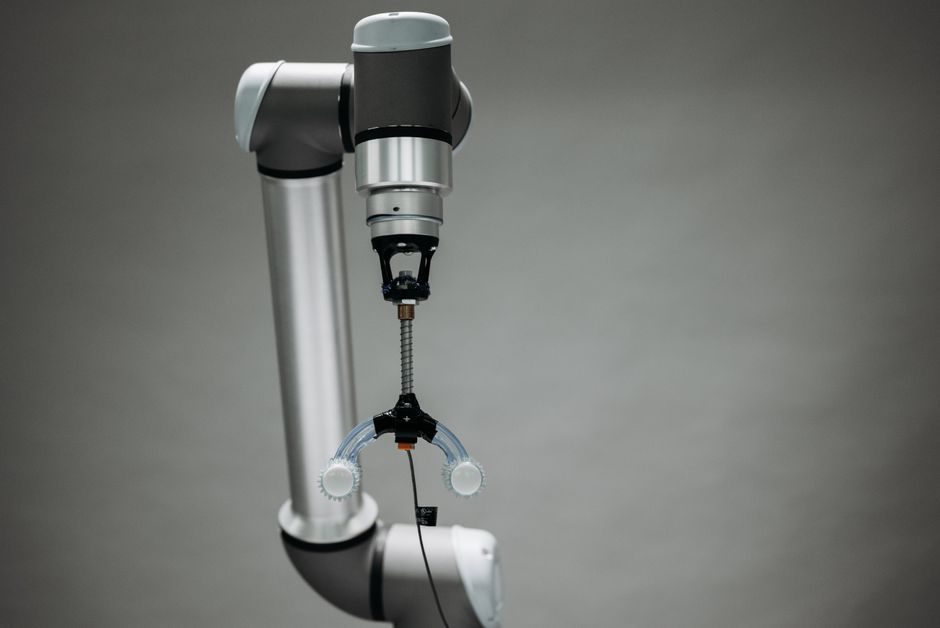
Delta robots are parallel-kinematic pick-and-place machines whose three or four arms drive a single end-effector through translations at high acceleration, typically rated between 0.5 and 12 kg payload with 0.05-0.1 mm repeatability across a 500-1300 mm cylindrical workspace [S2][S3].
Selection in 2026 turns on four pass/fail checks: payload after gripper mass, required pick rate in cycles per minute, working envelope diameter and height, and the environmental rating (IP65 / IP67 or stainless for food/pharma). Direct-drive variants are entering the catalog and remove the gearbox from the kinematic chain [S3].
When a Delta Robot Is the Right Pick — and When It Is Not
A delta is the right pick when the duty cycle is dominated by short, repeated translations between two or more fixed points: conveyor-to-tray sorting, top-load carton packing, blister loading, or high-speed 2D/3D pick from a moving belt. Standard units quote 60-120 cycles/min for 1-2 kg parts, and 150-300 cycles/min for sub-500 g pick-and-place with optimised motion profiles [S2].
A delta is the wrong pick when (a) the part exceeds roughly 10-12 kg, (b) the trajectory is long and serial rather than short and cyclic, (c) the work cell needs a large vertical reach above 500-700 mm, or (d) the cycle includes heavy insertion force. For those duties, a SCARA robot selection guide or a six-axis articulated arm is the better fit. Within the parallel family itself, the structural fork between three-arm delta, four-arm delta, and linear-drive delta is the first decision to make, and the comparison below lines them up.
Three-Arm vs Four-Arm vs Linear-Drive Delta: Criteria Comparison
The mainstream parallel options compared on four selection criteria: typical payload, peak cycle rate, working envelope diameter, and structural cost. The three-arm delta dominates food/pharma and standard pick-and-place; the four-arm variant adds a fourth actuator for higher tilting moment and palletising-style loads; the linear-drive (sometimes called "linear delta" or "XDirect" type) replaces rotary servos with linear motors to raise efficiency and reduce backlash [S3].
Three-arm delta: payload 0.5-6 kg, peak 200-300 cycles/min for light pick, 800-1300 mm workspace, lowest unit cost. Four-arm delta: payload 3-12 kg, peak 80-150 cycles/min, 1000-1600 mm workspace, mid cost. Linear-drive delta: payload 1-8 kg, peak 200-300 cycles/min, 600-1100 mm workspace, premium cost and tighter control tuning. Outside the parallel family entirely, articulated robot arms cover >12 kg and long-reach duties, while AGV/AMR mobile platforms handle the transport leg between cells, not the pick itself.
Kinematics, Repeatability, and Why Open-Source Simulators Matter in Sizing
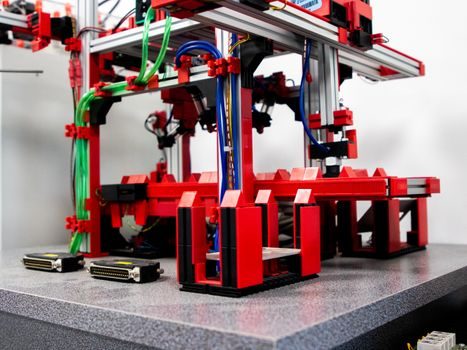
Delta kinematics are inverse-kinematic-closed-form: given a target XYZ for the end-effector, the three arm angles solve algebraically without iteration, which is why controllers can run at 1-4 kHz servo loops. Forward kinematics (arm angles to XYZ) is iterative, typically converging in 5-20 Newton-Raphson steps at sub-100 µs per step on a modern industrial controller [S2].
Open-source trajectory-planning repositories released in 2026, such as the x-itg/Delta-Robot-Trajectory-Planning project (269 commits, Python simulation plus C# demo) [S2] and the khKhKhEtelKhKhkh/rostock 3D-printer fork on a delta frame [S1], let buyers validate motion profiles, jerk limits, and pick-rate claims before commissioning. Practical implication: if a vendor quotes 200 cycles/min at 25/305/25 mm (accel/decel/cycle) stroke, ask for the matched trapezoidal or S-curve profile and the payload mass used in the test.
Workspace, Mounting, and the Real-World Envelope Penalty
Manufacturers state a cylindrical workspace, typically 1100 mm diameter × 250-400 mm height for a 1-3 kg class delta, but the usable envelope shrinks once the gripper mass, vacuum line drag, and vision-cable bend radius are subtracted. A common rule applied during cell layout is to keep the part-pick point at roughly 60-70% of the rated diameter and below 50% of the rated height to stay inside the high-acceleration zone where cycle rates hold.
Overhead mounting (gantry-style ceiling fix) is the default for food-grade and tray-loading cells because it keeps the floor clear for conveyors. For a related conveyor-side decision, see the roller conveyor selection map — conveyor width and indexing time set the delta's real cycle budget.
End-Effector, Vision, and Food-Grade / Cleanroom Variants
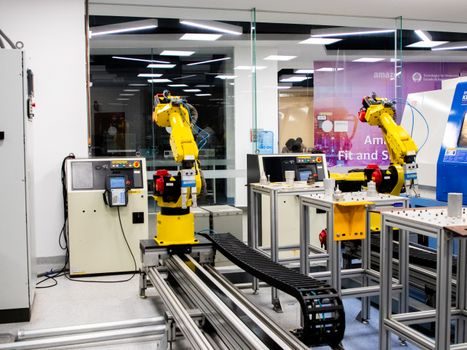
The end-effector is not part of the robot spec but dominates the cycle. Vacuum grippers (single or multi-cup) cover 50-80% of packaging and sorting work; soft-finger grippers handle irregular shapes; magnetic grippers suit ferrous parts in press-shop tending. Adding a vision-guided top camera with a 2-5 ms trigger-to-strobe latency can hold rated cycle rate; a 20-50 ms vision system will cap a 200 cycles/min robot at 80-100 cycles/min in practice.
Food-grade and pharma deltas add stainless-steel covers, IP67 ratings, NSF H1 food-grade lubricants, and crevice-free surfaces that survive daily wash-down. Cleanroom variants specify ISO Class 5 (Class 100) or better with low-outgassing cables and vacuum paths. For a parallel-format cousin that targets longer-reach SCARA duties, the SCARA robot selection guide covers those envelope and reach trade-offs.
Total-Cost Drivers and a 2026 Sourcing Shortlist Logic
The four cost drivers that move a delta quote by 20-60% are: payload class (1-3 kg vs 6-12 kg), reach band (under 800 mm vs over 1100 mm), environmental rating (IP54 vs IP67/cleanroom), and controller choice (vendor-native vs open PC-based). The robot arm itself is typically 30-50% of the cell cost; the rest sits in the gripper, vision, conveyor, guarding, and integration hours. [S1]
Shortlist logic for 2026: (1) confirm payload after gripper mass with a 20% safety margin; (2) set the required pick rate and reject any vendor whose datasheet cycle rate is not measured at your payload; (3) lock the IP/cleanroom rating against the wash-down or room spec; (4) verify the controller protocol (EtherCAT, PROFINET, or Ethernet/IP) against the existing PLC; (5) request the trapezoidal/S-curve motion profile and a measured repeatability number under load, not just the static spec. Vendors active in 2026 include the bekannter (勃肯特) product line in China, which lists both conventional servo-driven and XDirect linear-drive parallel robots [S3]. Buyer-side, for a parallel-arm pick cell tied to upstream conveyors, the roller conveyor selection spec map is the right companion reference.
Spec-level background on the components involved: linear guide, and crossed roller guide.