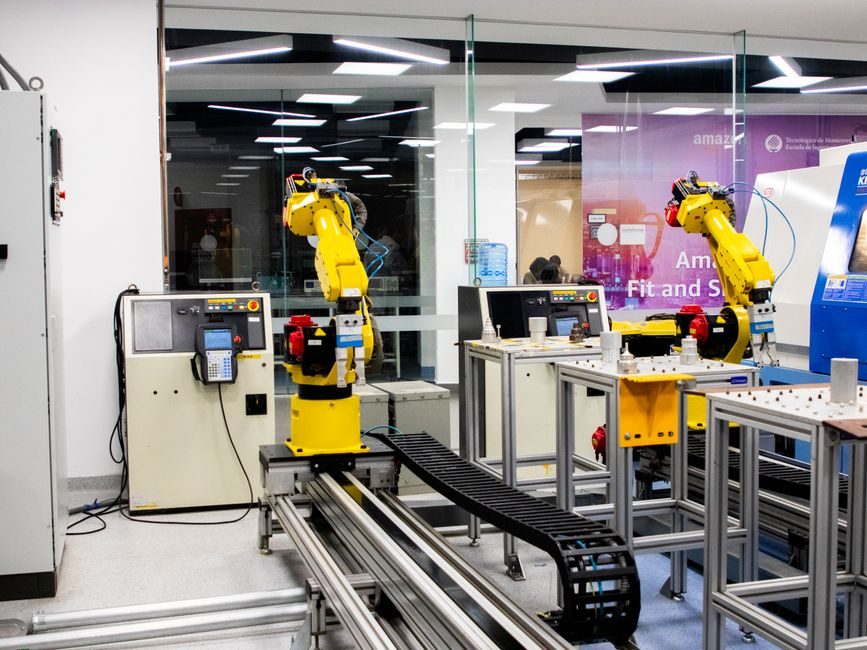
Articulated robot arm pricing in 2026 is dominated by four spec levers — payload, reach, axis count (4-axis vs 6-axis), and ingress-protection rating — with the dominant price jump occurring between 6-axis collaborative units (USD 15k–35k) and 6-axis heavy-payload industrial arms above 100 kg (USD 80k–250k+).
An articulated robot is a serial-link manipulator with at least three rotary joints arranged like a human shoulder–elbow–wrist chain; 6-axis variants are the most specified for arc welding, machine tending, and material handling, while 4-axis units compete with SCARA designs for pick-and-place. The underlying wrist architecture — outer, intermediate, and inner coaxially arranged shafts with a bevel-gear reduction — has been the canonical articulated-arm design since the 1980s [S1].
Price Bands by Payload and Reach Tier
Spec sheets for 2026 OEM lines segment articulated arms into four commercial bands. Entry-level 6-axis units with 3–7 kg payload and 500–800 mm reach list between USD 15,000 and USD 35,000 (collaborative variants) and USD 25,000–USD 45,000 (industrial). Mid-range 10–20 kg payload / 1,000–1,400 mm reach arms sit in the USD 45,000–USD 80,000 window. High-payload 50–100 kg units with extended reach climb to USD 80,000–USD 150,000. Heavy-payload 100–800 kg arms for automotive body shop and palletizing exceed USD 150,000, and integrated welding cells based on those arms can pass USD 250,000 before fixtures. [S9]
The same enclosure, controller, and teach pendant cover the band — the cost is in the mechanical structure and the second-stage harmonic-drive or RV reducer stack.
Cost Driver Map: Mechanical vs Control vs Integration
The base arm is roughly 55–60% of the system price; the controller + teach pendant + servo drives add another 15–20%; end-effector tooling, harnesses, and dress packs 10–15%; and system integration, safety scanners, and engineering 10–20%. The dominant mechanical cost on a 6-axis arm is the harmonic-drive (Harmonic Drive / Nabtesco pattern) or RV reducer at J2 and J3, which alone can run USD 1,200–USD 4,500 each at OEM cost; servo motors with absolute encoders add USD 400–USD 1,800 per axis [S10].
The cobot trade-off is slower cycle time (typically 250–1,000 mm/s TCP) in exchange for fence-free deployment and lower integration cost.
6-Axis vs 4-Axis vs SCARA — Decision Criteria

Choose 6-axis articulated when the application needs roll/pitch/yaw orientation of the tool (arc welding, deburring, polishing, complex machine tending) or 3D path following; choose 4-axis palletizing arms when the payload is high (50–800 kg) and the motion is vertical-column + horizontal-sweep + wrist rotation. SCARA arms remain the lowest-cost option for top-down pick-and-place: SCARA working radii span 100–1,000 mm and payloads 1–200 kg, with the SCARA topology providing planar compliance in X/Y and stiffness in Z — a profile well suited to PCB and electronics assembly, and whose cycle speeds have historically outpaced articulated arms at planar tasks [S2].
When comparing the three architectures on the same picking task, an articulated robot typically loses on cost and cycle time but wins on workspace reach and orientation flexibility. For long-reach material handling above 1.5 m, a 6-axis arm often replaces two SCARAs at lower total installed cost.
Configuration Variables That Move the Quotation
Five line items swing the most when negotiating an articulated-arm quote in 2026: (1) cleanroom or IP67/IP69K sealing — +8% to +18%; (2) foundry or high-temperature cable dress — +5% to +10%; (3) vision-integrated controller vs external PLC — +USD 3,000 to +USD 12,000; (4) extended warranty 36 vs 12 months — typically +6% to +10% of base list; (5) redundant encoder / SIL-2 / SIL-3 safety rated servo chain — +12% to +25%, and is the single largest adder for press-tending applications.
Lead time in mid-2026 is a real cost driver: standard 6-axis arms from major OEMs ship in 8–14 weeks, while custom-reach or heavy-payload builds run 18–30 weeks. Expediting a heavy-payload build to under 12 weeks has been quoted at 10–15% of the unit price on recent RFQs.
Total Cost of Ownership Beyond the Sticker Price

Energy draw for a 10 kg articulated arm sits in the 1.5–3.0 kW range under typical duty cycle, with collaborative arms drawing closer to 0.5–1.0 kW because of capped TCP speed. [S1]
Where the Articulated Arm Loses to Alternatives
For pure top-down pick-and-place under 1 m reach, SCARA and collaborative robot arms beat articulated arms on cost-per-cycle; for ground-level AGV-fed bin picking, an AGV robot topper with a vision-guided articulated arm is the more cost-effective architecture, since mobile handling replaces the fixed safety envelope. Heavy-payload palletizing above 800 kg crosses into gantry-robot territory, where portal-style Cartesian frames win on price-per-kilogram handled. [S9]
For high-precision linear motion inside the cell, an linear guide rail-extended 6-axis mount (7th-axis slide) is the standard add-on and adds USD 12,000–USD 25,000 to the cell; for compact work envelopes requiring rotary indexing, a crossed-roller guide bearing table is the typical pairing for the workpiece positioner.
Standards, Sourcing Notes, and 2026 Sourcing Signals

Specifying engineers should anchor the safety chain to ISO 10218-1 (industrial robot safety requirements) and ISO/TS 15066 (collaborative robot power-and-force-limiting guidance) when the cell is fence-free, and to ISO 13849-1 PL d for the safety-rated stop circuits regardless of variant. Reach and payload combinations are published in OEM datasheets as paired ratings — derate payload by approximately 30–40% for high-inertia tasks such as welding, and confirm wrist torque (Nm) and moment (Nm²) limits independently from the kg payload figure [S4].
Open-source kinematic libraries — including 6-axis forward and inverse solvers usable for offline programming and cycle-time simulation — have stabilized in 2026, with the RobinCPC/Robot_Arm_Kinematics_Lib and massimobottelli/robot-arm projects showing active commits in May–July 2026, which lowers the engineering cost of custom motion planning for non-standard cells [S5][S6]. For buyers, two trackable signals in Q3–Q4 2026 are (a) heavy-payload lead-time normalization back to 12–16 weeks as the 2024–2025 reducer allocation eases, and (b) the spread between cobot and industrial-arm list prices narrowing as cobot throughput improves — both will shift the TCO math covered in the breakdown above.
See also our earlier report, Clamp Meter Price and Cost Guide: 2026 Spec-to-Cost Breakdown.