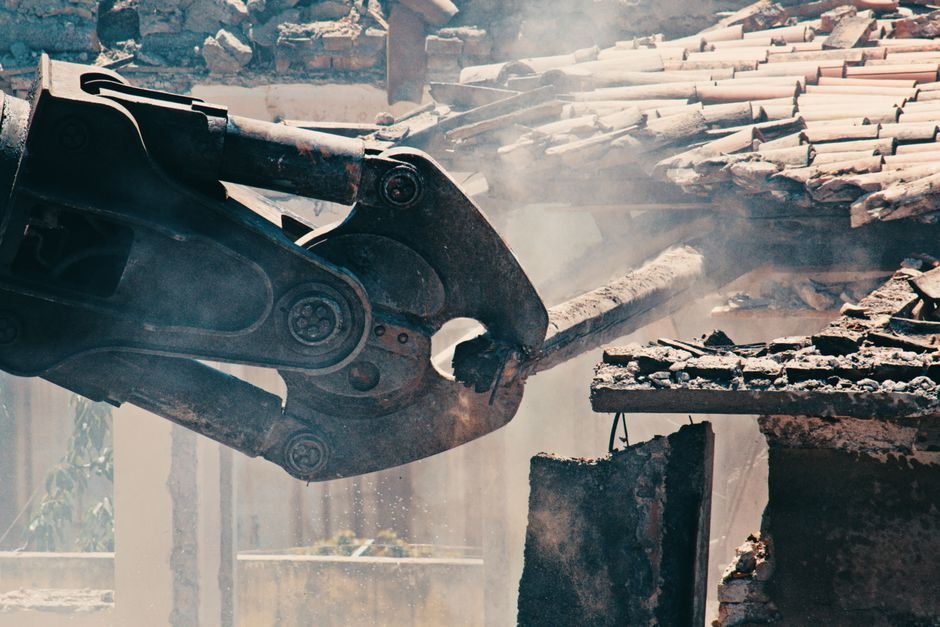
A demolition hammer rated at 1500 W input with 35–50 J single-stroke impact and a 1300–1500 bpm rate clears 0.3–0.5 m² of 150 mm reinforced-concrete slab per hour under intermittent operator loading, which is roughly 4–6× the throughput of a 6 kg rotary hammer on the same substrate [S1].
The tool class covers three form factors: a 5–8 kg light breaker for wall chasing and tile removal, a 10–16 kg mid-range hex or SDS-max hammer for slab and masonry work, and a 17–30 kg heavy breaker for road and foundation demolition. Selection is governed by stroke energy, blow rate, vibration emission a_hv and weight, not by wattage alone.
Core Advantages: Energy, Productivity, Versatility
Single-stroke impact of 30–60 J on mid-range units lets one operator break C30/37 concrete, 200 mm brick walls and compacted asphalt in the 5–30 mm chip range without pre-scoring, a productivity band that handheld rotary hammers cannot match above 10 kg class [S1].
Hex and SDS-max shanks accept 30+ chisel profiles (point, flat, spade, wide chisel, gouge, bushing tool, asphalt cutter), so a single power unit covers vertical chiseling, horizontal slab breaking, channel opening and surface scaling; this consolidates tool inventory on a structural demo crew. Air-cooled universal motors in the 1300–1700 W band sustain 80% rated impact energy through a 6-minute continuous cycle before thermal cutout on most nameplate units.
Key Disadvantages: Vibration, Noise, Weight, Cost
Hand-arm vibration a_hv of 12–22 m/s² on 10–16 kg breakers forces an 8-hour A(8) exposure limit below roughly 2 h trigger time per shift at the 5 m/s² EU threshold, so half-day crew rotation or anti-vibration gloves rated to ISO 10819 are mandatory on concrete demo [S1].
Sound power on 1500 W breakers measures 100–108 dB(A) at the operator ear, which places the tool in mandatory hearing-protection class 5 (SNR ≥ 30 dB) under most site PPE rules. Dust load from 150 mm concrete cutting runs 5–15 mg/m³ respirable crystalline silica at 1 m without extraction, which is well above the 0.025 mg/m³ ACGIH TLV-TWA and requires an M-class extractor plus a FFP3 half-mask.
Selection Criteria vs Rotary Hammer and Breaker Class

Demolition hammer: single-direction percussive only, no rotation, 10–30 kg, 30–60 J stroke, 1000–2000 bpm, no drilling mode. Rotary hammer: dual-mode rotary + percussive, 4–12 kg, 2–20 J stroke, 0–4000 bpm, drilling up to 32–50 mm in concrete. This makes rotary hammers the right tool for anchor and rebar-cutout work where a clean hole is needed, while demolition hammers are the right tool for bulk breaking where hole geometry does not matter [S1].
Within demolition class itself, the decision gates are: chisel shank (SDS-max 18 mm hex for high-power, 30 mm hex or 28 mm hex for heavy road breakers), impact energy at rated load (some brands publish 50% load figures 30–40% below nameplate), vibration a_hv (tri-axial, not single-axis) and service interval (brush life 200–400 h, grease fill 50 h). Buyers should compare a_hv rather than nameplate watts, since two 1500 W units can differ 2–3× in operator exposure.
Real Use Cases and Crew Allocation
Structural demolition on a 200 mm RC slab typically allocates one 1500 W demolition hammer per 8 m² of slab per shift, with a second operator on dust extraction and a third on rubble sorting, because the tool cannot be run continuously without tripping the EU A(8) vibration limit [S1].
For wall chasing in 100–150 mm brick or aerated block, a 5–8 kg light breaker (10–25 J) outperforms larger hammers because chisel control and lower handle vibration matter more than raw impact. Road and foundation work shifts to 17–30 kg breakers driven from a 16 A site supply, with chipping rate 1.5–2.5 m²/h on 200 mm asphalt. The same crews often pair a demolition hammer with a separate rotary hammer for through-holes, and a pressure transmitter-monitored water suppression ring for silica control on enclosed sites.
Limitations, Failure Modes and Sourcing

Common failure modes on demolition hammers: hammer-mechanism seizure from grease migration past 50 h service, brush wear below 8 mm at 200–400 h, chuck bushing ovality on SDS-max beyond 300 h, and armature bearing failure when the tool is run vertically for extended periods. Spec sheets that publish a 12-month warranty but withhold a_hv and service-interval data should be treated as incomplete, since both metrics drive real cost of ownership. [S1]
Procurement should request the tri-axial a_hv figure, the 50%-load impact energy, the brush and grease interval, the chisel shank standard, and a CE/UKCA declaration citing ISO 5349 for vibration and EN 60745 for hand-held power tool safety. For TCO framing across the wider power-tool fleet, the steel-section TCO lines and the marble-cutter TCO breakdown use the same hourly-cost method and are useful cross-references. A parallel read on safety helmet advantages and disadvantages is a sensible add-on since a demolition-hammer site mandates class E (electrical) + class B (impact) head protection in the US and EN 397 + EN 50365 in the EU.
Trackable signals for the next quarter: at least one major OEM releasing an a_hv figure below 8 m/s² on a 1500 W SDS-max platform; EN 60745-2-6 amendment updates on vibration test methods; and Chinese-export 1500 W demolition hammers landing at landed prices 20–30% below 2024 baselines on EU B2B portals.