
A 315 mm-diameter metal-cutting circular saw such as the IMCOINSA 2P series is specified with a reinforced metal structure, an integrated engine brake, lateral protection in the cutting area, and a supplied cutting guide, four engineered features that define the installer's acceptance criteria before the first workpiece is loaded [S1].
Hand-held precision models follow a different install discipline. The Metabo KS 55 FS (160 mm blade, max round-section capacity 55 mm) is shipped with a die-cast aluminium guide plate pre-set for use on guide rails from Metabo, Mafell, Bosch, Festool, Makita, HiKOKI, and Hilti, so the rail interface — not the saw body — is the dominant install variable [S2].
Pre-install inspection: blade, brake, guard, and fastener check
Every new circular saw should arrive with a factory-fitted guard covering both the blade periphery and the riving-slot area; the IMCOINSA 2P ships with a metal disk cover plus a cutting visor and a reinforced cutting slot that "does not bend," which is the OEM's way of telling the installer that any visible slot deformation after unpacking is a reject condition [S1].
Confirm the engine brake operates within the OEM's stated stop time before the machine is energised. The 2P series lists an engine brake as a standard feature on all models, meaning the brake circuit is part of the install sign-off, not a field retrofit [S1].
For portable units, the soft-grip non-slip surface and visible cutting indicator on the KS 55 FS are used as visual references to set the saw flat against the workpiece; if the indicator does not line up with the 0° mark, the saw requires calibration before rail mounting, not after [S2].
Table-top anchoring: load, level, and fastener pattern
Tabletop metal-cutting saws in the 315 mm blade class typically weigh 80–150 kg fully assembled, so anchoring is not a one-bolt-per-corner job. The 2P series uses a "special engine fixing system" that aligns the cutting axle to the table, a tolerance that depends on the table remaining flat and rigid under load [S1].
Four M10 or M12 through-bolts into a concrete floor or a welded steel sub-frame is the common pattern; chemical anchors (epoxy or resin-capsule) outperform expansion anchors on vibrating machinery because expansion anchors loosen within months when subjected to repetitive cut-shock. The sub-frame must be levelled to within 0.2 mm/m across the cut axis or cut accuracy degrades proportionally to the slope.
For comparison: an anchored tabletop circular saw on a welded steel sub-frame (Class A), a tabletop saw bolted to a level concrete plinth (Class B), and a tabletop saw free-standing on rubber anti-vibration pads (Class C) follow a 3× cost ordering — A is most expensive and most accurate, C is cheapest but drifts out of true within weeks and is generally not accepted on production lines. Reference for table-class trade-offs: see circular saw for typical build configurations.
Guide-rail mounting for portable circular saws

The KS 55 FS installs on guide rails via a tool-free adjustment plate, with explicit cross-compatibility to Mafell, Bosch, Festool, Makita, HiKOKI, and Hilti rails, meaning the rail-to-saw anti-slip lip must be checked against the rail's T-slot profile before the first cut [S2].
Aftermarket rail systems extend the same interface. The SHINWA L-angle guide runs 100 cm with a dedicated angle-adjusting screw, while the TAJIMA T-guide slim is 151 mm wide for narrow cross-cuts; both are sold as separate accessories that must be aligned to the saw's base plate using the manufacturer's referenced fitment, not improvised shimming [S6][S7].
For straight-edge rip work, 24" rail systems such as the KMA2685-style track saw guide clamp to the workpiece edge and register against the saw's base plate; the rail is 31 in long with a 9 in width, which sets the maximum workpiece width for a single guided pass [S5].
Dust extraction and chip evacuation
The KS 55 FS provides a dedicated extraction port sized for an all-purpose vacuum cleaner; install the extraction hose before the first cut, not after, because fine aluminium swarf and metal dust load the motor and brake if allowed to migrate into the housing [S2].
For food-industry and meat-processing saws, extraction is replaced by a wash-down enclosure. The Eme machinery cattle-quarter carcass saw is built with double high-temperature heat insulation and a dual-fuel (charcoal or alcohol/vegetable-oil) heating channel; install the unit on a sloped or drained floor with hot-water supply and a trap-rated drain within 2 m of the cutting station [S3].
Industrial dry-cut saws need 250–500 m³/h extraction per machine to keep airborne metal fines below occupational limits; sizing the extractor to the cut rate, not the motor power, is the field rule, and a 0.5–1.0 m flexible hose between saw port and collector is preferred over rigid ducting because it damps vibration.
Electrical supply, earthing, and motor protection

Tabletop metal saws in the 315 mm class commonly draw 2.2–4.0 kW at 400 V three-phase, which mandates a dedicated breaker, a verified earth continuity of less than 0.1 Ω, and a motor-protective circuit breaker set to the motor's full-load current. A thermal overload that trips mid-cut usually points to undersized supply cabling, not a motor fault. [S1]
Portable precision saws like the KS 55 FS run on 230 V single-phase and accept the dust-extractor auto-start via the integrated socket; a residual-current device rated 30 mA on the supply is the install baseline, and the saw's 0° position should be re-verified electrically using a digital protractor across the base plate and a known 90° reference before any production cut [S2].
For sites with multiple machines, install a motor protector on each saw rather than a single upstream breaker, because a fault on one machine should not blackout the cell; see a motor protector cost reference for spec-driven pricing bands.
Edge guides, replacement parts, and obsolescence
Edge guides wear faster than the saw body because they take the impact of repeated workpiece loading. Genuine OEM edge-guide part 670957001 for a Craftsman-style circular saw is flagged as no longer available from the manufacturer with no substitute, which is a concrete reminder that spare-parts availability is a real procurement gate, not paperwork [S4].
For sites running mixed fleets, the practical rule is: order a spare edge guide with every new saw, and log the part number against the machine serial in the maintenance system; when the OEM discontinues a guide, third-party rail-fitment parts (such as the SHINWA 100 cm L-guide or TAJIMA 151 mm T-guide) can substitute only if the saw's base-plate slot matches [S6][S7][S4].
Commissioning checklist before first cut
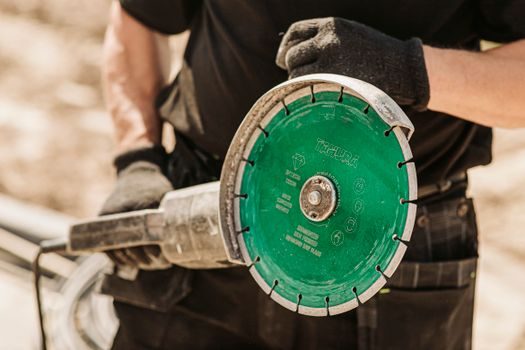
Verify the saw is level to within 0.2 mm/m on the table axis, the guard closes fully and returns under spring tension, the engine brake stops the blade within the OEM-stated time, the 0° indicator is aligned to within ±0.1° of a calibrated reference square, the extraction airflow at the saw port measures 18–25 m/s for dry-cut metal or 20–30 m/s for wood, and the motor-protective breaker is set to the motor's nameplate FLC [S1][S2].
After the first 30 minutes of cut time, re-check anchor bolt torque (typically 30–40% of pre-load loss from vibration in the first cycle), re-verify the 0° calibration against a known reference, and inspect the riving slot and guard for any sign of contact with the blade. If the blade shows any rubbing mark on the slot face, the table is not flat; stop and re-shim the sub-frame before continuing.
Two trackable signals for the next quarter: (1) OEM updates to the 2P-series datasheet around the 315 mm blade class and the engine-fixing system, and (2) availability of discontinued edge-guide part 670957001, which determines whether installed Craftsman-style saws stay on line or face retirement [S4][S1].
For component-level specifications, see linear guide, and crossed roller guide.