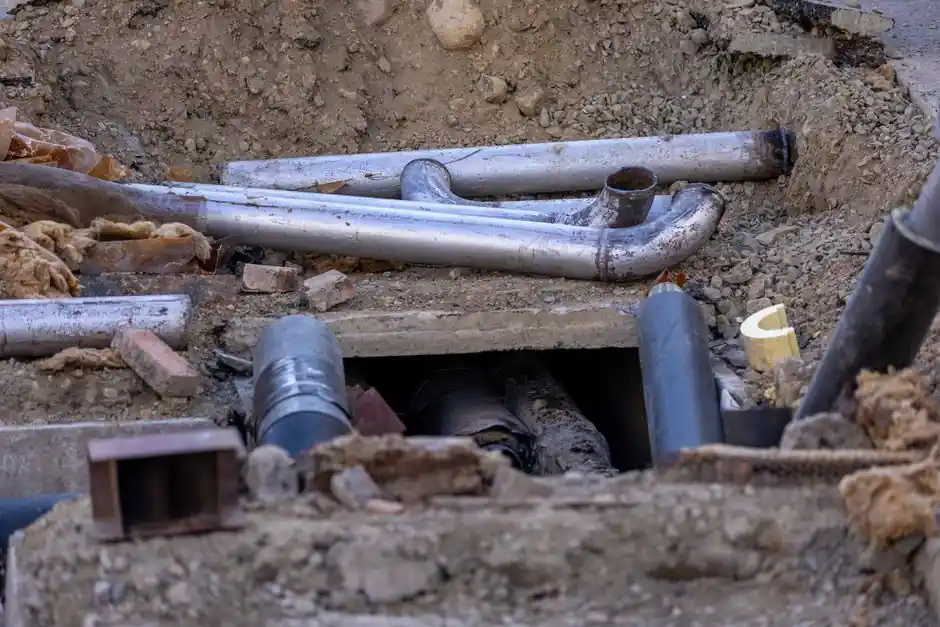
A 1,500-2,200 W corded demolition hammer delivering 30-50 J (22-37 ft-lbs) per blow at roughly 1,300-1,900 bpm covers the bulk of concrete chase, wall-penetration, and slab-breaking work that plumbing rough-in demands [S3][S4][S6].
Plumbing crews consistently reach for SDS-Max or 1-1/8 in hex class machines in the 25-35 lb bracket to chase walls, drill 1-1/2 in water-service penetrations, and break light slabs, citing Hilti, Bosch, Makita, Milwaukee, and DeWalt as the working shortlist [S5].
Where a Demolition Hammer Actually Fits in a Plumbing Job
The tool's job on a plumbing rough-in is to remove material, not to drill it: chasing a wall for a 3/4 in copper run, opening a slab trench for a DWV line, knocking out a brick chase for a vent stack, and breaking back a concrete encasement to expose a corroded service tee [S2]. Demolition hammers drive a chisel or clay-spade bit, not a rotary bit, which is why they outperform rotary hammers for material removal and underperform them for clean hole drilling [S5].
Typical plumbing-trade applications line up against three impact-energy bands. Light chase work in 4-6 in block or poured walls wants 20-30 J (15-22 ft-lbs). Mid-range slab and masonry trenching wants 30-50 J (22-37 ft-lbs), which is where most contractor-grade SDS-Max and 1-1/8 in hex machines sit [S3][S4][S6]. Heavy mass-concrete demolition, where a 75-90 lb electric or pneumatic breaker is the actual tool of record, is generally outside what a plumber hires in for, except for site prep on commercial undergrounds [S5].
Spec Bands That Map to Plumbing Tasks
Demolition and breaker hammers span roughly $100 to $5,000 retail, and the price gap tracks almost linearly with impact energy, chuck size, and weight class [S1]. A useful plumbing-side decision grid:
Power class and chuck. Sub-1,000 W consumer / DIY class machines (often SDS-Plus or proprietary 1-1/8 in) typically deliver 5-15 J and sit in the $100-$300 band; they handle 2-4 in chase work in concrete block but stall in reinforced slab [S1][S4]. The 1,500-2,200 W SDS-Max class, exemplified by the Milwaukee 5446-21 at 8.8 ft-lbs (11.9 J) and the XtremepowerUS 2200 W unit at 1,900 rpm with 55 ft-lbs (74.6 J) torque-equivalent impact class, sits in the $400-$1,200 band and covers the practical plumbing envelope [S3][S4].
Weight and ergonomics. Plumbing work is largely overhead or vertical, so weight matters as much as raw joules. The widely cited 25-35 lb bracket is the sweet spot for one-operator wall and slab work, with anything over 40 lb generally requiring a two-person lift or cart [S5]. Field reports from working plumbers describe a mid-size Bosch and a large Makita pairing, with the large Makita reading "much heavier than 35 lbs" once the case, second chisel, and clay spade are loaded in [S5].
Impact energy versus bpm. Higher joules break harder material per blow; higher bpm smooths the cut on softer material. For plumbing chases, prioritise joules first, bpm second, because most failures on the job come from under-rated energy, not from a slow blow rate [S3][S6].
Comparison: How the Five Plumber-Shortlisted Brands Stack Up

Field feedback from plumbing contractors on working demo hammers is unusually consistent, which is useful for spec-side decisions [S5].
Hilti (TE70/TE95 class) is rated highest for reliability and parts turnaround: contractors report sending broken machines back and getting fast turnaround, with the TE95 cited as a do-anything workhorse at a price premium [S5]. Bosch draws the strongest durability comments, including 30-year-old units still in service with only a brush change, and is widely used for both chasing and 1-1/2 in hammer-drilled water-service penetrations [S5]. Makita is the most common large-machine pick (the ~35 lb class) for "big jobs," though at least one shop moved off Makita because parts lead time hurt jobsite uptime [S5]. DeWalt shows up specifically in plumbing contexts for chasing concrete, drilling 1-1/2 in water-service holes, and dry-coring 5 in wall penetrations; it pairs well with the demolition hammer category buyers already understand [S5]. Milwaukee's SDS-Max 5446-21 is the most spec-rich in the contractor tier: 1-3/4 in hex / SDS-Max, 8.8 ft-lbs impact, dedicated to hard-hitting concrete work [S3].
Bit Selection and Technique: The Part Most Specs Skip
Bit choice changes productivity as much as machine choice. A pointed chisel self-drills starting holes and breaks thick slabs; a flat chisel drives horizontally to peel a wall chase; a clay spade is a wide blade for fast material removal in soil or soft material; a scaling chisel cleans mortar and tile without over-removing substrate [S2]. The general rule from field use: keep the tool perpendicular to the surface and use a controlled back-and-forth motion, starting at low power and ramping up to avoid bit walk on the first stroke [S2].
For plumbing wall chases, the practical bit sequence is a pointed chisel to establish the line, a flat chisel (1-1/2 in or 2 in wide) to peel the channel, and a scaling chisel to feather the edges before the pipe fitter lays in. This sequencing matters because over-cut chases force the wall patcher to over-fill, and that adds labour cost the demo-hammer selection never priced in [S2][S5].
Safety, Failure Modes, and When Not to Use a Demo Hammer

Demolition hammers are the most common source of vibration-related hand-arm injury on plumbing jobsites, so the work-envelope rules are hard, not advisory. Mandatory PPE is gloves, ANSI Z87.1 eye protection, and hearing protection rated for at least 100 dBA continuous exposure; a typical SDS-Max class machine runs 95-105 dBA at the operator [S2].
Failure modes worth flagging before a plumber commits: brush and armature wear on brushed universal motors (Bosch's 30-year-old survivor needed brushes once, no shock absorbers), bit jamming on rebar strike, and case cracks from drops off truck beds. Cordless 18 V class demolition hammers exist but are still under-powered for sustained slab trenching, so for production plumbing work, the 1,500-2,200 W corded SDS-Max class remains the spec-side default [S3][S4][S5].
When not to use a demo hammer: drilling clean, round, dimensionally accurate holes for pipe sleeves (use a rotary hammer or a diamond core rig), light-duty drywall or timber removal (use a reciprocating saw), and heavy mass-concrete demolition where a 75-90 lb breaker is the proper tool class [S5]. A practical cross-reference for that decision point is laid out in this spec-based rotary-versus-demo hammer selection guide, which lines the two tool families up against energy, chuck, and bit logic. For plumbers weighing the rotary-hammer path instead, the dedicated rotary hammer selection for plumbing write-up covers hole-size and chuck mapping.
Spec-Side Selection Criteria and Acceptance Test
Buying criteria that hold up across vendor shortlists: impact energy in joules (target 30-50 J for plumbing), blows per minute (1,300-1,900 bpm is the working band), chuck type (SDS-Max or 1-1/8 in hex for production work, SDS-Plus for light chase only), weight under 35 lb for one-operator overhead work, and a brand with verifiable parts and brush service within the operator's region [S3][S4][S5][S6].
Acceptance test on receipt: run the machine unloaded for 60 s and check for bearing rumble, then run against a known concrete sample (a curb offcut works) for 5 min and confirm the bit does not stall when pushed at 50% operator body-weight. Brush-motor machines should commutate smoothly without visible arcing at the brush housing; excessive sparking at start-up under no load usually means the armature is at end of life. Corded machines should be inspected for ground-pin integrity and double-insulated case integrity before each shift [S2][S6].
Trackable next signals for spec updates: manufacturer announcements on cordless 18 V / 36 V SDS-Max demolition hammers reaching 25 J class (current production units sit below this), and any Hilti or Bosch TE-class refresh that changes the weight-to-joule ratio below the 35 lb / 30 J threshold plumbing crews treat as the field ceiling [S3][S5].
Spec-level background on the components involved: pressure transmitter.
