
A 75,000 kg operating-weight XCMG XG360 diaphragm wall grab, with a 10,370 mm x 4,400 mm x 17,205 mm envelope, is the single model currently listed in the XCMG drilling-machinery catalog segment on Zoomkin's and Caterbe's engineering-machinery portals [S2][S3].
For agricultural projects in India, published contractor pricing sits in the INR 1,500 to INR 3,000 per cubic meter band for diaphragm wall work, a number that holds whether the wall is being cut for an urban basement or a rural water-control structure [S1].
Why a Diaphragm Wall Grab Shows Up on a Farm
Diaphragm wall grabs are trench-cutting rigs suspended from a crawler crane, used to excavate narrow vertical panels (typically 400-1,200 mm wide) down to 20-60 m and then tremie-filled with concrete to form a continuous wall [S2][S3]. On agricultural sites the same kit builds small dam cut-offs, sluice and head-regulator monoliths, canal-side retaining walls, pump-house substructures, and the ring walls of large circular storage tanks. The XG360 class at 75 t operating weight maps to roughly 30-50 m panel depths under typical clay/sand profiles, which covers most farm-scale water-control work [S2].
Because the rig is rented by the cubic meter of wall, not by the end use, the agronomic side of the project usually inherits the same grab selection logic as a transit-tunnel or cofferdam job, a logic that the tunneling spec map for diaphragm wall grabs lays out in detail.
Selection Criteria: Mass, Panel Width, and Soil Match
Three numbers drive the decision: operating weight (which sets hoist and crane class), jaw width (which sets panel thickness), and maximum digging depth. The XCMG XG360 sits at 75,000 kg, 4,400 mm machine width, and a transport envelope over 17 m tall, a footprint that needs a hard-standing crawler pad and clear crane access along the trench line [S2][S3].
For purely agricultural use, lighter hydraulic grabs in the 8-25 t class are often more practical: they can ride on a 30-50 t crawler crane, fit through a 4 m farm-track gate, and still dig 15-25 m panels for small check dams and tank ring walls. The 75 t XG360 only earns its keep on rural projects when wall depth exceeds ~30 m, soil includes dense clay or weak rock, or panel length runs over 800 mm to keep pour cycles down [S2][S3].
Agricultural grab selection also has to reckon with continuous-operation uptime. Canal jobs run 8-12 hour shifts in dusty, often wet conditions, so bucket-lip wear, hydraulic-hose abrasion, and Kelly-bar thread greasing schedule all matter more than peak torque on the spec sheet. Matching panel width to tremie-pipe spacing is non-negotiable, as an undersize pour section forces cold joints and water seepage that defeat the whole point of an irrigation cut-off wall.
What the Grab Is For, and What It Is Not For
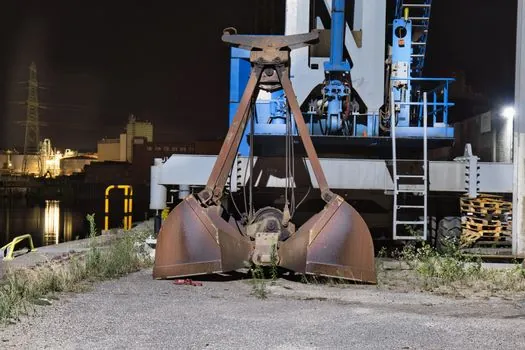
A diaphragm wall grab is the right tool when the agricultural structure needs a continuous, water-tight vertical wall: cut-off walls beneath small earthen dams, core walls in canal drops, head-regulator and division-structure monoliths, and the perimeter wall of a reinforced concrete service reservoir. It is also the right call where soil is soft-to-medium and groundwater is high, because the bentonite slurry stabilizes the trench while the grab works [S1].
It is the wrong tool for shallow field drains, open ditch cleaning, or stock-tank excavation in hard rock. For those, a standard long-reach crawler excavator or a dedicated trencher is faster and cheaper. The 1,500-3,000 INR/m^3 cost band only makes sense when the wall goes below roughly 6 m and the project has at least 500-1,000 m of continuous length to amortize the mobilization [S1].
Comparison of Common Grab Classes for Rural Water-Control Work
Lightweight hydraulic grabs (8-25 t operating weight, 600-800 mm jaw, 15-25 m depth) win on mobilization cost and farm-track access, and they suit 90% of small dam and tank ring-wall work. Mid-class rope-suspended grabs (30-50 t, 800-1,000 mm jaw, 25-40 m depth) cover most canal-lining and head-works monoliths, and they match a wide pool of 80-150 t crawler cranes. Heavy class grabs such as the XCMG XG360 (75 t, 1,000+ mm jaw, 40-60 m depth) only beat the lighter class when the wall must go through stiff clay, dense sand, or weak rock, or when the panel section exceeds 1,000 mm to control pour volume on a long alignment [S2][S3].
On cost, the 1,500-3,000 INR/m^3 published rate in Mumbai does not separate grab class, so the realistic selection lever is not headline rate but mobilization, panel-depth capability, and panel-width fit to the design [S1].
Limitations and Failure Modes to Spec Against
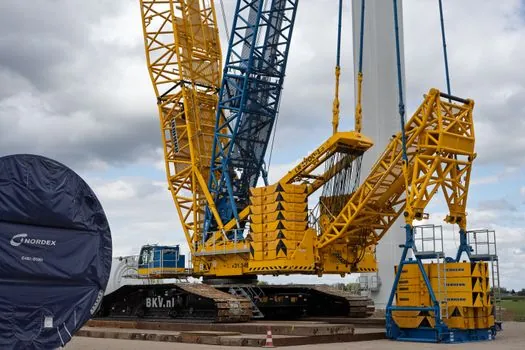
Three failure modes show up repeatedly when diaphragm wall grabs are misapplied on agricultural sites. First, an undersized crane leads to cycle-time stretch and grab stall in clay, which wrecks daily output targets. Second, narrow panels paired with a too-wide tremie pipe produce concrete segregation at the joint and honeycombing that the canal cannot tolerate. Third, slurry-circuit capacity on small rural jobs is often under-spec'd, so the bentonite pond is too small and the trench collapses before the grab finishes a bite, a risk that is amplified in sandy alluvial profiles common near river-fed irrigation systems [S1].
Selection should also check that the grab's maximum panel length and the crane's free-sheet height can both clear local power lines and tree canopies along the canal alignment, because the XG360 stands over 17 m tall in transport and needs similar headroom to slew [S2][S3].
Signals to Track Before Specifying
Two trackable signals will sharpen the next selection round: an updated XCMG drilling-machinery catalog page that lists a second grab model (Zoomkin and Caterbe currently show only the XG360 in this segment, both with the 75,000 kg / 10,370 x 4,400 x 17,205 mm envelope) [S2][S3], and a published 2026 contractor-rate card that splits INR 1,500-3,000/m^3 into grab-class buckets rather than a single flat range [S1].
For a comparative read on grab selection logic in a different soil-and-depth regime, the tunneling-focused spec map is the closest reference point in this catalog.
Detailed specification references: diaphragm wall grab, diaphragm pump, and diaphragm valve.