Specifying a diaphragm wall grab for quarrying means balancing lift force, panel geometry, and ground hardness before brand selection: 2026-vintage hydraulic models cluster around 660–750 kN line pull, trenching widths of 800–1,500 mm, and single-layer depths of 60–85 m, while mechanical Type-B grabs cap at roughly 70 MPa soil hardness with total rig weights near 22,500 kg [S3][S4][S5][S9].
Quarry projects borrow the same toolchain as deep urban foundation work, but the absence of a neighbouring structure means vibration and noise constraints are softer than typical inner-city diaphragm wall jobs [S1].
Where the Hydraulic Class Fits and Where It Does Not
Hydraulic grabs such as the ZDG650, with 660 kN max line pull, 2,800 mm grooving length, and 800–1,500 mm grooving width, target moderately to very demanding piling work, including hard soil and weathered rock conditions adjacent to quarry faces [S3].
The XCMG XG85 pushes that envelope to 750 kN lifting force, 85 m single-layer trenching depth, 36 mm wire rope, and a developed chassis width range of 3,500–4,900 mm, which gives operators lateral stability during impact-grab cycles on uneven quarry bench floors [S4].
For deeper, narrower slots down to 1,200 mm wide and 70 m deep (hydraulic reel) or 60 m (mechanical reel), a 34-ton-class unit like the BAUER GB34, with 80–120 ton hydraulic closing force, fits, but its 213 kW Cummins QSC8.3 powerpack and Grab Control System (inclinometer-based X-Y monitoring, 8/12 hydraulic flap correction, 0.1° verticality) make it overkill on shallow limestone pads under 20 m [S2].
In a quarry, these machines earn their keep when panels must be cut through backfill, clay seams, and competent rock in a single pass; for purely weathered overburden, a rope-suspended mechanical grab remains the lower-mover, lower-risk tool [S9]. The diaphragm wall grab encyclopedia page covers the wider rig taxonomy for cross-reference.
Mechanical Grabs: the Light-Tool Counterpart
Mechanical Type-B grabs cover ground up to about 70 MPa where light chiselling is acceptable, with standard lengths of 10 m or 12 m and ballast options that push total weight to 22,500 kg for the most demanding panels [S9].
Units such as the TYSIM KH40 illustrate the mechanical envelope: 3,500 mm grooving length, 400–1,000 mm grooving width, 60 m grooving depth, 0.8–1.8 m³ bucket capacity, 28 mm wire rope, and CE/ISO 9001 certification, with a 45-day delivery window from Jiangsu, China [S8].
For quarry operators who only need a few panels per blast cycle, the lower consumable cost and absence of a high-pressure hydraulic circuit make mechanical grabs a defensible choice, especially when the trench sits in competent but fractured rock rather than monolithic hard stone.
Selection Criteria Mapped Against 2026 Models
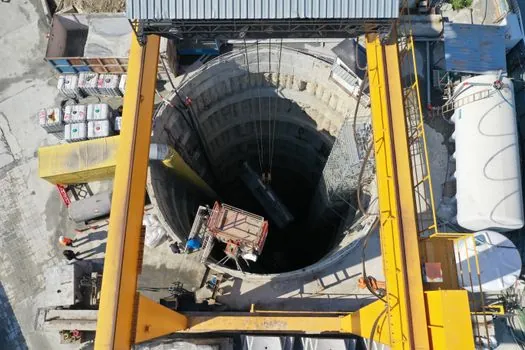
Four criteria separate the shortlist: required trench depth, panel width, soil/rock hardness, and on-site power availability. The ZDG650 covers 800–1,500 mm widths at moderate depths, while the XG85 stretches to 85 m at 750 kN lift on wider 3,500–4,900 mm chassis footprints [S3][S4].
The XG600D and XG480D (XCMG-branded, supplied via Xuzhou Unique) sit in the same family with extra-wide crawlers, large slewing bearings, and 1–500 unit/month supply capacity from a 1–90 day delivery window, useful when quarry procurement teams need scale [S5][S10].
For compact quarries, the APIE AHG80A hydraulic grab offers 700 kN max lift, 40 t total grab-body weight including soil, with overload protection, emergency stop, and self-diagnosis as standard safety layers, and a 12 m / 600 mm nominal pile foundation reference class on the same supplier [S6].
A direct comparison reads: ZDG650 (660 kN, 2,800 mm length, 800–1,500 mm width) is the workhorse mid-range; XG85 (750 kN, 85 m depth, 36 mm wire) is the deep-trench leader; BAUER GB34 (80–120 t closing force, 0.1° verticality, 213 kW engine) is the precision option; Type-B mechanical (up to 70 MPa soil hardness, 22,500 kg ballasted) is the low-cost, low-tech fallback [S2][S3][S4][S9].
Quarry-Specific Constraints: Noise, Vibration, and Bench Access
Diaphragm wall construction in urban settings is governed by strict deformation, groundwater, and emission envelopes, which is why low-noise, low-vibration tools (concrete pulverizers, hydraulic rock splitters) often handle the finishing interfaces [S1].
Quarry benches sit outside most of those envelopes, but haul-road gradient, bench width, and crane radius still dictate the chassis footprint: the XG85's 3,500–4,900 mm adjustable crawler width is a direct response to unstable impact-grab reaction loads on uneven ground [S4].
Verticality control matters even in quarry work, because out-of-tolerance panels compromise the seal between adjacent sections; the GB34's 0.1° GCS-class verticality, monitored continuously via X-Y inclinometers, remains a benchmark even where the surrounding noise ordinance is permissive [S2].
Standards, Safety Layers, and Operating Limits
No single ISO or EN standard was cited in the supplier research for diaphragm wall grabs specifically, but the equipment carries CE marking on mechanical units and ISO 9001 on manufacturers such as TYSIM (KH40), with onboard safety layers including emergency stop, overload protection, and self-diagnosis on hydraulic units like the AHG80A [S6][S8].
Operational discipline still follows the diaphragm wall construction sequence: guide-wall setup, slurry-supported excavation, cleaning and end-profile control, reinforcement lowering, tremie concreting, joint interlock, and wall head trimming; any grab selection must keep tolerances inside the geometry-control envelope that step demands [S1].
Buyers should also weight the support fluid cycle: bentonite or polymer slurry density and viscosity must be held inside the spec window during the entire grab cycle, because the trench wall's temporary stability depends on filter-cake integrity before tremie concrete displaces the slurry [S1].
Procurement Signals and What to Track Next
Three signals are worth tracking on the 2026 sourcing calendar: lead times (1–90 days for XCMG-branded units via Xuzhou Unique, 7–30 days for ZDG650 ex-stock, 45 days for KH40), supply capacity (1–500 units per month for the XCMG channel, 10 sets per month for KH40), and used-equipment availability through aggregators such as Machinio, where a BAUER GB34 was listed in Shanghai in May 2026 [S2][S3][S5][S8][S10].
For quarry procurement teams, the machine tool procurement strategy: spec-matched selection for 2026 buyers piece provides a useful cross-industry template on matching spec sheets to actual working envelopes rather than brochure maxima.
Field engineers should request two written confirmations before signing: the maximum sustained line pull at the rated depth, not the no-load peak, and the verified verticality tolerance under the project's specific slurry programme, because both numbers shift materially between 60 m and 85 m trenching depth classes [S4].
Component reference pages worth checking: diaphragm pump, and diaphragm valve.