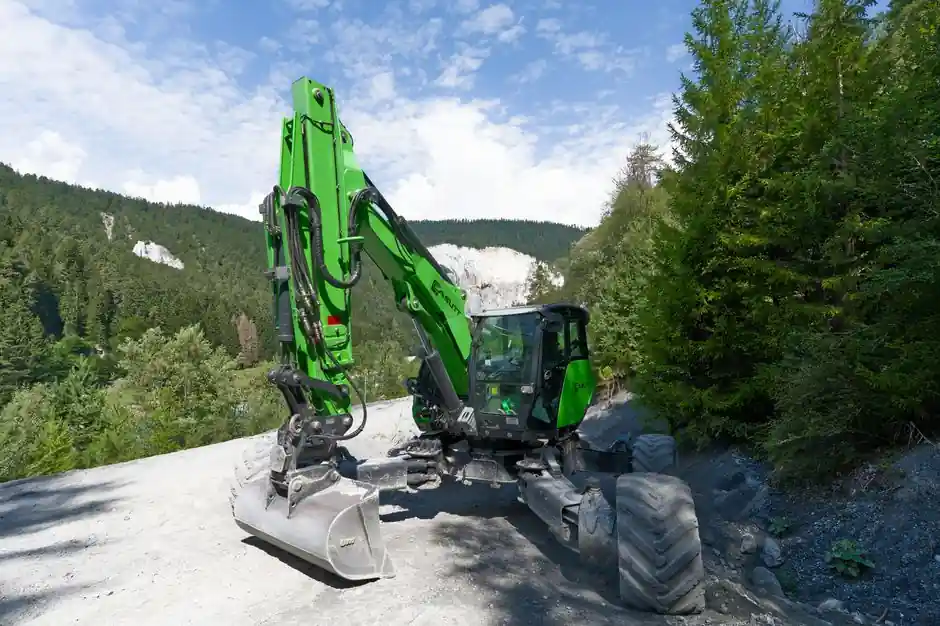
Forestry infrastructure foundations (bridge abutments, haul-road culverts, log-yard retaining walls, fire-pond cofferdams) typically need trench depths of 20-80 m, panel widths of 0.6-1.5 m, and operation in soft-to-medium-hard overburden with cobble and weathered-rock intrusions [S1]. A rope-suspended hydraulic diaphragm wall grab is the workhorse on most forestry sites below 50 m, while a rig-mounted hydraulic grab is the safer spec once depth exceeds 50 m or alternating hard rock and backfill soil strata appear in the bore log [S1].
For typical forestry-cutoff applications, the equipment class is the same one Zoomlion Canada lists under its Foundation product group (Hydraulic Diaphragm Wall Grab, Trench Cutter, Oscillator, Full Rotary Casing Drill, Horizontal Directional Drilling Rig, Hydraulic Pile Pressing Machine) [S2]. The grab is selected from that group when the panel is rectangular, the depth is in the grab envelope, and no full-cutter hydrofraise is required.
Forestry Foundation Scope: What the Grab Is Actually Building
Forestry projects most often need a grab for: (1) bridge and culvert abutment retaining walls along logging roads, (2) log-yard perimeter cut-off walls (preventing leachate migration into forest streams), (3) small dam and fire-pond cofferdams, and (4) tower-base foundations for forest-fire lookout and comms sites. Trench depths in these applications run 20-80 m, with the majority of forestry work in the 20-45 m band [S1]. Panel widths of 600-1200 mm cover the typical forestry wall thickness range, with 800 mm as the most common nominal.
Forestry ground is rarely clean sand or clean clay. Common profiles are: a top layer of organic forest soil and root mat (1-3 m), a clay-silt layer (5-20 m), then dense sand-gravel or weathered rock with cobbles. Where a diaphragm wall is needed deeper than the soft overburden, the grab must be sized for the hardest layer it will encounter, not the average. The same principle is documented for mining cut-off walls, where strata variability drives rig class more than nominal depth [S1].
Selection Criteria: Depth, Strata, Panel Width, and Site Access
Four criteria dominate forestry grab selection. Depth sets the machine class: 20-40 m work can use compact units such as the SG40F, 30-60 m work calls for mid-class units like the SG70F, and 50-80 m or rock-strata work needs heavy units like the SG85F or XG65 [S1]. Strata sets the bucket and chisel: alternating hard rock and backfill soil strata require a heavier chisel and a higher closing force (XG-class); uniform soft clay allows lighter SG-class units [S1]. Panel width is usually fixed at the bucket and rarely adjustable in the field. Site access on a forestry road typically limits machine transport weight to 35-50 t per truck, which excludes some fully-assembled heavy units and forces partial disassembly [S2].
A second-tier check is crane and power compatibility. Rope-suspended hydraulic grabs need a service crane with lifting height equal to grab length plus 1.5-2 m clearance, and a hydraulic power pack rated for the grab's continuous duty cycle. BVEM-class piling equipment suppliers serving infrastructure and forestry typically pair the grab with a matched crawler crane or purpose-built carrier, with the high-torque auger option kept for the harder boreholes [S3].
Machine-Class Comparison: SG40F vs SG70F/SG80F vs XG65/XG85
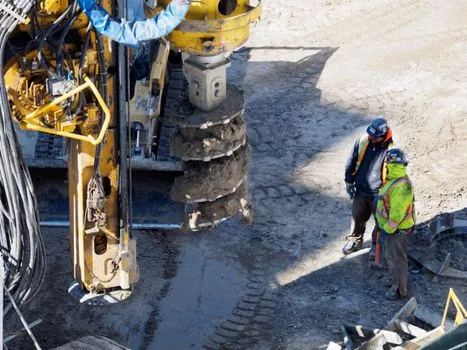
The clearest way to line the options up is by four forestry-relevant criteria: trench-depth envelope, typical strata, panel-width band, and site-access footprint.
Compact SG40F class (rope-suspended hydraulic): depth envelope 20-40 m, suited to medium-small urban foundation pits and utility tunnel retaining works where large trenching machinery struggles to enter compact work zones, panel width 600-800 mm, transport weight compatible with a single forestry lowboy [S1].
Mid SG70F and SG80F class (rope-suspended hydraulic): depth envelope 30-70 m, built for large-to-medium deep foundation pits and intercity tunnels where conventional trenching equipment lacks sufficient load-bearing capacity, panel width 800-1200 mm, suited to mixed clay and weathered-rock profiles [S1].
Heavy XG65 and XG85 class (rig-mounted hydraulic): depth envelope 50-80 m and deeper, designed for ultra-deep large foundation pits and large transit projects where common trenching machinery cannot reach sufficient depth and lacks enough clamping force, panel width 1000-1500 mm, mandatory for verticality-critical panels in alternating hard rock and backfill soil strata [S1].
For road-corridor forestry work specifically, the same depth-vs-class logic appears in adjacent road-construction spec maps, which can be used as a cross-check when the forestry haul road feeds a public-road upgrade.
Forestry Use Cases: Which Class Goes Where
Forestry bridge abutments on logged-over terrain with 20-35 m of soft alluvium over dense sand-gravel are the natural fit for the SG40F class: compact transport, single-crane deployment, and adequate closing force in non-rock strata [S1]. Log-yard cut-off walls around sorting and debarking areas, where the perimeter can exceed 400 m and depth is set by the leachate-migration horizon (commonly 15-30 m), also fall in the SG40F envelope.
Forestry culvert and small-dam cofferdams in valleys with 30-55 m of mixed clay, silt, and weathered shale call for the SG70F or SG80F class. Here the load-bearing margin matters: the bucket must cut through weathered-rock lenses without the chisel stalling, and the closing force must be high enough to pull a full bucket on each cycle rather than half-filling on hard layers [S1].
Lookout-tower and comms-tower base foundations in mountainous forest terrain, where alternating hard rock and backfill soil strata dominate the bore log and depth often exceeds 50 m, are the domain of the XG65 and XG85 class. Common trenching equipment on these sites often lacks sufficient directional stability, and deep trenching operations are prone to verticality drift, so the heavier XG-class chassis and the higher closing force are not optional [S1].
Limitations and Failure Modes to Engineer Out
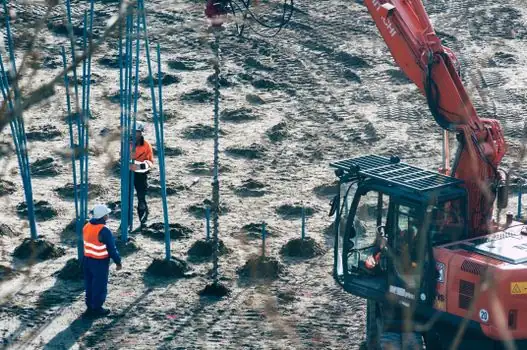
Three failure modes are common on forestry grab jobs and are preventable at the spec stage. Verticality drift in deep panels: above 50 m, rope-suspended hydraulic grabs without an active verticality correction system accumulate drift, and the panel will deviate from design; the XG65/XG85 class is the documented answer for ultra-deep large foundation pits and large transit projects [S1]. Bucket stalling in rock: an under-spec grab in alternating hard rock and backfill soil strata will stall on the chisel, and the crane operator will see a drop in cycle rate rather than a clean cut; spec the heavier class from the bore log, not from the average depth [S1]. Site-access damage: forestry haul roads have low bridges, tight curves, and load-limited stream crossings; oversized units force partial disassembly and add days to mobilization, so the spec must respect transport weight as a first-class constraint [S2].
Two operational constraints are also worth flagging. Spoil handling on a forestry site is rarely benign: the bucket must be cleaned between cycles if bentonite or polymer slurry is in use, and the spoil must be kept clear of any stream crossing. Power-pack noise and exhaust must be planned against any nearby fire-lookout or sensitive habitat; some forestry contracts require Tier 4 final / Stage V power packs for this reason, although the exact emission tier should be confirmed against the project's environmental spec rather than assumed.
Sourcing, Standards, and Trackable Signals
Forestry grab procurement runs through OEM direct-export channels, with manufacturers supplying full export documentation (factory certificates, quality inspection reports, emissions documentation) and a multilingual after-sales network [S1]. Spot inventory of new and low-hour used machinery with fast delivery is the norm for the SG40F and SG70F classes; the heavier XG65/XG85 class is more often built to order with longer lead times [S1]. Adjacent infrastructure-equipment suppliers, including piling-rig and diaphragm pump lines for slurry handling, also stock forestry-applicable augers for the higher-torque boreholes that show up in the same site package [S3].
Trackable signals for forestry grab selection over the next planning cycle: the SG40F-class compact envelope (20-40 m, 600-800 mm panel) is the volume band for forestry work, the SG70F/SG80F class covers the mid-depth mixed-strata majority, and the XG65/XG85 class should be reserved for projects where the bore log shows alternating hard rock and backfill soil strata or where panel depth exceeds 50 m. Cross-check forestry road-corridor grabs against the road-construction spec map when the same corridor is later upgraded to a public road, and against the mining cut-off spec map when the cut-off wall doubles as a mine-water barrier.
For component-level specifications, see diaphragm valve.
For related coverage, see ALC Panel Selection for Hospitals: Density, Fire, and Hygiene Spec Map.