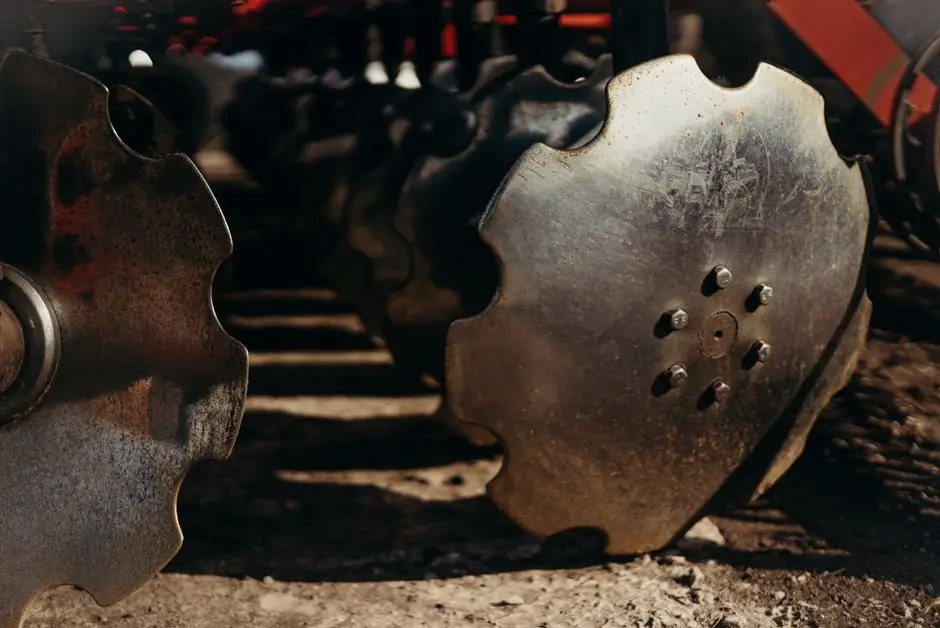
Frezer-brand CE and ISO 9001 certified multi-stage die casting molds for agricultural machinery parts are quoted at a 5-8 working day lead time, ±0.02 mm tolerance, 45,000-100,000 die-casting cycles, MOQ 1 set, and 2000 set/month capacity [S1]. Spray-painted surface treatment, wooden-case packing, and T/T, L/C, and Western Union payment terms are the listed commercial defaults [S1][S2][S4].
Heavy-duty agricultural die casting molds for pumps and tractor components from Shenzhen Smart Mold Technology are advertised at ±0.03 mm precision, US$2,500 per set, hot-chamber or cold-chamber die casting, MOQ 1 set [S7]. For higher-end transmission parts, an alternative agricultural transmission die casting mold line specifies ±0.006 mm precision on gear teeth and mounting holes, 54-56 HRC mold steel, 300 MPa tensile strength A380 alloy parts, and 135k+ cycle life [S3].
Alloy and part-family fit: A380, A356, ADC12, AZ91D
A380 and A356 aluminum alloys are the dominant casting materials for agricultural load-bearing parts, with 300 MPa tensile strength verified on A380 transmission castings [S3]. ADC12, ADC10, A360, 6061, and 6063 are the additional aluminum grades, and AZ91D, AM60B magnesium alloys are offered for weight-critical housings [S1]. Part families cited in active mold catalogs include tractor gearboxes, harvester drive shafts, tiller transmission housings, pump bodies, and frame components [S3][S7].
HEYA model HY-1003 agricultural aluminum die cast molds for gearbox and frame parts list ISO 9001 certification, ±0.005 mm tolerance, 15-20 working day delivery, and 200 pcs/week supply, with anti-corrosive oil coating and carton packing [S6]. Liushi (Luoyang) multi-cavity tractor casting molds are specified at HRC >45 hardness, 50,000-100,000 shot mold life, EPS mold material, wooden case packing, 30-45 day delivery, and ISO 9001:2008 [S8].
Tolerance and precision ladder: ±0.005 mm, ±0.006 mm, ±0.02 mm, ±0.03 mm
Selection by tolerance band is the cleanest gate: HEYA gearbox molds hold ±0.005 mm [S6]; the agricultural transmission line holds ±0.006 mm on gear teeth, shaft mounting holes, and housing seams [S3]; Frezer CE/ISO 9001 multi-stage molds hold ±0.02 mm flatness ≤0.1 mm with Ra1.6 surface [S1]; Smart Mold tractor-component dies are quoted at ±0.03 mm [S7]. Tighter precision commands a longer build cycle, with Liushi at 30-45 days versus Frezer at 5-8 days for the looser ±0.02 mm tier [S1][S8].
Mold steel hardness scales with the precision target: 54-56 HRC for ±0.006 mm agricultural transmission dies [S3] versus >HRC45 for the Liushi multi-cavity tractor tool [S8]. Both tiers sit well above the HRC 38-42 range typical of low-end commodity cast dies, which is why the agricultural segment prices its tooling per-shot rather than per-piece. Buyers should reject any agricultural die casting mold quote that omits steel grade and verified HRC, since mold life below 50k shots is uneconomic for seasonal farm-equipment production runs.
Cycle life and seasonal economics: 50k, 100k, 135k shots
Mold life claims in the agricultural mold segment cluster at three breakpoints: 50,000-100,000 shots on Liushi multi-cavity tractor molds [S8], 45,000-100,000 die-casting times on Frezer CE/ISO 9001 multi-stage dies [S1], and 135k+ cycles on the agricultural transmission line where the supplier claims 4-6 days of seasonal downtime avoidance and 40% lower mold procurement cost vs. standard options [S3]. For tiller and harvester transmission housings running two peak seasons per year, the 135k cycle band is the practical lower bound.
The agricultural transmission supplier ties cycle life to a maintenance regime, not just steel grade: basic maintenance between runs is required to hit the 135k+ number [S3]. The Liushi EPS-mold material tractor tooling reaches 100k shots with a longer 30-45 day build, which is the trade-off for lower mold steel cost [S8]. For OEM buyers running pump and tractor lines that must survive 500 kg+ field loads, the higher HRC and longer cycle life tier is the only defensible specification.
CAD/STEP file flow and design freeze
Direct import of AutoCAD, SolidWorks, and Siemens NX CAD/STEP files is offered as a baseline service on the agricultural transmission mold line, with the supplier claiming this skips file conversion and meets tight seasonal production windows [S3]. File-format acceptance is now a routine buyer requirement rather than a premium service, and any mold maker that requires IGES-only or 2D DXF re-draw should be treated as a capacity risk for seasonal agricultural production.
For garden-machinery plastic injection molds, the comparable flow runs through Kunshan Tehui's 6,500 m², 88-employee facility, which holds ISO 9001 and IATF 16949 certifications, runs five-axis high-speed CNC, Taiwan high-speed EDM, more than 20 injection molding machines, CMM measurement, hardness testers, and flaw detectors, and ships 80 million RMB annual output [S5]. Plastic injection tooling for garden machinery is a separate process from die casting, but it shares the same CAD/STEP intake and quality-system requirements [S5].
Certifications, surface treatment, and shipping defaults
ISO 9001:2015 is the dominant quality-system mark across the agricultural die casting mold segment, held by Frezer, HEYA, Liushi, and Kunshan Tehui [S1][S2][S3][S4][S5][S6][S8]. CE marking is added on Frezer multi-stage agricultural dies for EU shipment [S1][S2][S4]. IATF 16949 is held by Tehui for automotive-adjacent garden-machinery plastic molds [S5]. ISO 3522-84 and ASTM B85-96 are the alloy reference standards cited on the Frezer product specification [S1].
Standard surface treatments on agricultural die casting molds are spray painting, electroplating, anodizing, sandblasting, and powder coating, with wooden-case packing and 5-8 working day dispatch for the Frezer fast-turn line [S1][S2][S4]. Anti-corrosive oil and carton packing are the HEYA defaults for gearbox and frame molds [S6]. Salt-spray chamber testing is part of the Frezer QC flow alongside CMM dimensional inspection [S1]. Buyers specifying export to humid climates should pin salt-spray hours and surface treatment grade on the PO; do not accept the generic "spray painted" label alone [S1].
Decision matrix: which mold tier for which part
Pump bodies, tractor housings, and non-precision brackets: specify Frezer CE/ISO 9001 multi-stage dies at ±0.02 mm, 45k-100k cycles, 5-8 day delivery, MOQ 1 set [S1]. Gearbox and frame parts needing tighter fit: specify HEYA HY-1003 at ±0.005 mm, 15-20 day delivery, 200 pcs/week supply, anti-corrosive oil surface [S6]. Tractor pumps and components at moderate precision and low budget: specify Smart Mold hot-chamber/cold-chamber die at ±0.03 mm, US$2,500/set, MOQ 1 set [S7]. High-load transmission gears, shafts, and housings: specify the 54-56 HRC, 135k+ cycle, ±0.006 mm A380 line [S3]. Multi-cavity tractor castings on EPS mold material with HRC >45: specify Liushi at 50k-100k shots, 30-45 day build, ISO 9001:2008 [S8]. Garden-machinery plastic parts: route to a Tehui-class IATF 16949 / ISO 9001 injection mold shop [S5].
Verify before any release order: written HRC range on the mold steel, written cycle-life figure with maintenance conditions, written tolerance band tied to the specific datum (gear tooth, mounting hole, housing seam), CAD/STEP file acceptance in writing, and reference to ISO 9001:2015 (not the older 2008 revision) where the buyer is EU-shipped [S1][S3][S6]. casting mold selection for farm equipment ultimately reduces to three controlled variables, alloy grade, mold steel HRC, and verified cycle life, with tolerance and certification as the gates that disqualify weak bids. For related process context on how die-casting shops fit into a wider agricultural OEM tool room, see this construction machinery and equipment overview and the mold base reference.
This topic is covered further in FACP selection for electrical work: zones, loops, EN 54.