Shenzhen LEDv lists a P1.95 indoor RGB LED display panel at USD 1,000-1,200 per square meter with MOQ 1 m² on Made-in-China, a price band that anchors the entry point for virtual-production and control-room fine-pitch sourcing as of 27 May 2026 [S1].
Adjacent categories are moving in parallel: 12.2-inch IP65 resistive-touch industrial panel monitors from Panelmate (Jiangsu) sit at USD 248-285 per piece MOQ 1, and the automotive head-up display market is on track to cross USD 2.2 billion in 2026 after a USD 1.9 billion 2025 base, a 17.2% CAGR line running to 2036 [S2][S3].
LED Fine-Pitch Panel Pricing: P1.95 at USD 1,000-1,200/m², Volume-Stage Acoustics a Separate Line
Fine-pitch indoor RGB panels remain the headline category for film/TV virtual production, with the Shenzhen LEDv P1.95 entry sitting at USD 1,000-1,200/m² MOQ 1 m² and tagged "fast delivery" on the listing [S1]. Specifiers pairing an LED volume wall with sound treatment will find a second, lower-cost line: 12 mm PET felt acoustic panels from Suzhou Yuheng Textile at USD 5-25/m² with a 300 m² MOQ, pitched explicitly for "LED Volume Stage Background" use [S1]. The two-tier split — USD 1,000+/m² for the emissive layer versus single-digit dollars for the absorptive backing — is the cost structure behind any virtual-production build, and the two minimums (1 m² vs 300 m²) tell you which supplier you negotiate with first. For deeper spec context on fine-pitch and COB packaging decisions, the LED Display 2026 sourcing brief tracks the same fine-pitch transition.
Industrial Panel Monitors: 10.4-12.2" IP65 Resistive-Touch in a USD 248-285 Band
Panelmate (Jiangsu) is currently quoting a 12.2-inch industrial control panel — resistive touch, embedded, IP65 waterproof and dustproof, marketed as an HMI industrial tablet LCD monitor — at USD 248-285 per piece MOQ 1, and a 10.4-inch variant in the same resistive/IP65/embedded family on the same Made-in-China results page [S3]. The IP65 rating on a 10.4-12.2" resistive panel is the spec gate that keeps these units in the running for cabinet-front washdown and outdoor-enclosure duty where projected-capacitive tablets fail on gloved-hand or water-film operation. Buyers cross-shopping this category against generic panel PCs should weigh the industrial display form factor separately from the IPC question, since the LCD/touch/ingress triad here is a discrete bill of materials from the SoC and I/O stack. For control-cabinet specifiers deciding between an HMI panel and a PLC+HMI split, the Industrial PC vs PLC 2026 spec cut lays out the trade in adjacent terms.
Automotive HUD: USD 1.9B in 2025, USD 2.2B in 2026, 17.2% CAGR Through 2036
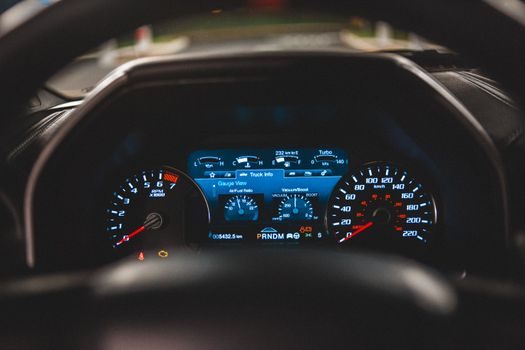
Future Market Insights sizes the automotive HUD market at USD 1.9 billion in 2025 and projects USD 2.2 billion in 2026, with a 17.2% CAGR carrying it to USD 10.8 billion by 2036 [S2]. The same briefing flags a functional shift away from single-function speed readouts toward AR overlays of dynamic lane-keep and collision guidance, which raises the optical-combiner and image-generation-unit bar for Tier-1 suppliers. For display-panel makers, the HUD category competes with HMI panel volume for the same LCD/OLED backplane capacity, but with a much tighter eye-box, luminance, and solar-load specification envelope — a different process line, not just a different bezel. Cockpit digitalization is the second-order driver, meaning the HUD is no longer an option bolted to an instrument cluster but a primary HMI surface whose failure mode is safety-critical rather than convenience-critical.
Transparent Display Market: Transportation, Healthcare and Media-Entertainment Anchor Demand
Allied Market Research's 2026 transparent display taxonomy segments demand by offering (hardware, software, services) and by end-user, with transportation and logistics, healthcare, and media entertainment named as the leading verticals alongside insurance and fleet/vehicle tracking applications [S4]. Transparent panels are not a drop-in replacement for standard LCD/OLED in the HMI panel ecosystem — the see-through optical stack constrains backlight uniformity, touch sensor placement, and pixel density — so procurement should treat them as a parallel spec track with its own vendor list rather than a substitute line on the same RFQ. For building-façade and retail-window installations, the relevant comparison is against conventional high-brightness LCD and LED fine-pitch, not against a general-purpose industrial display panel.
Selection Criteria: Four Gates Across LED, HMI, HUD and Transparent Categories
Across the four panel families visible in 2026 sourcing data, four decision gates separate a defensible spec from a price-only buy. First, pixel pitch and viewing distance for emissive displays — P1.95 fine-pitch is only the right answer if the minimum viewing distance is roughly 1.95 m or greater, otherwise COB or smaller-pitch panels enter the comparison. Third, optical combiner and luminance for automotive HUD — the USD 2.2B 2026 market is driven by AR overlay functionality that requires higher nits, larger eye-box, and ghost-image control than a 2018-vintage combiner HUD [S2]. Fourth, transparency ratio and backlight strategy for transparent displays — the hardware tier dominates the BOM, and the 2026 segmentation makes the offering line (hardware vs software vs services) a separate RFQ from the end-user application line [S4].
Limitations and Failure Modes Buyers Should Price In
Three failure modes recur across these categories. LED fine-pitch at P1.95 suffers pixel-level failure and color-shift drift over thousands of hours; specifiers should require dead-pixel guarantees and a multi-year spare-module commitment, not just an initial unit price [S1]. Resistive-touch IP65 panels lose touch accuracy as the top PET layer wears, and the USD 248-285 band quoted by Panelmate does not bundle a touch-calibration or replacement-film service [S3]. Automotive HUD units that overlay lane-keep and collision guidance must meet driver-distraction regulations; sourcing on display spec alone, without the optical and human-factors validation data, leaves the Tier-1 integrator carrying the compliance risk [S2]. Transparent display hardware tiers typically have lower native contrast than opaque LCDs of equivalent backplane generation, so daylight-readable installations need to be specified against measured nits under solar load, not the headline transparency percentage [S4].
The trading-channel snapshot will refresh on the next Made-in-China index pass, the next Future Market Insights HUD update, and the next Allied Market Research transparent-display revision — three trackable signals that will move the USD/m², USD 248-285, and end-user segmentation numbers quoted above.
For component-level specifications, see alc panel.