
An Industrial PC (IPC) and a Programmable Logic Controller (PLC) are both listed as "edge controllers" on the 2024 Xilinx industrial-I/O overview, yet they sit on opposite ends of the determinism-versus-flexibility trade-off [S1]. The same source labels them as programmable automation controllers (PACs) "today," meaning vendors have blurred the line with hybrid firmware, but the underlying hardware split — ruggedized x86 versus deterministic scan-engine — has not gone away [S1].
Historical context matters because the PLC was created in the late 1960s inside the U.S. automotive industry to replace relay-logic panels, and its scan architecture (input read → program execute → output write, typically 1–20 ms per cycle) was engineered for that exact job [S6]. An industrial PC is a fanless or short-form-factor x86 computer rated for 0–55 °C cabinet operation with vibration-resistant SSD storage; a PLC is a cyclic-scan device with deterministic cycle time and integrated digital/analog I/O terminals. The two meet in mid-range PAC hardware, but the procurement decision still has to be made on five criteria: determinism, I/O density, programming model, environmental rating, and lifecycle.
Architecture and Operating Principle
PLC scan cycle: input sampling → program execution (ladder, function-block, structured text per IEC 61131-3) → output update, repeated deterministically; cycle time is the binding spec, with 1 ms achievable on mid-range CPUs and 10–20 ms on small-frame units [S3][S4]. The control program lives in non-volatile memory and the OS (if any) is a thin real-time kernel or bare firmware; there is no general-purpose multitasking environment visible to the user.
Industrial PC architecture: an x86 SoC (Intel Celeron, Atom, Core i-series, or AMD Ryzen Embedded) running a full OS — Windows IoT, Linux RT-patched, or a containerised control runtime such as CODESYS Control — over a deterministic industrial Ethernet stack (PROFINET, EtherCAT, EtherNet/IP, OPC UA) [S1]. The control task runs as one of many processes, scheduled by the OS, which is why scan jitter on an IPC is fundamentally higher than on a PLC with a dedicated scan engine.
Selection Criteria: Where Each Wins
Choose a PLC when the task is hard real-time discrete or process control: cycle time must be bounded, I/O count is high (32, 64, 256+ points on a single backplane), the application is safety-rated (SIL 2/3), and the cabinet will see wide temperature swings with no conditioned air. PLC firmware boots in under 5 seconds and recovers from power loss without OS disk checks, which is critical for unattended pumping stations and remote well-head skids [S3][S4].
Choose an Industrial PC when the job is HMI rendering, SCADA concentration, vision inspection, edge analytics, or anything that needs a modern graphics stack, large RAM (16–64 GB), GPU/AI accelerator, or hundreds of gigabytes of data buffering. An IPC handles SQL historians, MQTT/OPC UA pub-sub, Python or C++ edge inference, and a 1080p/4K HMI panel simultaneously, which a PLC's ladder engine cannot. The trade-off is OS maintenance: Windows updates, driver version drift, and longer boot times are now part of the lifecycle plan.
Programming Model and Software Stack
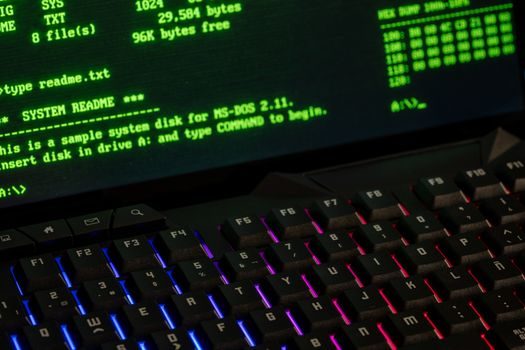
PLC programming is standardised under IEC 61131-3 with five languages: Ladder Diagram (LD), Function Block Diagram (FBD), Structured Text (ST), Instruction List (IL, deprecated), and Sequential Function Chart (SFC); programs are cyclic, with tasks split into fast (≤10 ms), normal (≤100 ms), and slow (≥1 s) classes [S3][S4]. The same code can run on a Siemens S7-1500, a Rockwell CompactLogix, or a Schneider M580 with only the I/O address map changing — that portability is the value proposition IEC 61131-3 delivers.
IPC programming uses the OS-native toolchain: C/C++, Python, .NET, CODESYS, TwinCAT, or Ignition Edge. Determinism depends on the real-time patch (PREEMPT_RT, Xenomai, or a vendor-proprietary hypervisor) and on isolating the control task from GUI and network processes. Without these, scan jitter on an x86 platform will land in the 50–500 µs range at best, an order of magnitude above a PLC's [S1].
Comparison Matrix: PLC vs IPC vs PAC Hybrid
On a four-criterion spec cut, the three families line up as follows: (a) Determinism: PLC highest (≤1 ms cycle, ≤10 µs jitter on high-end), PAC hybrid good (1–10 ms cycle, depends on RT kernel), IPC lowest (10–100 ms typical, 50–500 µs jitter); (b) I/O density and fieldbus: PLC and PAC both support PROFINET, EtherCAT, EtherNet/IP natively with hard-real-time drivers, while IPC needs a soft-PLC runtime or dedicated fieldbus card to match; (c) Environmental rating: PLC typically −20 °C to +60 °C with conformal coating, IPC 0 °C to +55 °C unless specified to wider; (d) Data handling: IPC leads with 16–64 GB RAM, SSD, and on-board GPU, PAC mid-range with 4–8 GB, PLC trailing with fixed-function firmware and limited buffering. [S1]
The PAC hybrid is the third option and the one to evaluate when a single machine needs both: a high-speed deterministic axis plus 4K HMI plus SQL/OPC UA gateway in one chassis. Xilinx's own 2024 industrial overview positions PACs at the convergence point, where the controller runs Linux or a real-time OS on SoC (Zynq Ultrascale+, Versal) with both PLC-style scan logic and Linux application space side by side [S1].
Failure Modes and Lifecycle Constraints
PLC failure modes centre on I/O module degradation (relay contact wear at 100 mA to 2 A inductive loads), backplane connector oxidation, and battery-backed RAM loss on PLCs older than 10 years. Mean time between failures on mid-range PLC CPUs sits around 300,000 hours, and spare-part availability from major vendors runs 10–15 years post-discontinuation, which is a deliberate lifecycle commitment for plants running 20-year depreciation cycles [S3].
IPC failure modes are storage and thermal: consumer-grade SSDs fail under sustained write at 60–70 °C, electrolytic capacitors dry out, and fan clogging triggers thermal throttling before shutdown. A specifier should require industrial-grade SSDs (1 DWPD minimum for 5 years), wide-temp components (−40 °C to +85 °C rated), and either fanless conduction cooling or dual-ball-bearing fans with monitoring. The upside is that an IPC can be repaired with off-the-shelf parts — a replacement SSD or DIMM costs under USD 200, versus a vendor-locked I/O module at USD 400–1,500.
Standards, Sourcing, and 2026 Selection Signals
Procurement language should cite IEC 61131-3 for the PLC programming model, IEC 61784 for fieldbus conformance, and IEC 60068 for environmental testing; for safety logic, the standard ladder is IEC 61508 SIL 2/3 with IEC 61511 for process-industry implementation, but the specific clause selected must match the supplier's certification, not a generic reference. A specifier should request the supplier's SIL certificate number, the exact IEC 60068 test profile (vibration, shock, temperature), and the firmware lifecycle commitment in writing. [S2]
Two trackable signals for 2026 procurement: (1) the continued migration of mid-range PLCs onto ARM Cortex-A and x86 hybrid SoCs, blurring the line into PAC territory, and (2) the rise of containerised control runtimes (CODESYS Control as a Docker image, TwinCAT running on Linux RT) that let an IPC host PLC logic side by side with AI inference on the same silicon. The PLC is not going away — relay-replacement is still its core job — but the "edge controller" label that Xilinx put on both classes in 2024 [S1] is increasingly accurate. For a deeper dive on the safety-rated variant of the same family, the spec cut in Programmable Logic Controller vs Safety PLC: Spec Cut for Specifiers pairs naturally, and the broader procurement checklist in Programmable Logic Controller Buying Guide 2026: Form-Factor, Protocol and Safety Spec covers the standalone-PLC case from a different angle.
For component-level specifications, see industrial adhesive.