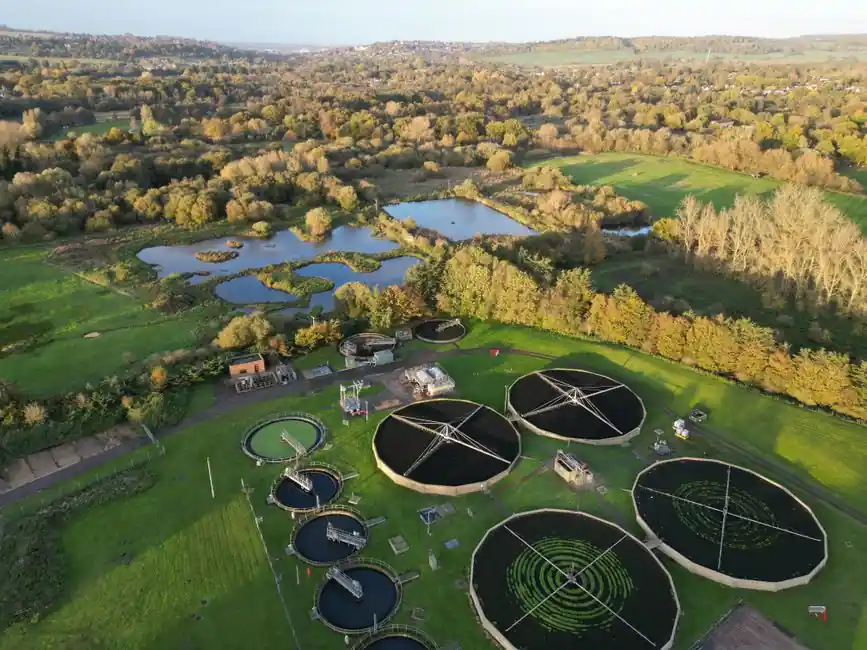
Wastewater aeration tanks demand a dissolved oxygen meter that carries IP68 submersion protection for the probe, an ATEX or IECEx certificate when the sensor is dropped into a Zone 1 aeration basin, and a calibration certificate traceable to a national standards body before the asset can be released to operations [S1].
Process engineers in municipal works typically specify optical (luminescent) membrane sensors rather than polarographic cells for the aeration basin, because optical probes do not consume oxygen during measurement, do not require a flowing electrolyte, and tolerate the long idle periods seen in SBR and MBR duty cycles [S1].
Scope: What the Checklist Covers and What It Does Not
The checklist applies to the measurement chain on a wastewater treatment plant: the sensing membrane, the body of the probe, the transmitter head, the cable gland, the cable itself, and the controller or SCADA card that receives the 4-20 mA plus HART signal [S1]. It is not a checklist for laboratory benchtop oxygen meters, which are governed by GLP and analytical instrument rules rather than by plant safety marks.
A municipal activated-sludge train almost always installs the probe in a basin that is classified as a hazardous area only when the mixed liquor volatile organic fraction or methane release from the surface can produce a flammable atmosphere, and many designers treat the aeration tank as unclassified and rely on the dissolved oxygen meter manufacturer's IP and EMC declarations alone [S1]. Where biogas collection lines, sludge digesters, or covered anaerobic zones are involved, the same probe may need a different mark for that section of the plant.
Ingress Protection: IP68 for the Probe, IP66 for the Head
For an immersion probe hanging on a swing-arm frame in an aeration basin, the practical baseline is IP68 at a rated submersion depth that the manufacturer prints on the data sheet, typically 5 m to 10 m of water column for at least 7 days, and the certification body must be a member of the IECEE scheme so that the IP code appears as a tested value, not a marketing claim [S1]. A transmitter head mounted on a handrail above the waterline usually only needs IP66 plus NEMA 4X equivalence for hose-down cleaning, and pairing a submersible-rated probe with a splash-rated head is the most common configuration seen on WWTP P&IDs [S1].
The cable entry is the weak link in most field failures, so specify a factory-moulded cable with the gland potted at the probe end, and require the vendor to supply the IEC 60529 test report alongside the shipping documents, not buried in a generic datasheet PDF. Where the cable runs through a conduit shared with the 480 V blower power feeders, the dissolved oxygen signal cable must be shielded and the shield grounded at the controller end only, with the probe end left floating, to keep the common-mode voltage from the VFD-driven blowers out of the low-level mV input stage.
Hazardous-Area Certification: ATEX vs IECEx vs UL Class I Div 1

If the aeration tank or the surrounding headspace falls inside a Zone 1 area, the probe and transmitter must carry Ex ia or Ex db marking tied to the gas group of the biogas, which is typically Group IIB or IIB plus H2 depending on the upstream digester composition, and the certificate number must be visible on the nameplate so the plant EHS auditor can verify it without opening the housing [S1]. The ATEX 2014/34/EU certificate covers EU installations, while projects in the Middle East, Africa, and most of Asia accept IECEx, and North American plants still rely on UL or CSA Class I Division 1 or the newer Class I Zone 1 marks [S1].
For a treatment plant with a North American utility customer, the most efficient procurement is a single probe model that carries an ATEX plus IECEx dual mark plus a UL or cUL mark, because the same probe then ships to any of the three jurisdictions without a recertification project. The certificate scope must explicitly include the dissolved oxygen application, because some Ex certificates cover only the housing and not the electrochemical or optical sensing element, and the auditor will reject a probe whose certificate scope is silent on the sensing function.
Metrology and Calibration: Traceable to Air-Saturated Water or N2-Purged Zero
Each probe ships with a factory calibration certificate showing the slope in nA per ppm or in partial-pressure units, and the wastewater plant QA file expects the certificate to be traceable to a national metrology institute such as NIST, NPL, PTB, or NMIM, with the certificate number, the standards used for the calibration bath, and the date of the last adjustment [S1]. Most optical dissolved oxygen probes use a two-point calibration in air-saturated water and in nitrogen-purged water, and the certificate must show both points plus the calculated zero and saturation current values rather than a single factory default.
For aeration basin control the usable range is typically 0 to 20 mg/L or 0 to 200 percent saturation, with a stated accuracy in the 0.05 to 0.2 mg/L band at 25 °C, and the probe should report a temperature-compensated value, since the saturation concentration of dissolved oxygen falls from 8.26 mg/L at 25 °C to 6.41 mg/L at 40 °C and an uncompensated reading will over-control the blower at summer mixed-liquor temperatures [S1]. Engineers writing the datasheet query should always request the salinity correction factor, because saline industrial effluents depress the saturation point and a probe calibrated on tap water will read high on brine-bearing influent.
Materials of Construction and Membrane Lifecycle
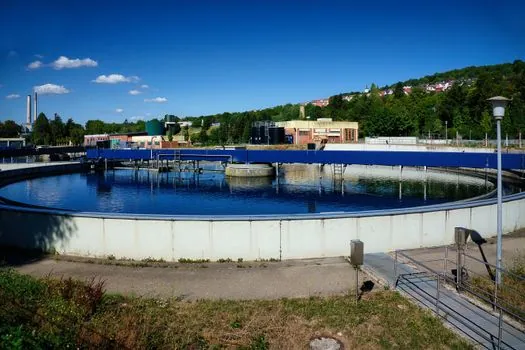
Optical sensor caps carry a fluorescent layer bonded to a glass or polymer substrate, and the cap replacement interval is normally 12 to 24 months in clean municipal service, dropping to 6 to 12 months in a plant with high grease or fibre loading, while a polarographic membrane cap is typically 3 to 6 months because the membrane and electrolyte deplete together [S1]. The probe body should be PVC, PVDF, or 316L stainless steel depending on the chemical exposure: PVDF survives the 2 to 5 percent sodium hypochlorite cleaning solution that operators use for in-situ wipe-downs, while 316L is preferred where the swing-arm frame is also stainless and operators want matched thermal expansion.
A common failure pattern in WWTP service is biofilm fouling on the sensing surface, which can drift the reading by 0.5 to 2 mg/L within 2 to 4 weeks of installation, so the procurement spec should require either an air-blast or brush-cleaning accessory, or a probe model with a self-cleaning wiper, and the cleaning interval must be entered into the SCADA maintenance schedule from day one. The dissolved oxygen meter page covers the underlying sensor families in more detail.
Electrical Integration: 4-20 mA, HART, and SCADA Hand-Off
The standard process signal is 4-20 mA with HART 7 superimposed, which lets a technician in the field use a 375 or 475 communicator to view the calibration, the membrane age, and the diagnostics while the SCADA continues to see the analog value, and this is the configuration most WWTP DCS upgrades now specify [S1].
Where a plant has standardized on oxygen detector loop-powered devices for the same panel footprint, the dissolved oxygen probe and the ambient oxygen detector can share the same 24 VDC power supply and the same spare I/O template, but the dissolved oxygen probe draws more current during the luminescence excitation pulse, so the loop load calculation must be redone rather than copied across. The dissolved oxygen probe should also be bonded to the same plant ground ring as the blowers, with the shield grounded at the panel end as noted in the cable section, to keep the reading stable when the VFDs ramp the aeration duty up and down.
Audit-Ready Documentation Bundle

The audit bundle that satisfies a plant EHS plus QA review contains seven items: the purchase order, the vendor data sheet, the IP68 test report, the Ex certificate plus its schedule of limitations, the metrology calibration certificate, the material declaration for wetted parts, and a signed loop-check sheet showing the mA reading at 0 percent and 100 percent saturation [S1]. Each certificate must show its issuing body, certificate number, scope of equipment covered, and the date of issue plus the expiry or recommended recertification date, because an auditor will reject a certificate that has no scope text on it.
For multi-site utility customers, the most cost-effective move is to pre-qualify two probe models from two different vendors and run them side-by-side on a swing-arm frame for 60 to 90 days before the second unit is procured in volume, and the parallel test lets the plant compare membrane life, drift, and cleaning interval in real mixed liquor rather than in a vendor demo tank. Where a probe carries the safety certification marks listed above, the engineering team can write a one-line entry in the P&ID legend instead of a full safety dossier.
Verify the certificate on the issuing body's online register before the PO is released, and check that the certificate status is "current" rather than "suspended" or "withdrawn" because dissolved oxygen probes that ship on an old certificate continue to be sold for years after a manufacturer has had a scope reduction. A practical verification step on the next quarter's PO is to ask the vendor to email the live certificate PDF with the registrar's URL printed in the footer, so the trace is paperless and survives an electronic audit.
Background reading: Gantry Crane Selection for Pipeline Construction: Span, Capacity, Mobility.