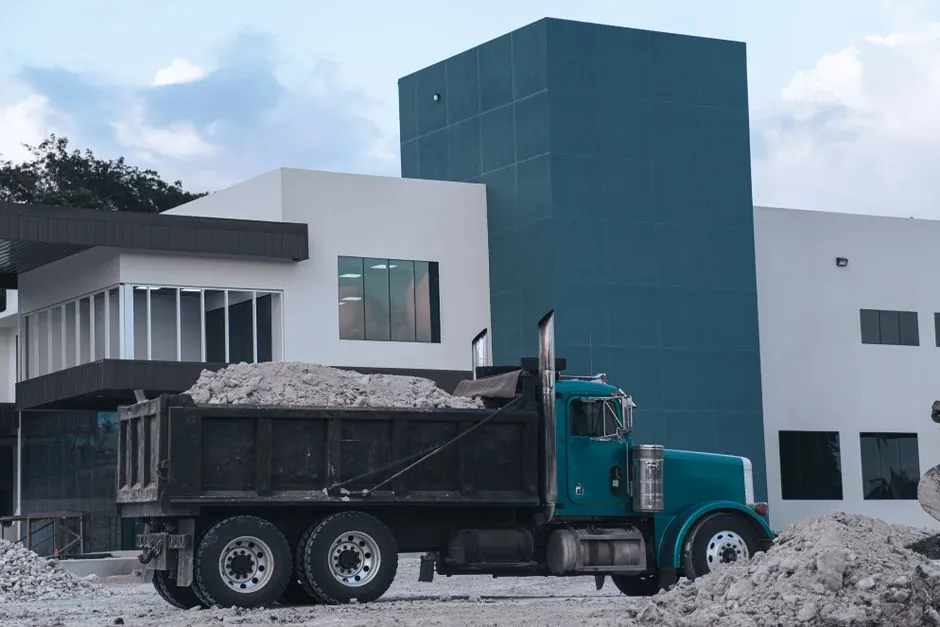
A dosing pump and a concrete pump truck solve opposite fluid-handling problems: one meters reagent-grade chemicals in millilitres per stroke against low back-pressure, the other transfers viscous, aggregate-laden concrete at hundreds of atmospheres through steel pipelines [S4].
Specifiers who blur the two classes risk pump body erosion, seal failure, or simply the wrong machine on site. The two product families share a hydraulic double-piston architecture [S2], but every other design parameter diverges: flow rate, pressure rating, wetted materials, hose class, and operator skill.
Duty Cycle, Flow, and Pressure: Orders of Magnitude Apart
Concrete piston pumps routinely generate hundreds of atmospheres of hydraulic pressure to push heterogeneous mixes containing hard-rock aggregate through delivery lines, with double-piston units running in a two-stroke mode under closed-loop hydraulic control [S4]. A ground line pump can push concrete up to 150 m vertically and beyond 1000 m horizontally along extended pipelines [S2].
Dosing pumps, by contrast, operate at the opposite end of the curve: low flow, high accuracy, low pressure, intended for injecting chemicals into a process stream rather than displacing slurries. The pressure gap, the viscosity gap, and the solids-handling gap make a direct comparison meaningful only as a sanity check, not a substitution guide.
Wetted Materials and Build: Abrasive Slurry vs. Corrosive Reagent
Concrete pump designers must cope with a fluid that is heavy, viscous, abrasive, and contains pieces of hard rock that solidify if motion stops [S4]. That is why hard-faced wear plates, S-valves, and large-bore concrete cylinders dominate the bill of materials, and why line-pump hoses are limited by aggregate size: line pumps handle 3/4 inch rock, while grout pumps are restricted to 3/8 inch or pea-gravel aggregate [S4].
Dosing pump wetted ends are selected for chemical compatibility (PP, PVDF, stainless) rather than abrasion resistance, and diaphragm or plunger geometries are tuned for stroke-to-stroke repeatability, not bulk throughput. Specifying a concrete-pump wear plate in a chemical skid, or a dosing-pump head on a concrete line, fails on the first cycle.
Reach, Placement, and On-Site Geometry
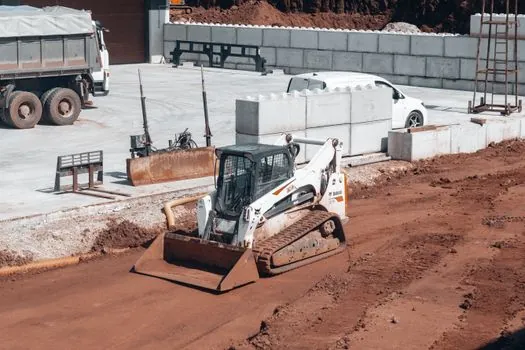
Concrete placement is a 3D geometry problem. Boom pumps add a multi-section articulating arm with a 365° rotating turret, where the first boom swings 2° to 90°, the second and third at 180°, and the fourth up to 240° [S2]. The CIFA K42L and K56L boom concrete pumps in active fleets deliver roughly 180 m3/h with automatic fold/unfold sequences [S1].
Line pumps stay on the ground and earn their keep on residential foundations, sidewalks, driveways, and swimming pools, where delivery pipes and flexible hoses are extended by hand to reach tight spots [S1]. A dosing pump has no reach problem at all: it sits next to the injection point and pushes reagent through a short tube.
Choosing the Right Class: Decision Matrix in One Pass
Use this four-criterion check before opening a quotation request:
1) Fluid handled. Concrete pump trucks move aggregate slurry up to 3/4 inch rock; dosing pumps handle reagent liquids only. Mismatched media destroys one machine or the other on day one [S4].
2) Output class. Boom concrete pumps such as the K42L/K56L are sized around 180 m3/h; line pumps cover the smaller residential and slab-pour range; dosing pumps typically run in the litre-per-hour band [S1].
3) Pressure and reach. Concrete pumps push hundreds of atmospheres through hundreds of metres of pipeline [S4]; dosing pumps work at low back-pressure across centimetres to a few metres.
4) Mobility. A truck-mounted concrete pump integrates boom, hopper, outriggers, and diesel drive on a single chassis for one-spot pours [S3]; a dosing pump is a skid- or wall-mounted instrument.
Use Cases and Fleet Logic

Concrete pump trucks are the right call for high-rise buildings, bridges, large industrial complexes, and any pour where the mixer truck cannot drive within hose range of the formwork [S1]. For road and infrastructure pours, the truck-mounted selection logic is dominated by reach, output, and mix fit, a topic covered in detail for road-construction applications and for mining-duty pumping where the wear budget dominates.
Dosing pumps belong in water treatment, chemical processing, and any closed loop where reagent injection accuracy, not bulk placement, is the deliverable. For underground concrete work where boom reach is constrained by headroom, the low-headroom truck-mounted selection map is the more relevant reference.
Limitations, Failure Modes, and Operator Overlap
Concrete pumps clog when aggregate size exceeds the hose class, when the mix sits idle in the hopper, or when delivery lines are not cleaned after the pour, especially in cold weather or with thick mixes [S1]. Boom pumps add stability constraints: outriggers must deploy before any lift, and the boom cannot be slewed into a 365° envelope without clearance [S2].
Dosing pumps fail differently: diaphragm rupture from chemical attack, air binding on the suction side, or stroke-length drift. The two failure catalogues share almost nothing, which is exactly why the two product lines are stocked by different distributors, serviced by different fitters, and listed under different categories on any industrial catalog.
Bottom line for specifiers: classify the fluid first, then match the pump class. Anything that carries aggregate rock or needs to climb a boom belongs to the concrete pump truck family. Anything that meters a reagent into a process stream is a dosing pump. No manufacturer publishes a cross-over model, because the design constraints genuinely do not overlap. Track signal: next time a quotation request asks for a "high-pressure chemical pump that also pours concrete," treat it as a scope error to be corrected before pricing.
The underlying component specifications are covered under concrete mixer truck.