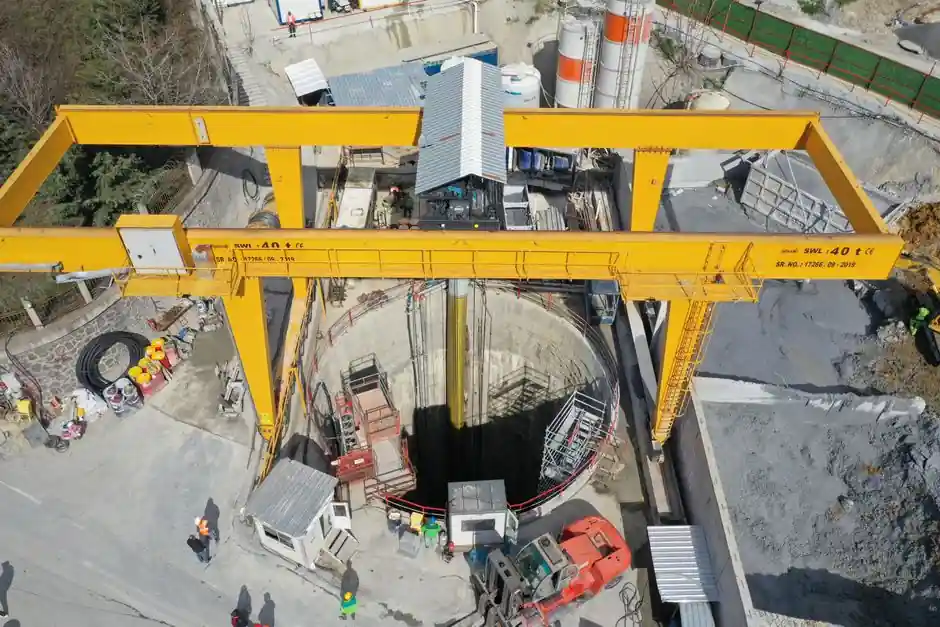
Gantry cranes are explicitly listed in OSHA 29 CFR 1926 Subpart CC (Cranes and Derricks in Construction) as covered equipment when used in construction, with telescopic/hydraulic gantry systems and stacker cranes carved out as exemptions [S1]. On a demolition project that is not a purpose-built teardown yard with permanent runway steel, the self-supported A-frame leg is what unlocks the spec, because the gantry carries its own load path to grade rather than into a structure that may be partially removed [S4].
The demolition load profile is unusual: maximum single-piece weight is usually a known number (a motor, a roll, a generator stator, a precast panel), but the load envelope shifts weekly as the structure comes down, which is why stationary rail-mounted and rubber-tired gantries are specified instead of fixed overhead bridge cranes [S2][S4]. For indoor industrial strip-outs where the building itself is being demolished around the work zone, a gantry on embedded rails or a movable hydraulic gantry is often the only crane that can stay in service as walls and roof steel are removed [S2].
OSHA applicability: which gantry actually triggers Subpart CC
OSHA 29 CFR 1926 Subpart CC applies to power-operated equipment that can hoist, lower, and horizontally move a suspended load when used in construction, and the standard text names "overhead and gantry cranes" plus "portal cranes" as covered equipment, while explicitly excluding "telescopic/hydraulic gantry systems" and "stacker cranes" [S1]. The exclusion is significant on demolition projects: a hydraulic gantry used to skid a 200-ton transformer out of a substation is not a Subpart CC crane, but a rubber-tired gantry with an electric hoist handling steel scrap is. Operators and riggers on the covered units need the qualification, inspection, and ground-condition requirements of Subpart CC; the excluded hydraulic systems fall under the general crane/equipment rule and the manufacturer's operating envelope [S1].
The same Subpart CC carve-out also excludes attachments used for material delivery (knuckle-boom truck cranes transferring material without arranging in a particular sequence for hoisting) and excludes converted excavators, wheel loaders, and backhoes even when rigged with chains and slings [S1]. On a demolition site this is the most common compliance error: an excavator with a chain hooked to a beam is treated as a crane by the crew but is not in OSHA's scope, which leaves a gap that site safety plans must close with their own rigging and lift-plan procedures. Where a gantry is in use, the operator's qualification, the pre-lift inspection, and the ground-bearing check all flow from Subpart CC's core requirements [S1].
Capacity sizing: pick above the heaviest single component, not the average
Gantry capacity is the maximum weight the structure is designed to lift and handle safely, set by structural integrity, component strength, and load-bearing capability, and the selected capacity must exceed the heaviest expected load to prevent overloading [S3]. On demolition work the conservative rule is to size the gantry to the heaviest single piece you will ever pick, not the daily mean, because overload events on teardown jobs are concentrated on the one-off lifts (boiler, generator rotor, pressure vessel head, large precast panel) and those are the events that drive structural damage to the crane [S3].
The 5-ton vs 10-ton comparison illustrates the operating logic: a 5-ton unit is the right match for repetitive lighter picks, lower utilization, and tighter indoor footprints, while a 10-ton unit handles substantial heavy, bulky loads and is the workhorse of heavy industrial applications [S3]. For demolition, the frequency question reverses from a manufacturing cell: you are not running a 10-ton unit at 60% utilization, you are running it at 10% utilization for 90% of the lifts and 100% for the critical few, which is why most demolition contractors carry the next size up rather than the next size down. Capacity is not the only gate, but it is the first one, because an under-spec'd gantry cannot be re-rated in the field.
Site fit: span, leg geometry, and travel

A gantry crane is a type of overhead crane with supporting legs or wheels that run along ground tracks or rails, and unlike a fixed overhead crane it provides flexibility and mobility for areas where a fixed crane is impractical, including outdoor worksites, warehouses, manufacturing facilities, and machine shops [S2]. For construction sites, shipyards, and open yards, a gantry crane system is the better fit than an overhead bridge crane because it needs no building structure, sets up fast, and is portable or fixed to the floor [S4]. That portability is the decisive advantage on demolition: the runway can be relaid as the work face moves, or a rubber-tired unit can drive between bays [S2][S4].
Cantilever and semi-gantry variants address the geometric problem of partial-height obstructions. A cantilever gantry crane has the main girder extending beyond the crane runway on one or both sides, which lets the hook reach over a wall stub, a stub of remaining slab, or the edge of a demolition pit that a standard gantry cannot straddle [S8]. A semi-gantry carries one leg on an elevated building rail and one leg on the floor, and is the right answer when one side of the building's structural steel is still intact and rated for the leg load but the other side is gone or unsafe to load [S9]. For demolition of multi-storey industrial buildings, specifying a semi-gantry with the building leg on a temporary outrigger beam is a common way to keep full gantry span and lift height without committing to a full new runway [S9].
Gantry vs crawler vs tower: which crane actually wins demolition
The most common types of cranes used in demolition work are crawler, tower, and telescopic cranes, and each of these crane types offers unique advantages depending on the project requirements [S5]. Crawler cranes are the default for outdoor structural teardown because they carry their own tracks, pick rated load at radius without outriggers on prepared pads, and free the operator to slew through 360 degrees for material sorting. Tower cranes dominate high-rise demolition where the machine is anchored to the structure being taken down and lifts debris down through the building footprint rather than over a neighboring property line. Telescopic mobile cranes fill the role of one-off heavy picks (HVAC, generators, structural steel) where the radius and lift height are fixed at the time of bid.
Gantry cranes enter this picture in three specific demolition niches, and trying to use them outside these niches is the most common spec error. The first niche is indoor industrial strip-out, where a rail-mounted gantry rides on a runway that is part of the existing building and survives the demolition, so the crane continues to work as walls and mezzanines are removed [S2]. The second is salvage yard and scrap-handling operations, where a rubber-tired gantry (RTG) or rail-mounted gantry (RMG) moves scrap to and from processing bays and is the same equipment used in container ports but on a smaller scale [S2]. The third niche is modular bridge and segmental demolition, where a launching gantry straddles the existing bridge and lifts segments out in reverse of the erection sequence, a direct mirror of the launching gantry's role in bridge construction. For a side-by-side comparison against the other demolition crane types, gantries win on the no-building-required criterion and on setup speed, lose on the pick-and-swing cycle time that a crawler or telescopic crane delivers, and are roughly comparable to a tower crane on vertical reach only when the gantry is built with a high-leg A-frame [S4][S5].
Selection criteria ranked: capacity, span, duty class, mobility, certification

Five criteria decide a demolition gantry spec, and they should be applied in this order. (1) Capacity above the heaviest single component, with a safety margin for shock loads and dynamic effects from pendulum swings on a long hook [S3]. (2) Span and lift height, set by the building bay width and the tallest piece to clear, with cantilever extension added if the hook must reach over a wall stub [S8]. (3) Duty class per CMAA or FEM classification, where demolition typically maps to Class D or higher because of frequent full-capacity picks and outdoor exposure, not the lighter Class C warehouse profile. (4) Mobility, with three options (fixed on embedded rails, rail-mounted for repositioning along a runway, or rubber-tired for true roadability) selected by site access and work-face travel distance [S2][S4]. (5) Certification fit, meaning whether the unit is in OSHA 29 CFR 1926 Subpart CC scope (overhead and gantry cranes, portal cranes) or is a Subpart CC exemption (telescopic/hydraulic gantry, stacker crane), because the answer drives operator qualification, inspection, and ground-condition requirements [S1].
Specifying a gantry crane for demolition also means checking the ground-bearing pressure the A-frame legs will impose on the slab or subgrade, because demolished slabs often have unknown voids, and a gantry's leg load is concentrated compared to a crawler's distributed track pressure. The crane spec sheet typically lists maximum wheel load and outrigger pad size, and the demolition contractor should match that to a ground-bearing survey rather than assume the existing floor is rated for the new point loads. For comparison work, the overhead bridge crane selection for mining spec map shows the same capacity-and-duty-class framework applied to a different duty cycle, and the tank container specs for demolition sites reference pairs with gantry selection when the lifted item is a process vessel rather than a structural member.
Common spec errors and failure modes
Three spec errors recur on demolition gantry projects. The first is treating the gantry like an overhead bridge crane and assuming the building will take the leg reaction; the second is using an indoor-rated duty class on an outdoor demolition site without checking wind load on the girder and the lifted load; the third is failing to confirm whether the chosen configuration is a Subpart CC gantry (covered) or a telescopic/hydraulic gantry system (excluded), which changes the operator qualification and inspection regime on day one [S1]. Demolition gantries are also subject to dust and debris ingress on the trolley rails and hoist gearing, so the spec should call for enclosed gearboxes and sealed bearings rather than the open gearing typical of indoor warehouse units.
A fourth and increasingly common error is specifying a fixed gantry on a long embedded rail where a mobile crane would deliver a faster pick-and-swing cycle, or specifying a crawler crane where the work face is inside a building that cannot accept the ground pressure. The decision rule is straightforward: if the runway is longer than 3 to 4 times the work-zone width and the same picks repeat along that length, a rail-mounted gantry is the economic answer; if the picks are spread out and one-off, a mobile or crawler crane is. A crane scale integrated into the hoist is also worth specifying on demolition work, where the load weight is rarely known with certainty on a salvaged part and overload protection is the cheapest insurance on the project.
Trackable signals for the next 6 months
Two signals will move the demolition gantry spec conversation by Q1 2027. First, OSHA's enforcement emphasis on Subpart CC ground-condition and operator-qualification requirements continues to tighten on construction sites, and any 2026 citation pattern that names gantry operations specifically will reshape how demolition contractors document ground-bearing and rigger training [S1]. Second, OEM rollout of higher-capacity rubber-tired gantries in the 40 to 80 ton range, an emerging response to indoor plant strip-out work where crawler cranes cannot enter, will expand the addressable demolition niche for self-supported cranes; watch for new product launches from major crane OEMs in the September 2026 to February 2027 window for confirmation.