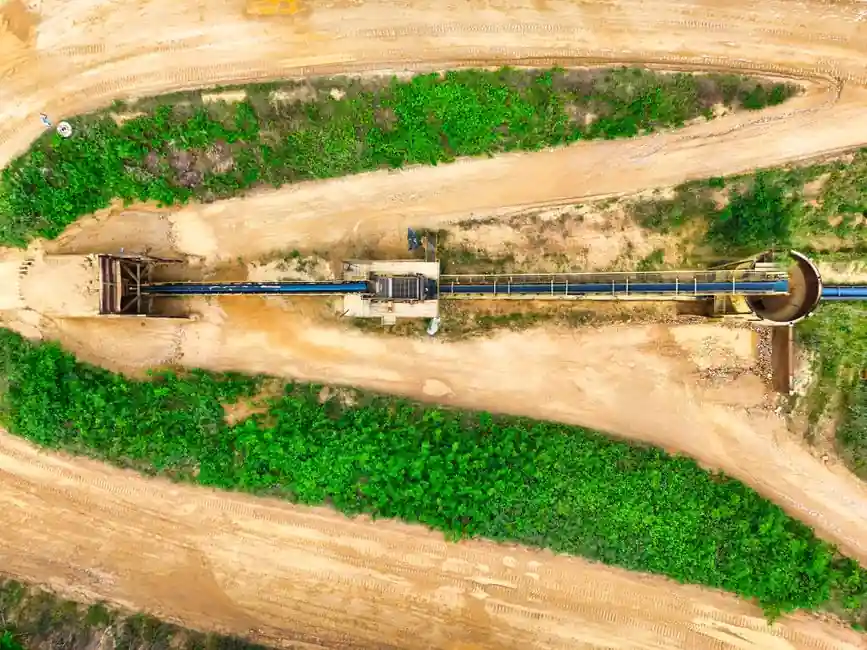
A truck-mounted concrete pump is a high-pressure pumping system on a heavy-duty chassis, and within mining it sits inside a roughly 20% "specialized usage" slice of the global market that Strategic Market Research models at USD 4.7B in 2024 growing at a 6.1% CAGR toward USD 6.70B by 2030 [S5][S1]. That sub-vertical covers tunneling, shaft lining, and shotcrete support, all of which need a truck-mounted concrete pump that can survive haul-road cycle times and uneven bench faces.
Selection in this space is rarely about headline boom length. It is about matching three independent variables: vertical reach into the open pit or decline, peak output in cubic meters per hour, and chassis plus component rating for abrasive aggregate and elevated dust. Liebherr truck pumps span 77.8 to 161.1 feet (23.7 to 49.1 m) of vertical reach, with cost on truck-mounted configurations from about USD 375,000 to over USD 1,000,000, while trailer-mounted line pumps run USD 90,000 to USD 175,000 [S4].
What a Mining-Rated Pump Actually Is
Specialized mining pumps are not just a boom-pump truck with a longer arm. They are engineered for the aggregate size, slump loss, and placement geometry of mine backfill, shotcrete, and tunnel linings, which is why they break out of the general construction segment and form a discrete 20% niche [S1].
For open-pit bench faces and portal works, a standard BSF-class boom pump (24m to 47m reach, with the BSF 36-4 rated at 108 m³/hr) is usually sufficient, especially where the truck can be spotted on a prepared bench [S2]. Underground and high-volume backfill jobs, however, often use trailer or stationary configurations because the carrier truck cannot physically reach the face, and a separate pipeline is laid through the decline. Liebherr stationary pumps handle 100 to 200 cubic yards per hour (76.5 to 152.9 m³/hr) and weigh 11,464 to 12,897 lb (5,200 to 5,850 kg), making them the throughput choice when reach is secondary [S4].
Output and Reach: The Two Numbers That Decide
Output and reach are the two specs that gate every other decision. Output is set by the pump cell (open or closed hydraulic circuit, cylinder bore, and stroke), and reach is set by the boom geometry, typically 4-section Z-fold on smaller units like the BSF 27-4 and BSF 33-4, scaling to 5- and 6-section folds on the BSF 47-5, BSF 51-5, BSF 56-5, and BSF 60-6 [S2].
A quick comparison for mine buyers weighing options:
Truck-mounted boom pump: 24 to 47m reach, output up to 108 m³/hr on the BSF 36-4, mobility is its main asset, suited to portal pads, bench-face support, and remote-controlled placement on prepared ground [S2]. Trailer / line pump: lower output, much lower cost (USD 90,000 to 175,000), suited to low- to mid-volume pours and shotcrete work, can be positioned in tight declines but lacks boom reach [S4]. Stationary pump: 76.5 to 152.9 m³/hr output, paired with pipeline through the decline or attached to a foundation rig (Liebherr crawler pumps working with a drill rig), used when boom reach is the limiting factor [S4].
For an open-pit or portal site where the truck can set up near the face, a 4-section Z-fold around 36m (BSF 36-4) is the most common balanced pick. For deeper mines or long-tunnel pours, a stationary pump plus a concrete mixer truck feed is the higher-throughput path.
Mix Compatibility and Aggregate Size
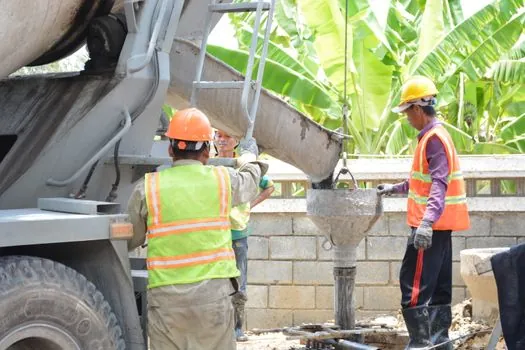
Trailer-mounted ball-valve pumps are limited to about 3/8 inch (9.5mm) pea-gravel aggregate, which makes them usable for low-volume shotcrete but a poor match for mine mixes with 20mm or 40mm aggregate [S4]. Truck-mounted boom pumps tolerate the coarser aggregate typical of mine structural concrete and shotcrete, which is one of the reasons they dominate high-volume placements in tunnels and portals.
If the project calls for abrasive aggregate, hard-rock backfill, or steel-fiber-reinforced shotcrete, confirm cylinder bore, S-tube wear ring material, and hopper grate size against the supplier data sheet before specifying. Aggregate size and pump cell geometry are the two factors that will shut a pump down on a mine site before boom reach ever comes into play.
Who a Truck-Mounted Boom Pump Is For (and Who It Is Not)
A truck-mounted boom pump fits a contractor who needs to relocate between benches or portal headings several times a day, has stable ground for outrigger setup, and needs 60 to 108 m³/hr of placement at up to 47m reach. It is the right tool for concrete-pour crews and shotcrete support teams working surface benches, crusher foundations, and portal pads. [S2]
It is not the right tool when the placement point is more than 47m above the truck pad, when the decline is too narrow or low for the carrier, or when the pour volume is small enough that a trailer pump is more economical. In those cases, a stationary pump with pipeline, a mining dump truck-sized agitator feed, or a trailer/line pump is the better fit. The Putzmeister BSF iONTRON hybrid 24m to 47m range targets underground and emission-restricted sites where diesel particulates are a concern, which is a common constraint in confined mine headings [S2].
Dynamic Loads, Boom Vibration, and Structural Margin
Boom vibration is the failure mode that ages a pump the fastest, and it is well documented in the IFAC literature for truck-mounted concrete boom pumps. The boom and pump cell behave as a coupled dynamic system, and uncontrolled vibration is what shortens boom life and stresses welds at the turntable [S3].
For mining use, that means the boom is not just a kinematic device. The number of fold sections, the mass distribution, and the pump pulsation frequency all interact. Buyers should ask the OEM for documented boom-pulsation damping or input-shaping logic rather than treating the boom as a static structure. The same dynamic loads are why mine-rated units typically use thicker steel at the knuckle joints and 5- or 6-section folds on longer reaches, to reduce the cantilever moment at full extension [S2][S3].
Chassis, Outriggers, and Site Access
Mine haul roads, benched loading areas, and underground portals impose very different load cases than a civil jobsite. Outrigger spread, axle load, and approach angle are the three numbers that decide whether a given truck can physically set up where the pour is. Multi-axle carriers for 47m and longer booms (BSF 47-5, BSF 51-5, BSF 56-5, BSF 60-6) usually require a wider prepared pad than a 24 to 33m unit [S2].
If the access road is steep, narrow, or has a tight turning radius, the practical limit is usually the 4-section Z-fold around 36m, not the longest boom in the catalog. Confirm carrier length, outrigger spread, and gross vehicle weight against the mine's traffic management plan before locking the model. Choosing a unit that is too long for the access road is a common and expensive mistake in retrofits of older open pits.
Selection Criteria at a Glance
For a mine project, the decision matrix lines up as: Reach (m), Output (m³/hr), Aggregate tolerance (mm), Carrier weight and outrigger footprint, and Emissions class (diesel vs hybrid like the BSF iONTRON) [S2][S4].
On a 0 to 47m reach, 0 to 108 m³/hr output, 20 to 40mm aggregate, multi-axle carrier, EU Stage V / US Tier 4f / hybrid diesel-electric envelope, a BSF 36-4 to BSF 47-5 is the typical middle of the market. Beyond 47m, the unit count drops, cycle times get longer, and the buyer should compare truck-mounted boom pumps against stationary pump + pipeline combinations. For a related comparison of truck-mounted equipment selection criteria, see the agricultural truck-mounted crane selection guide, which uses a similar reach, capacity, and chassis match framework.
For more on pump-versus-pump application logic, the self-priming pump vs concrete pump truck spec map breaks down when a self-priming pump is the right tool versus a boom-pump truck, and the truck-mounted crane selection for mining map covers the lifting-side cousin of this same chassis family.
Sourcing, Telematics, and Fleet Economics
Major OEMs (Putzmeister, Schwing Stetter, SANY, and Liebherr) lead the segment, with Putzmeister's truck-mounted line spanning BSF 27-4 through BSF 60-6 and the BSF iONTRON hybrid covering 24m to 47m [S2]. Buyers in price-sensitive regions also have mid-range regional options, though cycle-time data and parts support vary [S5].
Newer units ship with digital pressure monitoring, real-time performance diagnostics, and semi-autonomous boom control, which is becoming a routine ask on multi-pump mine fleets. Confirm telematics protocol (CAN, 4G telemetry API, OEM cloud) before procurement, since mine maintenance systems usually want a single fleet dashboard, not four OEM portals.
Trackable signals to watch over the next procurement cycle: OEM release notes on hybrid (diesel-electric) BSF-class units for underground-rated deployment, expansion of the SANY truck-mounted boom pump range referenced alongside the Putzmeister line, and any mine-site safety rule changes that affect outrigger setup on benched ground [S2][S5]. A working dump truck feed and pipeline sizing plan should be locked in parallel with the pump selection, because a boom-pump truck on a mine site is only as productive as the agitator trucks feeding it.