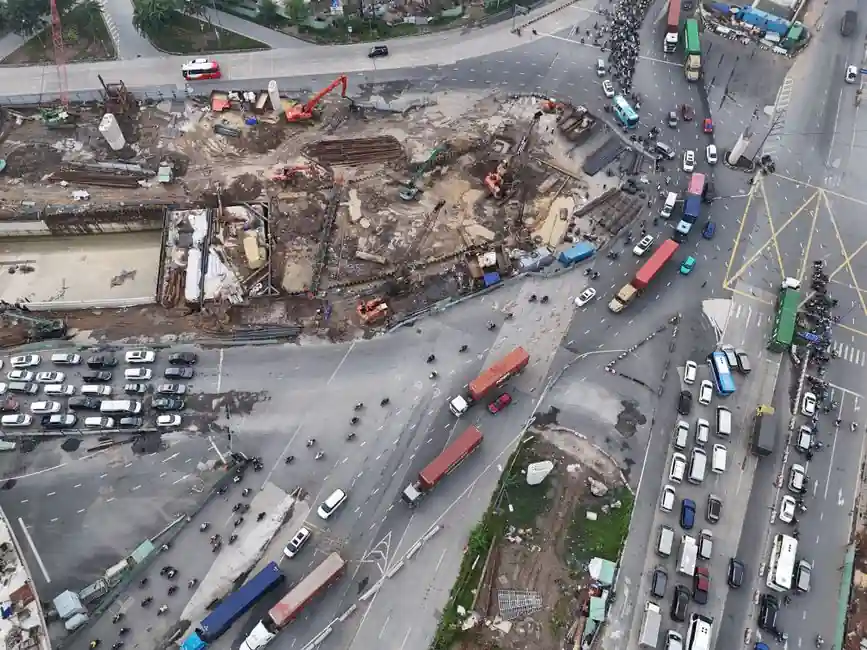
For tunnel drives, a truck-mounted concrete pump is selected first on its ability to enter a low-ceiling portal and then on boom reach, not on raw output. The Liebherr 31 XXT enters a building through a 4 m high opening at walking speed, with a low unfolding height of 5.4 m and a five-arm boom designed for confined working areas [S3]. The 24 XH, the smallest unit in Liebherr's truck-mounted line, holds a deployment height below 5 m, four arms and a quiet, vibration-free placing boom suited to indoor and renovation pours [S3].
Spec envelope for the compact segment sits between roughly 27 m³/h and 60 m³/h, with delivery pressure in the 51–71 bar band for shotcrete and 56–57 m³/h at 57 bar for the Putzmeister PUMI TMP 60 CS on an 8-wheel chassis with a 21.5 m turning circle, a 20.6 m vertical reach and a 14.5 m net horizontal reach [S4]. For broader scope, see the concrete pump truck reference page.
Unfolding height, portal clearance and low-headroom boom geometry
Low-headroom geometry is the first filter on any tunnel spec sheet. Liebherr quotes a 5.4 m low unfolding height for the 31 XXT and a sub-5 m deployment height for the 24 XH, paired with a LiDriveIn function that lets the 31 XXT drive into a 4 m high opening in normal operation with the arm package folded in front of the cab [S3]. Hose and pipe storage has been reworked to hold up to 90 m of DN125 piping on PE magazines, with hose and pipe storage on the support feet and an additional aluminum tray on the left side [S3].
Older fleet data still informs current spec floors: the Putzmeister PUMI TMP 60 CS carries a 100 mm diameter delivery line on a Z-fold boom with 20.6 m vertical reach, 14.5 m net horizontal reach and a 21.5 m turning circle, dimensions that remain the practical benchmark for compact PUMI-class equipment on tunnel approaches [S4]. When a job requires the smallest possible outrigger footprint inside a gallery, the same compact-boom logic extends to a truck-mounted crane selection, where the envelope mirrors pump geometry rather than lifting chart.
Output, pressure and piston vs. hydrostatic drive
Output is the second hard number on the datasheet. Normet's Spraymec 4100, a self-propelled wet-shotcrete unit, delivers 27 m³/h at 51 bar with a 55 kW drive and integrates a closed-loop control system with precise accelerator dosing for small to medium tunnel profiles [S1]. The Putzmeister BSA 1405 E, an electric stationary pump used in tunneling backfill, is rated at 55 m³/h (and 37 m³/h on the lower pressure setting) at 71 bar and 106 bar respectively, driven by a 75 kW electric motor [S1].
Piston pumps dominate higher-pressure ranges: the stationary Putzmeister P 718 two-cylinder piston pump reaches 17.4 m³/h at 68 bar with a 30 kW drive and a maximum aggregate size of 32 mm, sized for fine concrete and shotcrete [S1]. Zhengzhou Yugong's YG-series mobile pumps span 16–40 m³/h at 26–28 MPa on 22–103 kW drives, while the TUNELMAK Adroit 420AH uses a hydrostatic drive pairing a variable flow pump with a hydromotor to balance speed and torque at 22 m³/h and 60 bar with a 74.5 kW drive [S1]. The concrete mixer truck reference covers the matching supply-side chassis where the same engine class is used to feed the pump hopper.
Pipeline distance, pressure loss and tunnel profile
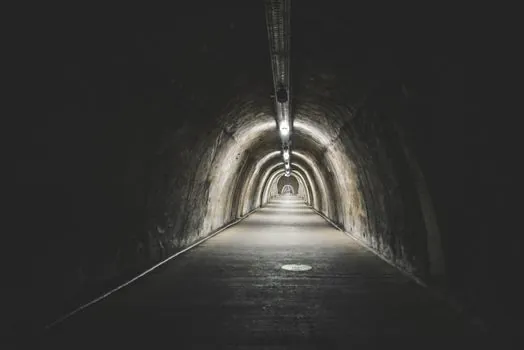
Long-distance pumping has a documented tunnel record. On the Heathrow Terminal 5 railway extensions, a static pump with a 240 kW diesel drive and 1,800 m of pipe delivered concrete across the run, a Pochin-supplied job at US$367,500 that exceeded Balfour Beatty's previous Terminal 4 mark [S4]. On the 12.8 km Lainzer Tunnel in Vienna, the Putzmeister BSA 2109HE, BSA 1408 E and BSA 2104 HP E were the workhorses, with one unit pumping concrete over 350 m at approximately 40 m³/h [S4].
Madrid's M30 tunnel used six Putzmeister KOV DUO 550 PM pumps with ball valves to feed two separate delivery lines for segment backfilling, plus four KOV 1050 ball valve pumps conveying mortar from silos, with the eight pumps integrated with the TBM back-up control system and run over three shifts a day, seven days a week [S4]. For the logistics side, see how a dump truck cycle interacts with hopper-fed pumps in narrow-space work, where every metre of turning radius counts [S5].
Tunnel-profile fit: rail, tyred and self-propelled options
Tunnel section dictates the carrier. Rail or tyred mixer-and-hopper trains, drop-chutes, belt conveyors, and long-distance pumping are the main practical choices, with selection driven by where the batching plant can be sited and by the tunnel cross-section [S4]. Mühlhäuser supplies rail-based remixers, silo cars and aggregate/cement cars purpose-designed for tunneling and mining, while Maxon's Mobile Maxcrete runs at 10 mph on a bi-directional chassis on the tunnel invert, with low-profile open-top carriers either skid-mounted or on rail or tyred vehicles [S4].
Normet's Spraymec 4100 is a self-propelled sprayer explicitly engineered for mining and tunneling projects with small to medium profiles, integrating closed-loop control and precise accelerator dosing for shotcrete [S1]. When a profile is too tight even for a 24 XH-class truck pump, the spec typically drops to a stationary piston pump plus pipeline, mirroring the BSA 1405 E operating envelope (55 m³/h at 71 bar, 75 kW) on a wheeled or skid chassis [S1]. The reach truck reference is useful where the question shifts from placing concrete to staging pallets of pipe segments and formwork in narrow adits.
Selection checklist for a tunnel truck-mounted concrete pump
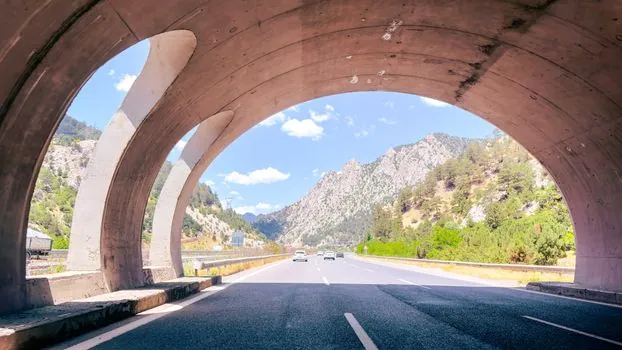
Use this four-line filter before signing a PO. (1) Portal and ceiling: confirm the truck can enter the opening in normal operation and unfold inside, matching the Liebherr 31 XXT's 4 m portal and 5.4 m unfolding height, or the 24 XH's sub-5 m deployment [S3]. (2) Boom reach vs. tunnel section: 20.6 m vertical reach and 14.5 m net horizontal reach remain practical PUMI-class benchmarks on the Putzmeister TMP 60 CS [S4]. (3) Output and pressure: target 27–60 m³/h at 51–71 bar for compact class, 17–55 m³/h at 68–106 bar for stationary piston backfill [S1]. (4) Carrier and turning: an 8-wheel PUMI chassis at 21.5 m turning circle is the working benchmark for tyred access on tight tunnel approaches [S4].
Verify match with adjacent articles on the same platform: Concrete Pump Truck Selection for Mining: Boom, Outrigger, and Ground-Pressure Criteria and Mining Truck-Mounted Concrete Pump Selection: Reach, Output, and Spec Match both address the same envelope on a mining site, where the boom/outrigger numbers carry across; for a contrasting urban profile see Selecting a Concrete Pump Truck for Urban Infrastructure Work.
Limits and failure modes to flag in the spec
Pumping distance is a real failure mode: pipe length, bend count and aggregate size drive pressure loss faster than rated pump pressure, and the 1,800 m record run on Heathrow T5 used a static 240 kW diesel pump, not a truck-mounted boom pump [S4]. Aggregate size is binding: the P 718 is sized for 32 mm maximum aggregate, and oversize will lock a two-cylinder piston pump quickly [S1]. Confined profile risk is binding too: a boom that cannot unfold below 6 m rules out a 31 XXT-class machine regardless of output.
Hydrostatic drives on the Adroit 420AH trade top-end flow for torque smoothness, which matters on long pipeline runs and on retempered mixes but limits peak output to 22 m³/h, well below the 55 m³/h electric piston class [S1]. Closed-loop accelerator dosing on the Spraymec 4100 is a must for shotcrete rebound control in small to medium profiles, not a marketing line, since set-time drift will undercut early strength on wet-mix applications [S1].
Track next month whether Liebherr publishes 31 XXT field-deployment data on a named metro or rail tunnel, and whether Normet extends the Spraymec 4100 output above 27 m³/h. The 1,800 m pipeline record at Heathrow T5 [S4] and the 350 m at 40 m³/h on Lainzer [S4] are the working benchmarks any new long-distance tunnel pumping claim will be measured against.