Draw-wire position sensors translate linear travel into rotary motion via a recoiling stainless-steel cable, letting a compact drum-mounted encoder or potentiometer read strokes from roughly 1 m up to 15 m on a footprint of a few hundred millimetres [S1][S2].
Across the 2026 catalogue the envelope runs from the FIAMA PF1000 / PF2000 at 1100 mm / 2200 mm strokes with 0-10 V potentiometric output [S2], through the WayCon SX120 at 3000-5000 mm [S3], to the WayCon SX300 series at 10-15 m absolute measuring range with CANopen, SSI, PROFIBUS, EtherCAT and Ethernet options [S1].
Stroke, Output, and Protocol: The Three Knobs You Set First
The first decision is stroke length, because drum diameter, cable diameter, and overall housing size scale with it — a 15 m SX300 is a different mechanical package than a 1.1 m PF1000, and the cable fatigue budget at full extension is the binding constraint, not the encoder inside [S1][S2].
Output comes next. Potentiometric 0-10 V or 4-20 mA remains the cheapest path for simple panel-meter or PLC analogue input integration [S2][S3]. Where deterministic digital data is needed — for multi-cylinder synchronisation, hydraulic position control, or ride-control on amusement equipment — the SX300 offers digital output, CAN bus, SSI, PROFIBUS, EtherCAT and Ethernet on the same housing, with CANopen listed as the headline protocol [S1].
Protection class closes the mechanical decision. The SX120 and SX300 both ship at IP65 with IP67 as an option [S1][S3], and the FIAMA PF-series uses a self-extinguishing, solvent-, petrol-, grease- and oil-resistant case aimed at machine-tool, marble, glass and hydraulic-cylinder duty [S2]. For washdown food or outdoor mobile hydraulics, IP67 is the floor; for inside an enclosure, IP65 is enough.
Comparing the Three Common Variants in 2026
Three families bracket the spec landscape. The FIAMA PF1000 / PF2000 is a pure potentiometric wire transducer with 1100 mm or 2200 mm stroke, 0-10 V supply, and a precision rotating potentiometer driven by a stainless-steel wire — positioned as low-cost, easy-assembly analogue output for machine tools and shutiers [S2]. The WayCon SX120 is a mid-stroke workhorse at 3000-5000 mm with ±0.02 % max linearity, analogue 0-10 V / 4-20 mA / potentiometer, plus digital TTL, HTL, SSI, Profibus, CANopen, DeviceNet, EtherCAT, Profinet, and IP65 standard / IP67 optional [S3]. The WayCon SX300 series is the long-stroke absolute unit at 10-15 m with rugged IP65/IP67 housing, aimed at hydraulic-cylinder position feedback and synchronous multi-cylinder motion on industrial machinery and fairground rides [S1].
Selection falls out cleanly. For ≤2.2 m, budget analogue readouts, and machine-tool retrofit, the PF-series is the cost winner. For 3-5 m mixed-protocol plants that need both 4-20 mA for a legacy PLC and CANopen for a newer controller on the same machine, the SX120 covers the gap. For 10-15 m hydraulic-cylinder synchronisation or long-stroke outdoor duty, only the SX300-class package is in spec [S1][S2][S3].
Where Draw-Wire Sensors Fit — and Where They Do Not
Draw-wire sensors belong on cranes, scissor lifts, hydraulic cylinders, mobile hydraulics, agricultural machinery, machine tools, automated wood / marble / glass lines, amusement rides, and any linear motion that exceeds the practical length of a rigid linear encoder or crossed-roller guide scale [S1][S2][S3].
For non-contact high-speed measurement of small targets, an optical displacement sensor is the better fit. And where the moving part runs hot, oily, or in a sealed tank, the cable exit is a wear point — prefer a sealed rigid-rod LVDT or magnetostrictive displacement sensor instead. The cable-and-drum is fundamentally a contact mechanism with finite cycle life, and the SX-series datasheet language — "rugged, absolute" [S1] — implicitly assumes the buyer has accepted that trade.
Linearity, Cycle Life, and the Engineering Trade-Offs
Linearity is the headline accuracy number. The WayCon SX120 publishes a maximum of ±0.02 % full-scale linearity across 3000-5000 mm, which is the spec to anchor a competitive comparison against [S3]. Potentiometric units like the PF1000 / PF2000 do not publish an equivalent figure in the catalogue excerpt but rely on the precision of the wound potentiometer, which generally lands worse than the SX120-class encoder inside but is acceptable for position-indication rather than closed-loop control [S2].
Cycle life is the other binding spec. Each drum-bend cycle stresses the cable; manufacturers rarely publish a single cycle-life number, but longer strokes see fewer cycles-per-metre of cable travel and shorter cable bend radii at the drum. The SX300-class 10-15 m body exists precisely because the mechanical limit for a 1 m-class unit in continuous dynamic service is cable fatigue, not encoder life [S1]. For a 2026 sourcing pass, the practical move is to ask the manufacturer for a duty-cycle curve (cycles per day × stroke × acceleration) and compare against the wire-rod and drum material — stainless-steel cable on a precision-wound drum is the baseline that all three families share [S1][S2].
Integration, Cabling, and the Fieldbus Question
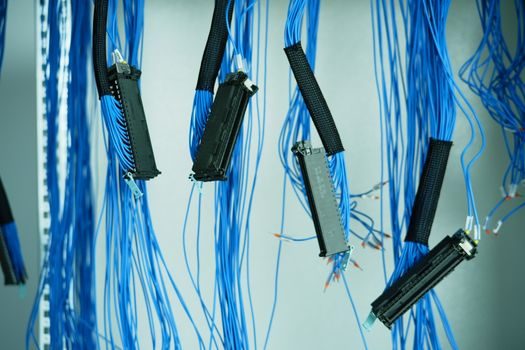
Analog integration is a 3-wire hookup: supply, ground, signal. The PF1000 publishes 0-10 V supply as the headline spec, which doubles as the output range in a ratiometric potentiometric configuration [S2]. The SX120 publishes 0-10 V, 4-20 mA and potentiometric outputs simultaneously, which means the same body can be reconfigured by terminal assignment rather than model swap, useful for spares rationalisation across a mixed PLC fleet [S3].
Fieldbus integration is where the SX300 earns its premium. Native CANopen on the SX300 and SX120 lets multi-cylinder synchronisation run on a single bus with deterministic latency, and SSI on the SX300 supports point-to-point absolute readback where noise immunity is a concern [S1][S3]. PROFIBUS and EtherCAT support on the SX120 / SX300 means a European machine builder can drop the sensor into a Siemens or Beckhoff rack without gateways [S1][S3]. The PF-series stays analog-only — there is no fieldbus option in the catalogue excerpt, so any networked deployment needs an external A/D or a controller with analog input [S2].
Standards, Sourcing Signals, and What to Track Next
Draw-wire sensors are general industrial components and are not governed by a single dedicated product standard; instead, they ride on the enclosure (IP65 / IP67 per IEC 60529), EMC, and fieldbus conformance regimes that the host equipment already meets. The SX120 datasheet language explicitly states "IP65 (optional IP67)" [S3], and the SX300 ships at IP65/IP67 standard [S1], so an IEC 60529 ingress rating is the cleanest cross-vendor spec to demand on a datasheet review.
For 2026 sourcing, two signals are worth tracking. First, watch the linear encoder and LVDT displacement sensor catalogues — when encoder strokes cross 5 m at comparable linearity, the SX120's mid-stroke niche compresses. Second, watch the industrial magnet and rare-earth process control supply chain, because permanent-magnet encoders inside the SX-series depend on the same neodymium feedstock that drives magnet pricing — a 2026 magnet cost spike will eventually show up as encoder-body list-price revisions. For now, the FIAMA PF-series remains the cost floor, the WayCon SX120 the mainstream choice, and the SX300 the only credible 10-15 m absolute draw-wire package on the European catalogue.