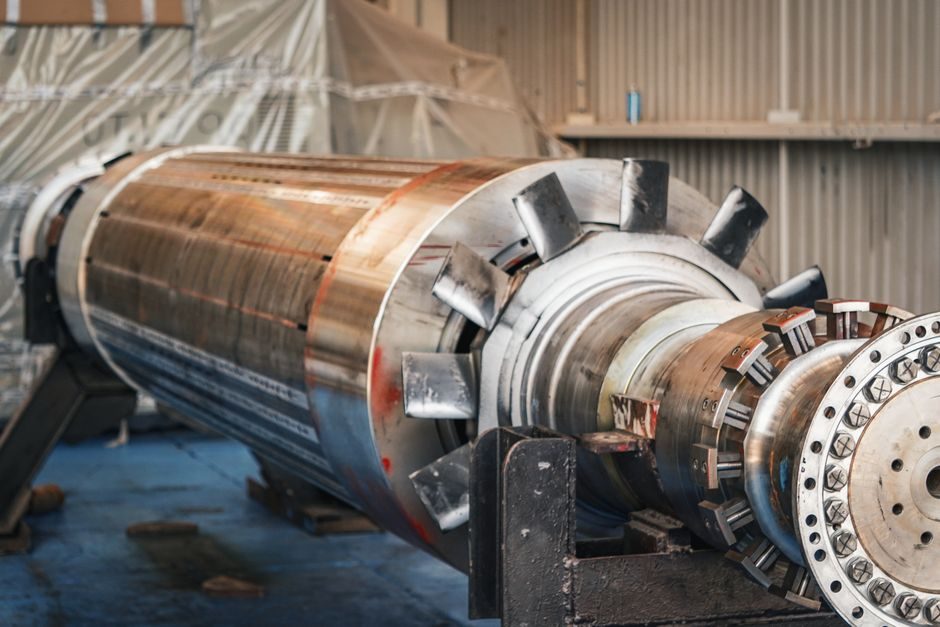
Industrial magnet supply in 2026 is a two-track market: a small number of US system-integrators handling high-specification rare-earth and precision magnetic assemblies, and a broad Chinese wholesale base covering commodity ferrite, alnico, and NdFeB grades at price points starting near US$0.03-12 per piece [S4].
Procurement decisions are driven by magnet chemistry (ferrite, alnico, NdFeB, SmCo), maximum operating temperature, corrosion resistance, dimensional tolerance, and compliance with ITAR, DFARS, REACH, and ROHS — not by brand alone [S1][S3]. For broader context on related industrial components, see the industrial coating overview where surface treatment directly affects magnet corrosion life.
Magnet Chemistry vs Industrial Duty
Ceramic (ferrite) magnets, sintered from iron oxide with strontium or barium, are the cost-efficient default for motors, chucks, and tools, but are porous, brittle, and lose magnetism at elevated temperature, so they are typically avoided in structural or high-heat service [S3]. Alnico magnets deliver higher temperature stability and stronger residual flux, making them common in sensors, ignition systems, and welding equipment, at the trade-off of lower coercive force against demagnetisation [S3].
Rare-earth grades — primarily NdFeB and SmCo — give the highest magnetic strength per volume; NdFeB dominates motors, speakers, sensors, and MRI systems where compact force is required, while SmCo is specified where temperature or corrosion margin outweighs raw strength [S1][S3]. Where assemblies integrate multiple magnet types, see the industrial ceramic primer for the sintering context shared with ferrite production.
US System-Integrators and Compliance Posture
Arnold Magnetic Technologies, founded in 1895, manufactures high-performance permanent magnets, electromagnetics, magnetic assemblies, and precision thin metals used in high-efficiency motors, generators, sensors, and batteries, with multiple ITAR-registered locations compliant with DFARS [S3]. This compliance posture is the differentiator in US defence, aerospace, and medical programmes where European and Chinese commodity sources are restricted by export-control lists rather than technical limits.
US directory listings position ceramic, alnico, and rare earth magnets across industrial applications including motors, magnetic chucks, solenoid valves, AC and DC motors, biomagnetic separation, transformers, magnetic clamping, and separation systems [S3]. The pattern across US suppliers is identical: catalogue of chemistry, then custom assembly to customer drawing with full material traceability.
Chinese Wholesale Base: Volume, Price, and Audited Suppliers

Made-in-China.com's industrial-magnet category lists thousands of SKUs across magnetic track lighting, linear motor magnets, lifting magnets, and arc/segment NdFeB, with MOQs as low as 1 piece on commodity items and bulk pricing from US$0.03-12/piece for neodymium discs and blocks [S2][S4]. Stronger industrial grades and assemblies (lifting magnets, magnetic chucks) cluster in the US$5-15 per set band at 100-set MOQ [S4].
Audited Diamond Members on the platform carry third-party-verified business licences, and Secured Trading Service escrow is the standard payment risk-mitigation for cross-border RFQs [S2]. For buyers, the practical gate is sample approval on magnetic flux, dimensional, and coating data — not platform tier alone.
Selection Criteria: Temperature, Corrosion, Force, Tolerance
Four decision criteria dominate a magnet buy: (1) maximum continuous operating temperature versus Curie/max-use limit of the chosen grade; (2) corrosion environment, which dictates coating (nickel, zinc, epoxy, parylene) or grade shift to SmCo; (3) required pull force or flux density at the air gap, typically expressed in Gauss or Tesla; (4) dimensional tolerance and magnetisation pattern (axial, radial, multi-pole) [S1][S3].
A baseline comparison: ferrite (cheap, brittle, loses magnetism at heat, corrosion-prone uncoated) versus alnico (high temperature stability, lower coercive force, cast or sintered) versus NdFeB (highest strength, requires coating, demagnetises at moderate heat) versus SmCo (high strength plus high temperature plus corrosion resistance, premium cost) [S3].
Compliance, Standards, and Failure Modes
For aerospace and defence programmes, ITAR-registered US suppliers with DFARS-compliant material sourcing are effectively the only admissible path; common European and Chinese grades may be technically adequate but legally restricted [S3]. REACH and ROHS apply to all magnets sold into the EU, covering nickel plating, epoxy binders, and the rare-earth content itself, with REACH SVHC declarations routinely requested by EU OEMs [S1].
Dominant failure modes in service are corrosion of uncoated or damaged-coated NdFeB, irreversible flux loss when operating temperature exceeds the grade's max-use limit, and mechanical chipping of brittle ferrite and sintered grades under impact loading [S3]. Specifying a coating system matched to environment — nickel for indoor mild, epoxy for outdoor humidity, parylene or PTFE for chemical exposure — is the standard mitigation.
Use-Case Map: From MRI to Magnetic Separator
High-efficiency motors, generators, and EV traction drives use NdFeB rotor magnets for power density, paired with SmCo or alnico in high-speed or high-temperature windings [S1][S3]. MRI systems and medical sensors specify high-grade NdFeB or SmCo with tight dimensional tolerance and full traceability on heavy-metal content. Lifting, holding, and separation equipment typically use ferrite arcs or NdFeB blocks in epoxy-coated assemblies, often integrated with steel pole pieces to shape the field. Solenoid valves, AC and DC motors, transformers, magnetic chucks, and automated fixturing draw on electromagnets, which drop the permanent-field problem but introduce a coil, driver, and thermal envelope of their own [S3].
For related selection logic on rotating equipment duty, see the fluid coupling selection map where magnetic clutch/brake variants overlap with electromagnetic assemblies.
Signals to Track in the Sourcing Cycle
Watch the next two indicators before issuing a magnet RFQ: (1) REACH SVHC list updates for rare-earth and nickel substances, which can force a grade or coating change overnight; (2) NdFeB spot-price movement, which directly shifts the US$0.03-12/piece commodity band on Made-in-China listings [S2][S4]. Verifying these against your last buy's landed cost and a sample-pull test on the new batch is the lowest-risk gate.
Component reference pages worth checking: industrial adhesive.