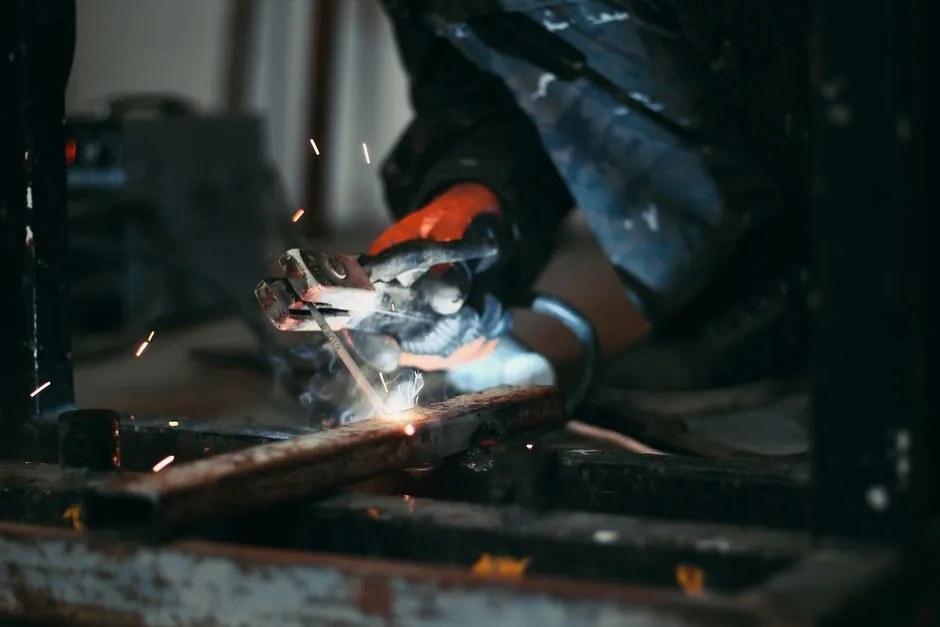
Drawn arc (DA, also called ARC) stud welding covers stud diameters from 2 mm up to M24 (25 mm) at welding times of 100 to 1500 ms, with a ceramic ferrule (or shielding gas) containing the molten pool [S2]. Short cycle (SC) drawn arc stud welding uses the same lift, pilot-arc, forge-down sequence, but runs at higher current for a maximum of 100 ms and is typically used for stud diameters of 2 to 16 mm onto sheets as thin as 0.5 mm [S4].
The two processes are not separate weld physics; SC is a high-speed, thinner-stock variant of DA. That overlap, plus the fact that both sit in the stud welder family alongside capacitor discharge (CD), is where most selection mistakes happen on a shop floor.
Weld sequence: how DA and SC actually differ step by step
DA and SC share the same mechanical motion: the stud rests on the plate, an internal solenoid lifts it to a preset gap, a low-current pilot arc ignites, the main arc melts the stud tip and the parent material, and a return spring forges the stud into the molten pool [S1][S2]. The ferrule in DA, made of a ceramic arc shield, holds the molten metal and shapes the fillet; SC is run without a ferrule up to about 8 mm stud diameter, relying instead on a stud upset-flange geometry to keep tensile strength up despite porosity in the weld zone [S4].
Where the processes diverge is current density and time. SC operates at relatively higher current for a shorter welding time (≤ 100 ms), with a tighter thermal envelope that lets it weld thin sheet without burn-through [S4]. The HBS process reference frames SC as a deliberate trade: shorten the arc, accept some porosity below 8 mm, and recover strength through the upset flange [S4]. Above 8 mm, HBS recommends shielding gas to suppress that porosity [S4].
Time, current, and equipment envelope
Three numbers summarise the practical gap between DA and SC. Welding time for DA spans 100 to 1500 ms depending on diameter; SC caps at 100 ms [S2][S4]. Minimum sheet thickness for DA is 2 mm; SC drops to 0.5 mm, the same threshold that CD (capacitor discharge) also targets [S1][S2][S3]. Power supply class is the same for both DA and SC: three-phase 415 V industrial kit, with DA sized for diameters up to M24 (25 mm) and SC sized to M8 per the Taylor Studwelding range, while HBS extends SC coverage to 16 mm with shielding gas [S1][S4].
The shorter arc time is not free. Because the heat input window is narrow, SC depends on the higher current to develop full fusion, which is why the same stud welder platform can run either process but the parameter set, the stud geometry, and the optional shielding gas differ. For high-volume production of small studs onto coated or hot-rolled stock, SC beats DA on cycle time; for large-diameter structural studs, only DA is a viable process.
Material and diameter coverage compared
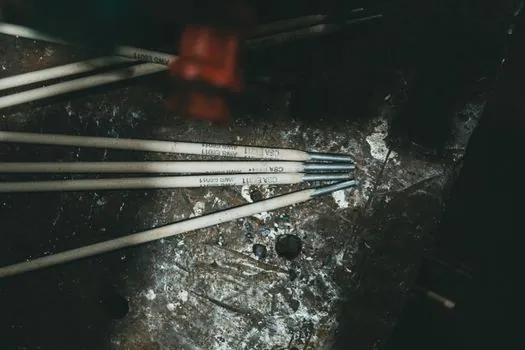
DA covers mild steel and stainless steel studs from 2 to 25 mm onto plate from 2 mm upward, and tolerates surface imperfections such as light rust, scale, grease, and some coatings because the longer arc burns through the contamination [S1][S2]. SC covers 2 to 16 mm studs onto 0.5 mm and thicker sheet in mild steel, stainless steel, and aluminium, and is described as more tolerant than CD of uneven or dirty surfaces but less forgiving of contamination than full DA [S1][S4].
On coated materials the call is explicit: SC is recommended for hot-rolled and coated sheet where CD would misfire, while full DA remains the workhorse for structural stud welding using large-diameter studs, ferrules, and an aluminium flux load on the weld end [S1][S3]. Material combinations such as steel base with stainless or aluminium stud are noted as a strength of the SC variant, and HBS recommends shielding gas to lift weld quality on those mixed joints [S4].
When to pick DA, SC, or CD
For thin sheet from 0.5 mm with minimal reverse-side marking, and stud diameters up to about M10, CD stud welding is the cheapest, cleanest choice, with a welding time of about 1 to 3 ms and no ferrule or shielding gas required [S1][S2]. For thin sheet where the surface is coated, slightly dirty, or where a deeper penetration than CD can give is required, SC is the right step up: same ferrule-free setup below 8 mm, but higher current and a controlled 100 ms arc [S1][S4]. For large-diameter structural work from M10 up to M24, only DA delivers the penetration, the controlled fillet, and the multi-gun scalability that fabricators rely on [S1][S3].
Specifying a stud welder for an arc stud welding cell is therefore a question of stack: the power source must support the chosen process envelope, the stud must be the matching geometry (with upset flange for unshielded SC, with ceramic ferrule for shielded SC and for DA), and the weld controller must hit the time-and-current combination within tolerance. Mistaking DA for SC on a thin-sheet job burns through; mistaking SC for DA on a 20 mm stud fails to fuse.
Limitations, failure modes, and shielding gas trade-offs
SC's biggest known limitation is porosity in the weld zone when run without shielding gas above 8 mm stud diameter; the upset-flange stud design is the standard mitigation, but it is a strength compromise, not a metallurgical fix [S4]. For stainless steel, Taylor Studwelding specifically notes that shrouding with gas improves weld fillet formation even below the 8 mm threshold [S1]. HBS sets a parallel rule: from 8 mm stud diameter upward, a shielding gas should be used to avoid pore formation, which makes the SC process with shielding gas effectively the bridge to full DA practice [S4].
DA's known failure modes are ferrule-related: the ceramic arc shield is a consumable that must be removed after the weld, and a missing or cracked ferrule ruins fillet geometry. DA is also intolerant of gross surface contamination in a way CD and SC are not, and it requires the stud to carry a flux load at the weld end to deoxidise the pool [S3]. In high-cycle production cells, ferrule handling is the hidden cost that pushes line designers toward SC for the small-diameter, thin-sheet portion of the build.
Decision matrix: DA vs SC against four shop-floor criteria
On cycle time, SC wins below M8 because the arc collapses inside 100 ms versus 100 to 1500 ms for DA [S2][S4]. On minimum sheet thickness, SC ties CD at 0.5 mm and beats DA's 2 mm floor [S1][S2][S4]. On stud-diameter ceiling, DA at M24 (25 mm) beats SC at M8 (Taylor) or M16 (HBS, with shielding gas) [S1][S2][S4]. On shielding gas and ferrule cost, SC is cheaper below 8 mm because no ferrule and no gas are mandatory; DA always requires a ferrule or a gas shroud and an aluminium-fluxed stud [S1][S3][S4].
Use that matrix as the gate: if the stud is larger than M10, the answer is DA; if the stud is M3 to M8 and the sheet is thin or coated, the answer is SC; if the stud is M3 to M10 and the sheet is 0.5 to 1 mm and the back side must stay unmarked, the answer is CD. Mixing the three inside one welding cutting tool cell is normal: fabricators routinely run CD for trim studs, SC for coated body panels, and DA for chassis studs on the same vehicle.
Standards and sourcing notes for specifying engineers
Stud welding process definitions and the DA / SC distinction are documented in process references from HBS, Taylor Studwelding, Stanley Engineered Fastening (Nelson), and Image Industries, all of which use the same lift-pilot-arc-main-arc-forge sequence to distinguish the two drawn-arc variants from the capacitor-discharge process [S1][S2][S3][S4][S5]. A January 2026 short-form comparison on completestudweld.com restates the time relationship, framing SC as a faster version of the standard DA method, with weld-time figures consistent with the 100 ms cap from HBS [S6]. The AWS practitioner forum thread on stud welding (community discussion) is a useful sanity check on parameter sets and ferrule choice but is not a normative source [S9].
For a cell spec, three signals are worth tracking over the next procurement cycle: shielding-gas-fixture availability for SC above 8 mm stud diameter, ferrule-free SC gun ergonomics for high-mix small-diameter work, and dual-process power units that can switch between DA and SC without re-cabling, since parameter overlap is the easiest cost win on a brownfield line. Related reading on adjacent process decisions, including bearing selection logic that mirrors this diameter-versus-load trade-off, is in the full complement vs caged roller bearing trade-off map.