
Inside a concrete vibrator head, a rotating eccentric weight is the standard mechanism that converts rotary motion from the drive shaft into orbital oscillation of the steel housing, per multiple manufacturer references [S4][S6]. The head itself does not spin about its axis; the offset mass inside it does, and the resulting imbalance is what shakes the surrounding cement concrete.
This distinction matters operationally because the head's effective radius of influence is roughly 3 to 4 times its diameter [S2], and tip speeds commonly run 6,000 to 10,500 vibrations per minute on controllable units [S2]. Anyone shopping a concrete vibrator should treat the head as a vibrating, not rotating, body.
Rotating mass inside a stationary head: the working principle
The internal vibrator head contains a rotating offset weight that generates high-frequency vibration, which temporarily reduces internal friction and lets entrapped air rise [S6]. In shaft-driven "stick" units, the drive enters through a flexible or rigid shaft, and the offset weight is housed within the cylindrical tip; in motor-in-head designs, the electric or pneumatic motor sits at the tip itself and drives the eccentric directly [S4].
From the outside, what the operator sees is the steel housing vibrating in a small circular or orbital pattern, with the amplitude defined as the maximum displacement of any point on the head from its rest position [S5]. That amplitude scales with head diameter: smaller heads run higher frequency, lower amplitude, while larger heads run lower frequency, higher amplitude and move heavier aggregate [S5].
Oscillation frequency, amplitude, and radius of action
Frequency and amplitude together set the radius of action, the area of fresh concrete that each insertion point consolidates, with the typical field rule quoted at 1-ft to 2-ft radius around the head [S4]. A common shorthand from formwork practice is the 3 to 4 head diameters figure, used to space insertions across a pour so influence zones overlap and no pocket is missed [S2].
Controllable-frequency units such as the Minnich CSV let crews pre-set 6,000, 8,000, or 10,500 VPM and hold that speed as concrete load changes, which directly addresses the surface-water-separation problem that comes from running too high a frequency on a given mix [S2]. Smaller-diameter heads with higher frequency suit higher-slump, more workable concrete used in manufactured products, while larger heads match low-slump mixes that need more energy to liquefy [S4][S5].
Insertion, withdrawal, and head-size selection
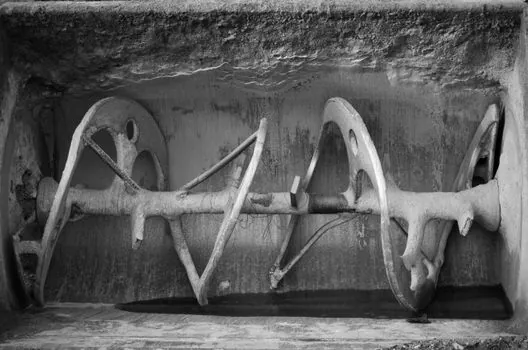
Internal vibrator technique is a vertical-insertion discipline: the head should be lowered under its own weight into the pour, penetrate the previous lift by about 6 inches (150 mm), and be withdrawn at roughly 1 inch per second while still running [S3][S5]. Dragging the head horizontally through the mix is a known defect-creator, leaving a mortar channel that weakens the finished section [S2][S5].
Head sizing is dictated by form geometry and rebar spacing: shallow or closely spaced forms take a smaller head, wider forms a larger one, and a common rule of thumb is that the head diameter should be about a quarter of the wall thickness being cast [S2][S5]. Under-vibration leaves bubbles still emerging on withdrawal; over-vibration drives water to the surface and segregates the mix, both of which reduce strength [S2].
Where rotation vs oscillation actually shows up across vibrator types
Internal vibrators rely on the rotating-eccentric-in-head principle described above; external formwork vibrators are typically mounted to the outside of the form and are spaced at about 6-foot intervals on large pours, while surface "jumper" vibrators work from the top and lose effectiveness beyond roughly 6 inches of depth [S3]. For precast and congested-rebar work where the head physically cannot reach the mix, external form vibrators replace internal insertion and deliver consolidation through the formwork wall [S3][S4].
The American Concrete Institute figure cited by AIRMATIC puts proper vibration at up to 5% additional density, with fresh concrete starting out at 5% to 20% entrapped air depending on the mix and pour, so the head is essentially converting a high-air, high-friction mass into a fluid that releases air and packs aggregate [S4][S5]. For the broader concrete tool and concrete vehicle ecosystem, the head motion is the same physical principle, only the drive source (electric, pneumatic, internal combustion) and shaft length change.
What can go wrong: defects tied to head motion

Most in-place defects trace back to three operator-level variables that are really about how the head is moved: incorrect head size for the formwork and rebar spacing, wrong frequency for the mix, and incorrect vibration duration or insertion angle [S2]. Pulling the head out too fast and dragging it through the mix are the two most common field mistakes, and both are direct consequences of operators not respecting the head's small orbital motion and limited radius of action [S5].
For related on-site reading, see this concrete consolidation and cutting method comparison and the broader cement-sector signal stack for 2026-09-25 for context on mix design and admixture trends driving vibrator selection. Also worth pairing with vibration is the practical guidance in cut-off machine features that lift steel bar cut accuracy, since rebar and embedment preparation directly affect how a head can be inserted without snagging.
Trackable signals for the next reporting cycle: any new OEM release of variable-frequency drive electronics in the 6,000 to 12,000 VPM band, and any update to ACI 309 or equivalent consolidation guidance on minimum head-insertion overlap distances. Both would materially change the numbers above.