
On 2026-07-10 the lowest visible B2B entry point for a foldable 1080P HD WiFi-camera quadcopter sits at US$25.00 per unit at a 20-piece MOQ from a Guangdong manufacturer quoting 600,000 PCS/month capacity and Shenzhen FOB terms [S1].
That same week, a comparative retail roundup of 2026 AliExpress quadcopters filtered the catalog down to four SKUs across toy, camera, GPS-stabilised and brushless-motor tiers, framed as a buyer's reference rather than a promotional shortlist [S2].
Shenzhen FOB floor: what US$25 actually buys
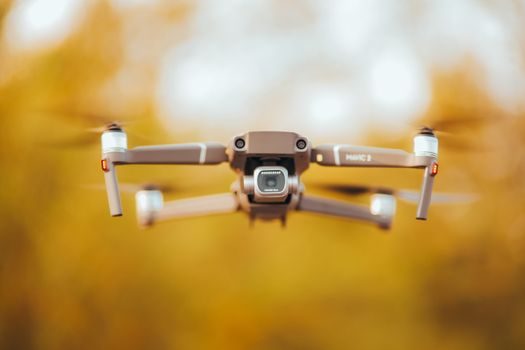
The Made-in-China listing for the Gd89PRO-style 1080P HD folding quadcopter is sold at US$25.00 per piece with a 20-piece MOQ, T/T or PayPal terms, and a stated production capacity of 600,000 pieces per month out of Guangdong [S1]. The camera is 1080P HD over WiFi to a smartphone app; the airframe is the typical folding consumer quadcopter form factor used by multiple white-label factories in the Pearl River Delta.
Below that floor, the price discussion is no longer about drones — it is about toy-grade micro-quadcopters, replacement propellers and bare airframes without cameras, GPS or a real flight controller. Above the US$25 band, the next visible steps on the same platform run into dedicated-GPS, optical-flow and brushless-motor SKUs that typically double or triple the unit price for incremental stability and wind tolerance.
2026 retail shortlist: four tiers on AliExpress
The 2026 AliExpress roundup narrows the consumer catalog to four reference SKUs, each representing a distinct price/spec band rather than a single "best buy" [S2]. Toy quadcopters anchor the entry tier, 1080P / 4K camera quads occupy the mid-band, GPS-hold and return-to-home quads sit one tier above, and brushless-motor quads with longer flight times top the shortlist.
The price gap between the entry toy SKU and the brushless top-tier SKU is typically 5-10x in retail terms, driven primarily by the motor type (brushed vs brushless), battery capacity, GPS module presence and whether the camera is stabilised on a gimbal. Buyers using the roundup as a sourcing map can map each retail tier back to the equivalent FOB Shenzhen price band, then apply a typical retail-to-FOB multiplier of 2-3x for low-MOQ dropshippers and 1.5-2x for higher-volume importers.
Industrial and prosumer crossover: where the spec lines blur

Consumer-grade brushless quadcopters with GPS hold, 4K cameras and 30-minute flight times are increasingly specified for light industrial work such as rooftop inspection, stockpile volumetrics and short-range surveying. The hardware is consumer-priced because the airframe, motor and battery are shared with the toy and prosumer lines, but the value sits in the payload, the pressure-sensor integration on industrial variants and the data pipeline. [S1]
At the same time, dedicated industrial multirotors — those with RTK GNSS, thermal payloads and IP-rated enclosures — sit in a completely different price band, typically US$3,000 to US$20,000+ for the airframe alone, and are not part of either the US$25 FOB entry tier or the AliExpress consumer shortlist. The crossover category buyers should watch is the sub-US$500 brushless + GPS quadcopter with a third-party SDK, which can be repurposed for inspection, agricultural scouting and basic mapping when paired with a ground-station software stack.
Cost levers: motors, batteries, cameras and GPS modules
The four line items that move a quadcopter's FOB price the most are the motor set (brushed vs brushless, with brushless units built on servo-motor-style rotor/stator construction typically adding 20-40% to motor cost), the battery pack (1S/2S/3S Li-Po, with cell count and mAh rating driving both flight time and price), the camera module (480P vs 1080P vs 4K, with stabilised gimbal versions multiplying the camera cost 3-5x) and the GPS module (optional vs standard, with optical-flow positioning sitting between the two). [S2]
For a buyer comparing two otherwise identical-looking quadcopters, the difference in FOB price is almost always explained by exactly one of these four items, not by the airframe plastic. A buyer targeting the same airframe at a lower price should ask the supplier which of the four has been downgraded — usually brushed motors replacing brushless, or a lower-mAh battery pack — because the flight-time and wind-tolerance penalty of those swaps is severe.
Supply side: Guangdong capacity and 2026 trade-show pipeline

Guangdong remains the dominant production base, with the Gd89PRO-style 1080P HD quadcopter listed at 600,000 pieces per month from a single Guangdong manufacturer [S1]. That single-factory figure is consistent with the wider Pearl River Delta cluster, where parallel factories run similar airframes under different brand labels and aggregate capacity for the 1080P HD folding class runs into millions of pieces per month across the region.
On the trade-show side, the 2026 Drone International Expo is scheduled for 2026-09-28 to 2026-09-30 at Yashobhoomi in New Delhi, India, with a stated exhibition area of 20,014 m² and an exhibitor directory published as a paid electronic catalogue [S3]. For buyers tracking price moves, the September show is the first major 2026 milestone after the July Shenzhen sourcing window, and any FOB adjustments announced there will set the Q4 contract baseline.
2026 outlook: where the floor, the spread and the ceiling are likely to move
The US$25 FOB floor for a 1080P HD folding quadcopter at 20-piece MOQ is likely to hold within a ±10% band through the rest of 2026, because the four main cost drivers (brushed motors, 1S/2S Li-Po packs, low-end 1080P camera modules, no GPS) are all at or near commodity pricing [S1]. Pressure on the floor comes from oversupply in Guangdong and from white-label factories competing on the same airframe; support comes from incremental battery and camera-module cost increases.
The mid-tier brushless + GPS consumer quadcopter band is the segment most exposed to component cost moves, particularly the industrial-valve of cell pricing on Li-Po packs, the cost of brushless motor stators and the inclusion of optical-flow sensors. Buyers should track connector pricing as a leading indicator for the motor and ESC harnesses, and the CNC machine price trend as a leading indicator for the airframe tooling amortisation that gets baked into FOB unit cost.
Buyer checklist: five trackable signals for the rest of 2026
First, watch the Shenzhen FOB listing refresh on the US$25-class 1080P HD folding quadcopter between July and September 2026 for any sub-5% price move, which would signal oversupply pressure at the factory level [S1]. Second, watch the 2026 Drone International Expo in New Delhi on 2026-09-28 to 2026-09-30 for the first set of Q4 2026 contract indications out of India as a parallel sourcing region [S3].
Third, watch the power semiconductor pricing trend for ESC and BMS cost pass-through, which directly affects the brushless-motor tier. Fourth, watch lithium cell capacity as the upstream input to Li-Po pack pricing across all tiers. Fifth, watch the AliExpress 2026 retail shortlist refreshes [S2] for any tier compression — if the gap between toy and brushless SKUs narrows in retail terms, it usually means mid-tier FOB prices are softening first.