
Chinese OEM directories index dry-mix mortar production lines from roughly 5 t/h semi-automatic units up to 60 t/h fully automatic plants with bulk-silo and palletizing add-ons, with Henan-based manufacturers (De Jin Yang, BHM) supplying the bulk of catalog SKUs visible to global buyers in 2026 [S1][S2][S3].
Selection is not a price race; it is a sequence of engineering gates — formulation, output, mixer, packaging, storage, and dust/safety conformity — that lock the spec before any RFQ goes out. Skipping a gate produces plants that over-spend on capacity, under-deliver on bond strength, or fail environmental inspection on day one.
Gate 1: Formulation Family — Cementitious, Gypsum or Polymer-Modified
Cementitious dry-mix mortars (tile adhesive, plaster, masonry mortar) dominate the global mix with binder ratios of 15-30% Portland cement by mass and aggregate sizes 0-4 mm [S2][S3]. Gypsum-based plants target plaster and self-leveling underlayment lines, requiring lower drying temperatures (inlet 250-350 °C vs 600-800 °C for cement) and stainless contact surfaces to prevent gypsum corrosion of mild steel.
Buyers who do not lock the formulation family in writing at RFQ stage end up with a generic twin-shaft line that cannot dose polymer without a retrofit. For a side-by-side, cementitious lines lead in cost-per-ton, gypsum lines lead in energy efficiency per ton, polymer-modified lines lead in end-product performance and command higher unit price.
Gate 2: Output Tier and Tower Configuration
Output tiers cluster into three bands: small (3-10 t/h) for regional distributors, mid (10-30 t/h) for project contractors, and large (30-60 t/h) for nationwide plants serving ready-mix concrete operators and pre-mixed mortar distributors [S1][S2]. Tower height and bucket-elevator lifts follow output — a 30 t/h line typically needs 25-32 m tower height with two 8-ton cement silos and a 6-ton sand-dryer buffer.
Manual packaging at 5 t/h drops to economic single-bagger output near 15 t/h; above 30 t/h, a valve-bag or open-mouth palletizer is mandatory, and the screw-conveyor pitch must be matched to bag weight (25 kg vs 50 kg vs 1 t bulk bag) to avoid spillage. Total bagging throughput should be sized 1.15-1.25× the mixer nominal output, not 1:1, because weigh-and-fill cycle time is the real bottleneck — not the mixer.
Gate 3: Mixer Type — Twin-Shaft, Paddle or Gravity-Free

For dry-mix, the gravity-free (planetary, also called non-gravity) double-shaft paddle mixer is the industry default because it handles 1.2-1.6 t batches in 90-180 s with a coefficient of variation (CV) typically under 5% on binder content [S2][S3]. Twin-shaft compulsory mixers, common in ready-mix concrete plants, work for high-moisture semi-dry mixes but require more clean-out time and are less common for true dry mortar.
Selection rule: below 5 t/h, a ribbon blender is acceptable for non-critical tile adhesive; 5-20 t/h mandates a non-gravity paddle mixer; above 20 t/h, twin-shaft or planetary with rotor-tip speeds of 25-35 m/s. Wetted-mix zones, when a polymer slurry must be dosed, require a separate agitator downstream of the dry mixer with 316L contact parts.
Gate 4: Raw Material Storage, Drying and Weighing
Sand moisture is the hidden cost driver: a 1% increase in sand moisture costs roughly 1.1-1.3 L of diesel per ton of dried sand in a rotary sand dryer. Henan OEM catalogs list 1-15 t/h sand-dryer SKUs sized to a 3-pass rotary drum with cyclone dust collector [S2][S3]. For buyers in humid climates or in regions with winter-sand moisture above 8%, an insulated dryer with a pre-heater is non-negotiable.
Cement silos must be sized for at least 3 days of peak output to ride out silo-truck delivery gaps; a 50 t silo supports roughly 2 days of 20 t/h operation, so 100 t is the practical minimum for a mid-tier line. Weighing accuracy: aggregate ±1%, cement ±0.5%, additive ±0.3% — these are the OEM-default tolerances but EN- or ASTM-grade production often tightens the additive band to ±0.1%.
Gate 5: Packaging, Palletizing and End-of-Line Automation
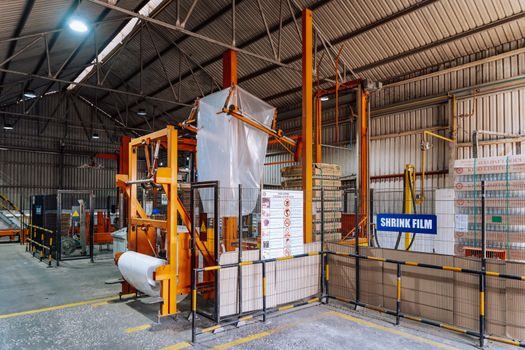
Bag choice defines the packaging line: 25 kg valve-bag (most common in Asia and EU masonry), 50 kg open-mouth (Middle East and Africa), 1 t / 1.5 t FIBC bulk bag (large projects), or 25-30 kg PE-lined kraft paper for moisture-sensitive gypsum [S2][S3]. A 25 kg valve-bag line at 200-400 bags/h needs a robotic or cantilever palletizer; above 600 bags/h, a high-level gantry palletizer with stretch-wrapper is the only viable configuration.
Dry mortar lines marketed as "fully automatic" almost always mean mixer-through-palletizer is PLC-linked, with HMI recipe storage of at least 50 formulations and remote diagnostics via 4G/Ethernet. Buyers should confirm the PLC brand (Siemens S7-1200, S7-1500; Mitsubishi FX5U) before signing, because spare parts and firmware support vary widely. For a project-contractor use case, semi-automatic (manual bagging) plus PLC-controlled mixing is the most common cost-effective spec in 2026.
Gate 6: Dust Collection, Safety and Regional Compliance
Dust at the mixer, conveyor transfer points, sand dryer, and bagging spout is the dominant EHS issue. A 10-30 t/h line needs a pulse-jet bag filter of 8,000-15,000 m³/h with emission below 20 mg/Nm³ to meet the China GB 4915-2013 (cement industry dust standard) or EU directive 2010/75/EU IED thresholds [S2][S3]. Buyers in the EU should also confirm machinery-safety compliance with EN ISO 12100 and ATEX zoned-classification for any silo-top dedusting unit, because starch- or cellulose-ether dust clouds fall into ATEX category 1 in practice.
Noise is the second environmental gate: a non-enclosed tower typically reads 85-92 dB(A) at 1 m; enclosed cabinets with vibration-isolated footings drop this to 75-80 dB(A) and are effectively mandatory for plants inside EU urban perimeters. Two more concrete reference points: the cement silo must include a relief valve certified to a minimum 0.06 MPa burst, and the bucket-elevator head pulley requires a belt-slip sensor and a zero-speed switch per ISO 5048 — both items are sometimes dropped from budget SKUs.
Side-by-Side Decision Matrix for the 2026 RFQ
For a buyer comparing 3 paths — small semi-automatic, mid-tier tower, or large fully automatic — the four decision criteria to score on are: output (t/h), bagging automation, polymer-modification capability, and EU-compliance package. Small semi-auto wins on capex and lead time but loses on output ceiling and polymer dosing. Mid-tier tower is the default for project contractors: 10-30 t/h, PLC-linked, valve-bag output, optional polymer skid, and a starter dust package that can be upgraded. [S1]
For Chinese OEM catalogs in 2026, the typical price band is 150,000-300,000 USD for a small 3-5 t/h line, 300,000-700,000 USD for a mid-tier 10-20 t/h tower, and 800,000-1,800,000 USD for a 30-60 t/h fully automatic line with bulk-silo and palletizing — figures consistent with current Made-in-China and direct-from-Henan OEM quotes [S1][S2][S3]. Freight, installation and civil works typically add 12-20% on top of FOB value, which is often missed in early budget rounds.
Common Spec Traps and Failure Modes
Buyers also report 3-5 month delivery slips on lines ordered with a CE-marked control cabinet, because retrofitting the documentation package after the fact is treated as a new order at the OEM. A second spec trap is specifying a 50 Hz motor for export to a 60 Hz country, or vice-versa — gearboxes for the rotary sand dryer are motor-coupled and not field-swappable without mechanical rework. For buyers also evaluating pressure transmitter and bulk-weigh scale integration, confirm Modbus TCP or PROFINET support at the plant PLC level before purchase.
Linked Buying-Frame Reference
Dry-mortar selection shares its gate-by-gate structure with adjacent bulk-material decisions covered in our concrete admixture selection guide — same philosophy of locking formulation, output and compliance before pricing — and with the tank container selection criteria write-up, where spec gates also determine whether a 2026 unit ships or sits. For a different industrial spec frame, the silicon steel vs nickel alloy comparison shows the same six-gate logic applied to electrical steels. [S2]
Trackable signals in the next reporting window: 2026 H2 price revisions from Henan OEMs (De Jin Yang, BHM) for full CE-marked lines; any tightening of EU IED dust thresholds below 10 mg/Nm³ for cement-and-mortar mixers; and an update on whether Chinese suppliers extend polymer-modified-skid pricing through 2026 Q4 [S1][S2][S3].