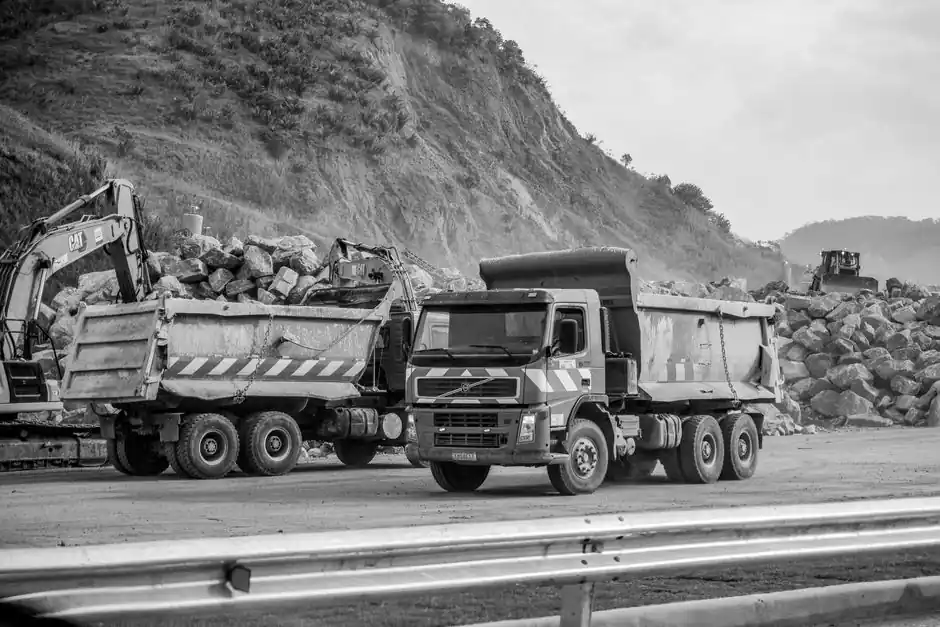
Payload on a dump truck is the difference between the manufacturer's Gross Vehicle Weight Rating (GVWR) and the truck's tare weight, with material density, bed volume, and axle class setting the practical upper limit on every load [S1][S3].
Confusing GVWR (a maximum total loaded weight assigned by the OEM) with payload (a derived cargo number) is the most common specification error on dump truck orders, and it cascades into axle, brake, and tire mis-sizing if the empty weight is not pinned down before quoting [S2][S4].
Defining the three numbers: GVWR, tare, and payload
GVWR is the OEM-assigned ceiling that includes the chassis, body, fluids, fuel, driver, and every pound of cargo, and the same definition is used by the U.S. Federal Highway Administration to bin vehicles into eight classes [S3][S4].
Tare weight (also called empty, curb, or unladen weight) is the truck ready-to-drive but unloaded, including full fluids, mounted dump body, hoist, tarp, and any permanently attached equipment, and it is the value that has to be subtracted from GVWR [S1][S3].
Payload capacity is the arithmetic remainder: GVWR minus tare weight, expressed in pounds or kilograms, and it represents the maximum mass of dirt, gravel, sand, asphalt, or demolition debris the truck can legally and mechanically carry on a single load [S1][S3][S5]. A worked example from the sources: GVWR 14,000 lb minus 4,000 lb empty leaves 10,000 lb of usable payload, while a Class 2 light-duty truck at 9,000 lb GVWR with a 6,000 lb curb weight shows a 3,000 lb payload [S1][S3].
FHWA class structure and where dump trucks sit
The FHWA class table, reproduced identically in current industry references, bins vehicles by GVWR: Class 1 up to 6,000 lb (compact pickups); Class 2a 6,001–8,500 lb; Class 2b 8,501–10,000 lb; Class 3 10,001–14,000 lb; Class 4 14,001–16,000 lb; Class 5 16,001–19,500 lb; Class 6 19,501–26,000 lb; Class 7 26,001–33,000 lb; and Class 8 above 33,001 lb [S3][S4].
Conventional on-highway dump trucks (single-frame, tandem rear axle) typically live in Class 7 to Class 8 with GVWR between 26,001 lb and roughly 60,000–80,000 lb for tractor-trailer end-dump or bottom-dump combinations [S3][S4]. Off-highway mining dump trucks sit well above Class 8, with rigid-frame haul trucks rated 100–400+ short tons and articulated dump trucks in the 25–45 ton range, none of which are FHWA-classed because they never operate on public roads.
Federal grouping: Classes 1–2 are light duty, Classes 3–6 are medium duty, and Classes 7–8 are heavy duty; CDL requirements typically engage at Class 7 [S3][S4]. For buyers of lighter dump trucks and trailers, the same GVWR logic applies to Class 3–6 chassis cabs with dump bodies fitted by a secondary manufacturer, where the body builder's weight certificate combines with the chassis OEM plate to set the final rated values.
Decision matrix: rating type vs use case
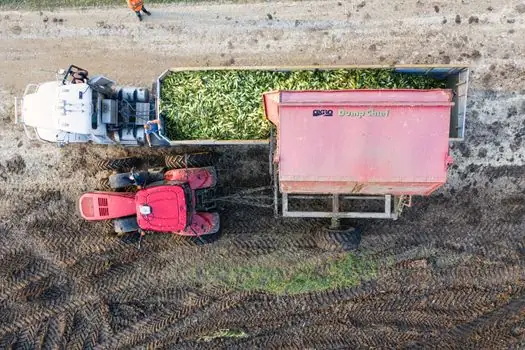
Three spec values drive the buying decision, and each is wrong in a different direction. GVWR is the legal and mechanical ceiling set by the manufacturer and must not be exceeded on public roads; tare weight is a fixed cost you carry every trip regardless of load; and payload is the variable revenue-earning capacity per cycle [S1][S3][S4].
Use case comparison: a landscaper running 4–6 yd³ of mulch in a Class 3 (GVWR 10,001–14,000 lb) chassis-cab dump will see payload of 5,000–7,000 lb after a 4,000–5,000 lb body tare, which is plenty for topsoil but forces light loads on dense aggregate [S3]. A municipal Class 7 tandem with a GVWR near 33,000 lb and a 9,000–11,000 lb body tare delivers a 20,000+ lb payload, enough for a heaped 5–6 yd³ load of wet sand at 3,200 lb/yd³ [S4]. A Class 8 highway end-dump set up at 60,000–80,000 lb GCWR with a 12,000–15,000 lb aluminum or steel trailer tare can move 22–27 yd³ of gravel per cycle, and that is where the per-ton economics of a haul business live [S4].
Selection rule of thumb drawn from the sources: pick the GVWR class first to satisfy CDL, insurance, and bridge-formula rules, then verify the body builder's tare certificate in writing, then compute payload as GVWR minus tare, and only then size the bed volume to the material density [S1][S3][S4].
Where the math breaks: material density, water, and the heaped yard
Dump truck buyers routinely oversize the bed and undersize the chassis, then wonder why the truck is overloaded on the third load of the day. The reason is that GVWR is a mass limit, not a volume limit, and common construction materials have very different mass per cubic yard: wet sand around 3,200 lb/yd³, gravel roughly 2,800–3,000 lb/yd³, topsoil 2,200–2,500 lb/yd³, and mulch only 400–800 lb/yd³ [S4].
Water absorption alone can move a load by 10–20%, and aggregate suppliers do not guarantee a consistent moisture content, so a payload calculation done on dry-weight brochures will be wrong on a wet January morning. Two dump trailers with the same 14,000 lb GVWR can have very different payloads if one is a heavy steel body and the other is an aluminum body; the heavier body eats into the cargo allowance [S1][S2].
Trailer-specific construction machinery and equipment references flag the same point: a "14K" trailer label describes the maximum loaded trailer weight, not the cargo number, and filling such a trailer with 14,000 lb of gravel would be a structural and legal overload once the 4,000 lb empty weight is netted out [S1][S2].
Compliance, axle, and tongue-weight constraints
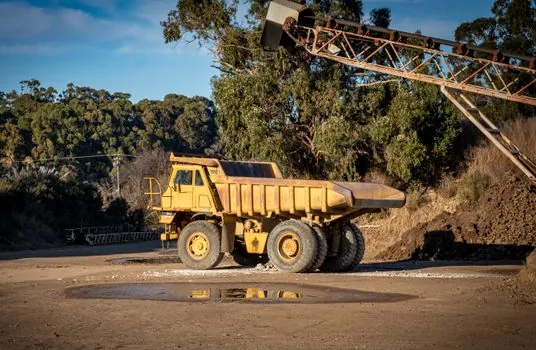
GVWR is a single number, but on a tandem dump truck it must satisfy both the GAWR (Gross Axle Weight Rating) on the front axle and the GAWR on the rear axle group, and an overloaded rear axle on a tandem is a common weigh-station failure even when total GVW is under GVWR [S3][S4].
On trailer combinations, tongue weight (the downward force on the hitch) should sit between 10% and 15% of the loaded trailer weight; below 10% the tow vehicle is prone to sway, and above 15% the steering axle is under-loaded [S3][S4]. This is part of the broader Gross Combined Weight Rating (GCWR) envelope, which the OEM sets from frame, suspension, axle, brake, and drivetrain strength, and it is the limit the towing vehicle plus loaded trailer must respect together, not separately [S3][S4].
Exceeding any single rating, even when others remain in range, can void the chassis manufacturer warranty, jeopardize insurance coverage, and trigger FMCSA roadside-out-of-service penalties in commercial use, which is why fleet spec sheets treat GVWR, GAWR, GCWR, and payload as a coupled set rather than independent numbers [S2][S3][S4].
How to read the data plates and the spec sheet
The OEM's GVWR is on the certification label on the driver's side door pillar, in the owner's manual, and on the Tire and Loading Information placard; for trailers the equivalent Federal Certification/VIN label is on the front left side, and the body builder's weight certificate should be filed alongside the chassis plate for any aftermarket dump body [S4].
For buyers working off a marketing brochure, a 2026 spec sheet will typically state GVWR, the installed body type, the empty weight, and sometimes a calculated payload, but the empty weight on the brochure is frequently a "base" figure that does not include tarp, hoist, toolboxes, rear hitch, or pintle, and each of those can add 200–800 lb [S1][S4]. The defensive move is to ask the body builder for an as-built scale ticket and add the chassis published tare, then compare the sum to GVWR before signing the PO.
Trackable signals for the next spec cycle: OEM chassis tare weights for Class 7 and Class 8 tandem configurations, body builder weight certificates for common 11–18 ft landscape and contractor dump bodies, and bridge-formula limits on state DOT postings for the haul routes, all of which feed back into a defensible GVWR, tare, payload triplet. For a related spec view, the dump truck bed size by axle configuration sizing chart pairs volume to GVWR class for direct lookup.