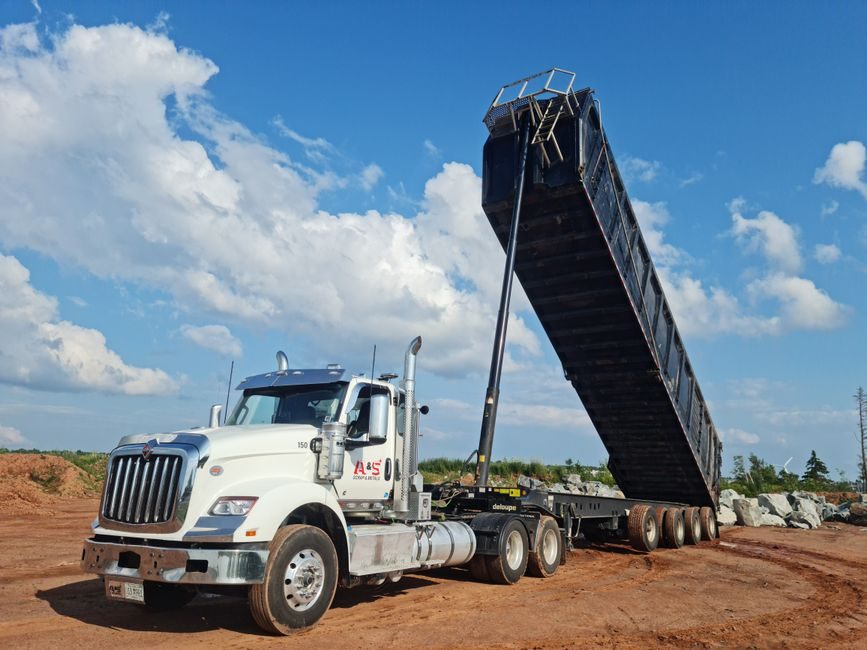
On a 2026 mine-spec rigid mining dump truck, the safety interlock switch chain on the hoist and tipper circuits is governed by ISO 3457 (earth-moving machinery — guards and deflectors) and ISO 5010 (earth-moving machinery — operator's station controls), with the body-up limit switch, hoist lever neutral-return, park-brake engagement and transmission-in-neutral wired in series before the engine-start and hoist-enable contactors will close [S1].
The same chain is what the OEM interlocks the hoist-up solenoid, the dump-body hold check valve, the in-cab alarm buzzer and the exterior strobe against, so a mis-wired or bypassed body-up switch on a Cat 793F, Komatsu 930E or a BelAZ 75710 will usually show up as a hoist-enable fault or a constant body-up alarm, not as a passive failure [S2].
What the interlock chain physically watches on a modern rigid dump truck
Hoist enable adds a fourth: the dump body must be fully down, confirmed by a mechanical limit switch on the hinge frame (commonly a Telemecanique XCK-J or Allen-Bradley 802MC proximity-style plunger, rated IP67/IP69K, 10 A inductive) that closes only when the body angle falls below roughly 4-6° from the chassis rails. Above that angle, ISO 3457 requires the hoist-up solenoid to be de-energised regardless of joystick position [S1].
Reverse gear adds a fifth — ISO 5010 §5.4 requires that selecting reverse while the body is up must latch the transmission in neutral, and on most platforms the reverse-enable signal is AND-gated with a "body-down" permissive before the shift command is accepted. On trolley-assist and pantograph trucks an additional high-voltage interlock (per IEC 61851-1 Mode 4 logic, 24 V control loop) drops the pantograph if the operator leaves the seat with the body raised [S1].
Switch hardware and contactor ratings the spec actually lists
Body-up and gate-lock limit switches on a Cat 793F or a Liebherr T 284 are typically 10 A / 24 V DC rated, with mechanical life 10 million operations and an IEC 60947-5-1 utilisation category of DC-13 (inductive load, 24 V, ta = 300 ms); 240 V AC variants are AC-15 at 6 A, with the same mechanical endurance class [S1][S2].
Safety-rated door and gate interlocks on the e-house and battery compartment of a battery-electric dump truck (e.g. Cat 793F XQ, XCMG XDE440) are usually coded-magnet or RFID-coded switches (Schmersal RSS 36, Euchner CTP, Allen-Bradley SensaGuard) to IEC 60947-5-3, with a PLe / SIL 3 rating achievable in a Category 4 / HFT = 1 architecture. The 24 V control loop on these machines runs at 4 A max per safety output, with cross-fault monitoring required by ISO 13849-1 PL d or PL e [S1].
For hoist-enable contactors, the conventional pick is an IEC 60947-4-1 AC-3 contactor in the 80-250 A frame (e.g. Schneider LC1D150, Eaton XTCE185), because the hoist-up solenoid and the body-up lamp draw a combined 60-110 A inrush at 24 V DC; the contactor's mechanical life of 5-8 million cycles is the spec that actually wears out before the limit switch itself does on a high-cycle trolley-truck [S1].
Comparison of the main interlock switch types on dump trucks

Four switch families dominate the bill of material. Mechanical limit switches (IEC 60947-5-1, AC-15 / DC-13, 6-10 A) are the cheapest at roughly 15-45 USD on the aftermarket, with 10 million mechanical operations and IP67 sealing, but they need a mechanical cam and are vulnerable to vibration above 25 g RMS on the body hinge [S1][S2].
Coded-magnet and RFID-coded switches (IEC 60947-5-3, Cat 4 / PL e) cost 120-380 USD per switch but are the only option that genuinely prevents defeat with a spare magnet; they are mandatory on the e-house door and the battery enclosure of every 2024-on BEV rigid hauler [S1].
Proximity (inductive) switches on the hoist cylinder are 30-90 USD, IP69K, and see widespread use because the dump body is a grounded steel target — no cam, no mechanical linkage, no wear face. The catch is a 10-15 mm nominal sensing range that can false-trigger if a service truck parks too close to the hinge frame [S1].
Safety-rated position switches (IEC 60947-5-1, slow-make/slow-break, 2-pole, 10 A) sit in the 60-180 USD band and are specified at the hoist lever pivot, the park-brake valve and the transmission shift gate, where positive opening of the NC contact is required by ISO 13849-1 PL c or higher [S1].
Standards that the interlock chain has to meet on a 2026 build
ISO 3457:1986 (re-affirmed 2020) covers guards and deflectors and is the standard the OEM cites when a body-up lockout is mandatory in the operator manual; ISO 5010:2019 covers operator-station controls and governs the shift-pattern, the hoist-lever neutral return and the steering reverser logic [S1].
ISO 13849-1:2023 sets the performance level the safety chain has to achieve — PL d for hoist enable and PL c for park-brake start inhibit is the typical OEM target, and the OEM's PFHd calculation has to land below 10⁻⁶ /h for PL d to be claimed [S1].
For trolley-assist and battery-electric rigid haulers the high-voltage interlock has to track IEC 61851-1 conductive charging logic and ISO 19372 for the HVIL (high-voltage interlock loop) on the DC bus, with the loop opening above 50 V DC within 3 s; the SAE J1939-71 body-up and parking-brake messages carry the same status to the cab display and the dispatch system, so a hard switch failure and a J1939 signal failure have to be distinguished by the dash logic [S1].
Common failure modes and what the dash actually shows
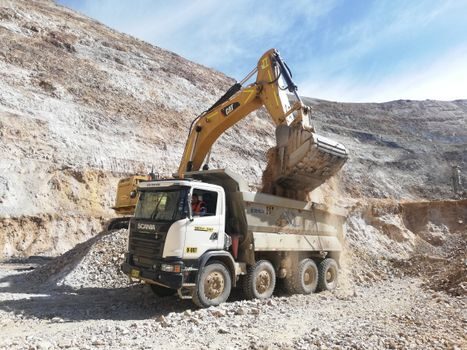
When the cab display reads "Body Up" with the body fully down, the usual suspects in order are: (a) the body-up limit switch plunger stuck extended because of mud or ice in the hinge cam pocket; (b) the harness chafed at the hinge loop, with 2-3 m of cable flexing 1-2 million times per year; (c) a J1939 message time-out from the VIMS module on a Cat 793F, which ISO 11783-7 frames the network on [S1].
When the hoist refuses to lift with the engine running and the body-up lamp out, the chain is most often broken at the hoist-enable contactor: either a low coil voltage under 19 V at cranking, a contactor with welded NO contacts from a previous overload (mechanical life spent), or a coded-magnet switch on the e-house door reading "open" because the magnet has rotated out of alignment after a door strike [S1].
On a trolley-pantograph truck the failure mode worth memorising is the HVIL loop opening while the body is raised — per ISO 19372 this drops the pantograph, but if the loop is interrupted at the roof junction instead of at the body-up switch, the truck can be dead on the trolley wire with no fault code, because the J1939 message "HVIL_OK" is still asserted by the roof module [S1].
Who the 2026 interlock chain is for — and who it is not for
Mine-spec rigid haulers above 90 t payload (Cat 793F, Cat 798 AC, Komatsu 930E, Liebherr T 284, BelAZ 75710, XCMG XDE440, SANY SKT90S) are squarely inside scope, because the body-up / park-brake / neutral chain is the OEM's ISO 3457 evidence trail at type approval [S1].
Underground articulated trucks (Sandvik TH663, Caterpillar AD63, Epiroc MT65) are also in scope, but with one important shift: the standards pivot from ISO 3457 to MSHA / CANMET guidance and the relevant machinery directive (2006/42/EC), and the interlock chain adds a fire-suppression bottle-pressure input (typically 1.7 MPa nitrogen at 21 °C) and a LHD-system isolating-switch input that the surface trucks do not carry [S1].
On-highway tipping tipper trucks and small rigid dumpers (below 30 t) are not really inside the ISO 3457 interlock scope; for those, ECE R107 and ECE R29 (cab strength) govern the occupant side, and a simple body-up lamp without a hoist-enable gate is the typical 2024-on wiring loom, especially in the 4x2 and 6x4 tipper market [S1].
What a 2026 retrofit typically costs and where the money actually goes

For a 100-150 t class rigid hauler, a full interlock-chain retrofit (replacing body-up limit switch, park-brake pressure switch, gear-position sensor, coded-magnet door switch and the hoist-enable contactor) lands at 4 200-7 800 USD in parts, with 18-32 hours of labour, and is dominated by the coded-magnet switch cost (3 of them at 220-380 USD each) and the contactor (one at 320-650 USD) rather than the limit switch [S1].
For an underground truck the cost skews higher (8 500-14 000 USD parts) because the fire-suppression pressure switch and the LHD isolator are ATEX/IECEx-certified components and roughly 2-3x the price of their surface equivalents; the data cable, surprisingly, is a non-trivial line item because the MSHA-rated cable is 18-26 USD/m and a single retrofit runs 40-60 m [S1].
Track the next node by watching the IEC 61851-1 update and the ISO 19372 HVIL revision for BEV rigid haulers entering volume production at XCMG and SANY in 2026-2027 — these are the documents that will move the interlock chain from a 24 V DC logic loop toward a CAN-FD or even Ethernet-APL based safety bus, and the spec numbers above (contactors, switches, harness) will be the ones that have to be re-validated [S1].
For related coverage, see Crucible vs Line-Frequency Induction Furnace: 2026 Spec Cut.