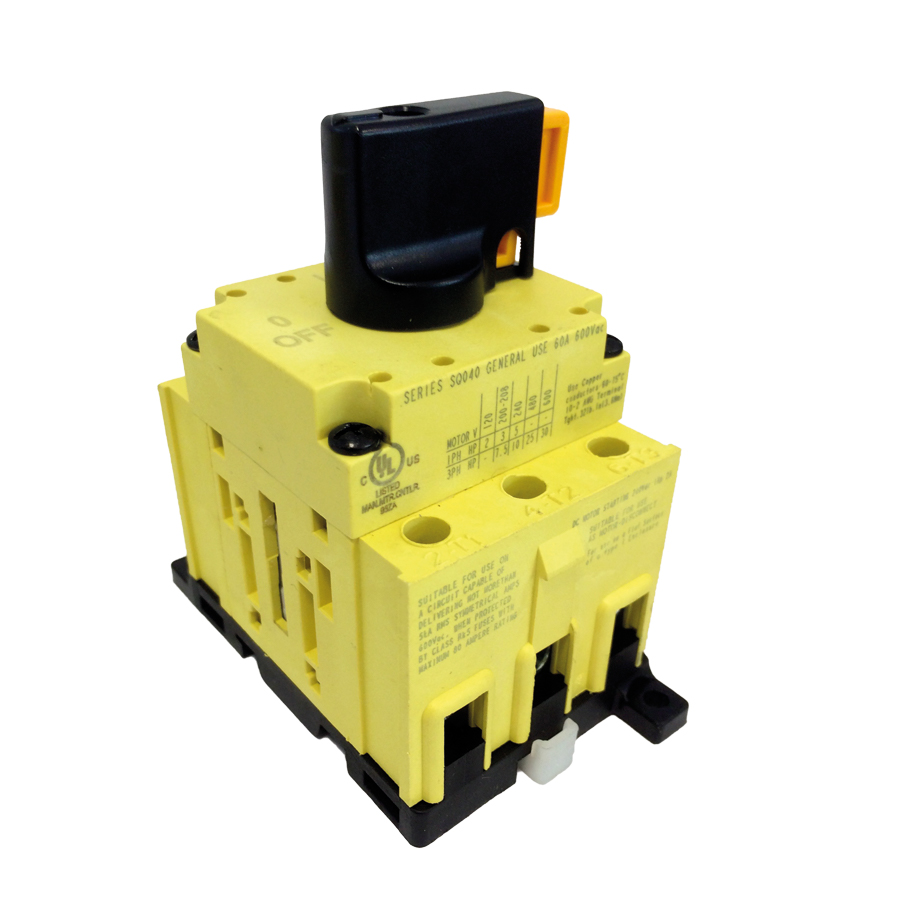
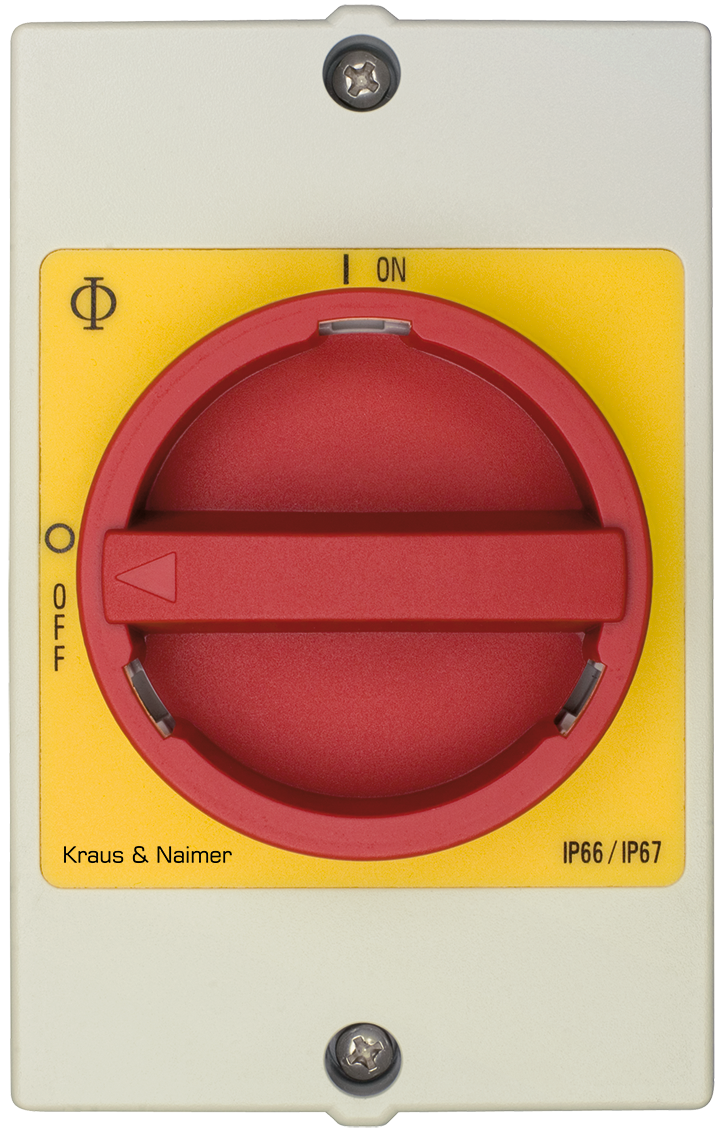
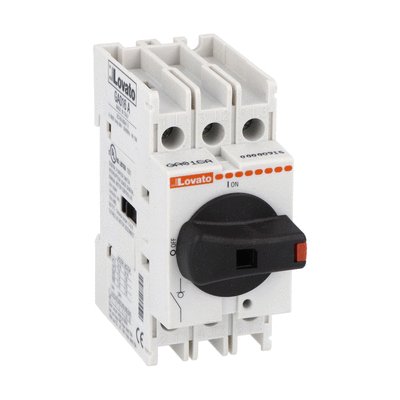
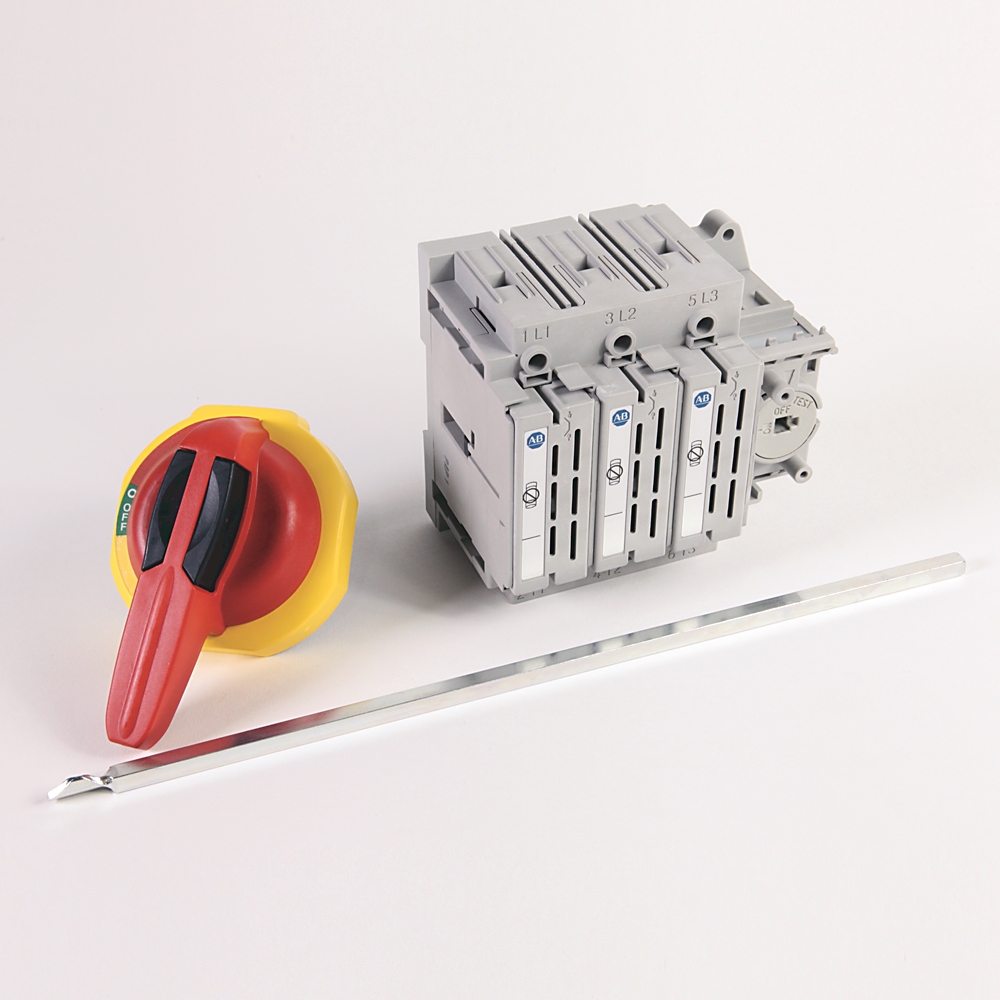
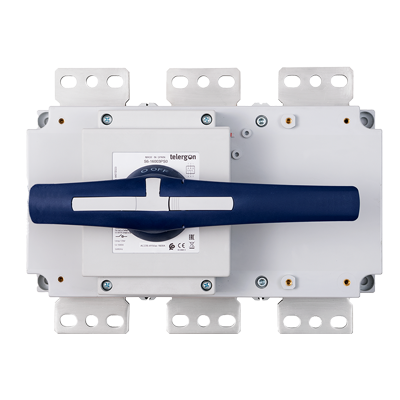
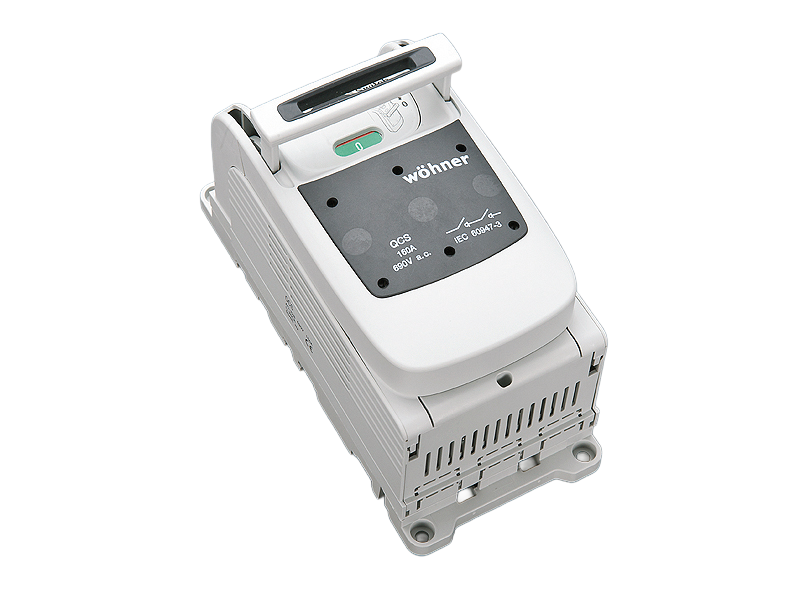
An isolating switch is a mechanical switching device that creates a verifiable break in a power circuit so the downstream section can be safely de-energized for maintenance. The umbrella term covers three distinct devices defined in IEC 60947-3: the disconnector (a pure isolator that must not be operated on load), the switch (which can break load current but does not by itself guarantee isolation), and the switch-disconnector or load-break switch (which does both). Most products sold today as isolating switches are switch-disconnectors, because they let an operator open a live circuit and then lock it out in one motion.
The defining property is not how much current the device carries but what it guarantees when open: a specified isolating distance, an impulse voltage withstand across the gap, and a lockable OFF position that cannot indicate open unless the main contacts truly are. That isolation guarantee is what separates an isolating switch from an ordinary control switch, and it is why these devices are the legal lock-out point for live-work permits.
Photo: Dmitry G, CC BY-SA 3.0, via Wikimedia Commons
This guide is written for industrial purchasing engineers and design engineers. It covers six chapters from device definitions, the type taxonomy, isolation physics and arc control, ratings and standards, spec-sheet decoding, through to selection decisions, plus seven selection FAQs and manufacturer references. All parameters reference the IEC 60947-3 (low-voltage switches, disconnectors, switch-disconnectors and fuse-combination units), IEC 62271-102 (high-voltage disconnectors and earthing switches), and UL 98 / UL 98B public standards.
Chapter 1 / 06
What is an Isolating Switch
An isolating switch is a manually or motor operated mechanical device whose primary engineering purpose is to interrupt a circuit and hold it open in a state that a maintenance worker can trust. The phrase "isolating switch" is a category label, not a single product. Under the international low-voltage standard IEC 60947-3, three formally distinct devices share the role: the disconnector, the switch, and the switch-disconnector. The differences are not cosmetic. They decide whether you are allowed to operate the handle while current is flowing, and whether you are allowed to certify the open device as a safe point of isolation.
A disconnector, often called an isolator, provides the isolation function and nothing else. In the open position it guarantees a defined isolating distance between contacts and a defined impulse voltage withstand across that gap, but it has no rated load-breaking capacity. Operating a disconnector under load risks a sustained arc that welds or destroys the contacts, which is why disconnectors carry interlocks or warnings against on-load operation. A switch is the inverse: it can make, carry, and break currents under normal and specified overload conditions, but it does not by itself certify isolation. A switch-disconnector, also called a load-break switch, combines both functions, so it can be opened on load and then relied on as the isolation point. Most devices on the market today are switch-disconnectors precisely because they remove the operating restriction of a pure disconnector.
The deeper distinction is between two engineering jobs that look similar but are governed by different physics. Switching is about controlling an arc as the contacts part under current. Isolation is about the dielectric and mechanical integrity of the open gap once current is gone. A device can be excellent at one and useless at the other. A relay contact switches well but provides no certified isolation. A knife switch isolates but cannot break a motor safely. The standard exists to force makers to declare exactly which jobs a given device is proven to do.
Historically, the isolating function was performed by the open-blade knife switch, a hinged copper blade pulled out of a jaw contact, still visible in legacy panels and in some utility yards. The visible air gap of the open blade was its safety argument: you could see that the circuit was open. Modern enclosed switch-disconnectors keep that principle but hide the contacts inside a housing, so the standard now requires either a true visible break through a window or a positive position indicator mechanically tied to the main contacts. This is the reason a reputable device shows OFF only when the contacts are genuinely separated, never on handle position alone.
Four engineering properties decide whether an isolating switch is fit for a job: the rated operational current and voltage it carries continuously, the utilization category that declares what loads it can make and break, the short-time withstand current that determines whether it survives a fault until an upstream device clears it, and the integrity of the isolation guarantee, namely the visible or verifiable break and the lockable OFF position. The chapters that follow decode each of these in turn.
Chapter 2 / 06
Device Types and Classification
Isolating switches are classified along three independent axes: the IEC 60947-3 device type (disconnector, switch, switch-disconnector, or fuse-combination unit), the construction and mounting form, and the supply system (AC or DC, low or medium voltage). Confusing the first axis is the most common and most dangerous beginner error, because it determines whether on-load operation is permitted at all. The table below summarizes the four IEC device types and the function each one guarantees.
Device Type
Isolation Function
Load Make/Break
Typical Role
Disconnector (isolator)
Yes
No (off-load only)
Maintenance isolation, busbar sectioning
Switch
Not guaranteed
Yes
On-load control, no certified lock-out
Switch-disconnector
Yes
Yes
Main switch, feeder isolation, motor isolator
Fuse-combination unit
Yes (when so designed)
Yes
Isolation plus HRC short-circuit protection
A fuse-combination unit deserves its own note. It integrates a switch or switch-disconnector with high-rupturing-capacity (HRC) fuses in a single body, delivering isolation, load breaking, and short-circuit protection together. Two arrangements exist: the switch-fuse, where the fuses are downstream of the switch contacts, and the fuse-switch, where the fuse carriers themselves move and act as the contacts. The unit is compact and gives current-limiting fault protection from the fuse, at the cost of having fuses to stock and replace after a fault. Telergon, IMO, and ABB build extensive fused switch-disconnector lines rated to IEC 60947-3 and, for North America, UL 98.
By construction and mounting, isolating switches fall into several practical forms. Open-frame and DIN-rail switch-disconnectors mount inside a panel or distribution board and are the workhorse of low-voltage distribution, typically 16 to 160 A. Front-operated and door-interlocked switches use an extended rotary handle so the panel door cannot open while the switch is closed, enforcing a safe sequence. Enclosed safety switches ship in their own IP65 or NEMA 3R/4X box for outdoor, washdown, or field disconnect duty next to a motor. Bus-mounted and withdrawable disconnectors serve large switchboards and motor control centers up to 4000 A.
By supply system, the split between AC and DC isolating switches is fundamental and not interchangeable, a point Chapter 3 develops. AC low-voltage devices follow IEC 60947-3 up to 1000 V AC. DC devices, dominated today by solar photovoltaic and battery storage, follow the DC utilization categories of the same standard and are commonly rated 600, 1000, or 1500 V DC. Above 1000 V AC the relevant standard changes to IEC 62271-102, which governs medium and high-voltage disconnectors and earthing switches for systems from 3.6 kV up to and beyond 40.5 kV, where isolation is paired with a dedicated earthing switch to ground the isolated section before anyone touches it.
One more classification axis is the number of poles. Three-pole devices switch the three line conductors of a balanced load. Four-pole devices add a switched neutral, required where the installation standard demands that the neutral be isolated along with the lines, for example in certain TT and IT earthing systems or where a transfer switch must fully separate two sources. ABB OT and Socomec SIRCO lines offer 3, 4, 6, and 8-pole variants to cover multi-circuit and changeover arrangements.
Chapter 3 / 06
Isolation Physics and Arc Control
Two physical problems define isolating switch engineering: extinguishing the arc that forms as contacts part under current, and holding off voltage across the open gap afterward. The first is a switching problem, the second an isolation problem, and they are solved by completely different parts of the device. Understanding both explains why an AC switch cannot be reused on DC and why a true disconnector needs no arc control at all.
When loaded contacts separate, the last point of metal contact carries the full current through a shrinking area, heats to vaporization, and ionizes the gap into a conducting plasma: an arc. In an AC circuit the current naturally passes through zero twice every cycle, 100 or 120 times per second at 50 or 60 Hz. At each zero crossing the arc momentarily loses its energy source, and if the gap has cooled and lengthened enough, the arc fails to restrike and the circuit is cleared. AC arc control therefore works with nature: arc chutes split and stretch the arc, deion grids divide it into many short series arcs, and the next current zero finishes the job. This is why AC ratings are achievable in compact devices.
A DC circuit offers no current zero. The current is steady, so the arc never loses its energy source on its own and will burn indefinitely until the device physically forces it out. DC isolators must therefore drive the arc to extinction by brute force: magnetic blow-out coils or permanent magnets deflect the arc into long arc chutes, the arc is stretched until its voltage exceeds the source voltage, and multiple contacts are placed in series so each gap shares the burden. This is why a switch rated only for AC will fail catastrophically on a DC load, sustaining an arc that erodes the contacts and can ignite the enclosure. It is also why DC voltage ratings are lower for a given physical size and why solar DC isolators are conspicuously larger than their AC equivalents.
The table below compares how the four IEC 60947-3 AC utilization categories define the making and breaking duty a device must prove. The category is the single most important line on the datasheet for load switching, because it states the multiples of rated current and the power factor the device is tested at.
Category
Load Type
Make (xIe)
Break (xIe)
Power Factor
AC-20A/B
No-load isolation only
—
—
—
AC-21A/B
Resistive, light overload
1.5
1.5
0.95
AC-22A/B
Mixed resistive + inductive
3
3
0.65
AC-23A/B
Motors, highly inductive
10
8
0.35 make / 0.45 break
Reading the table: an AC-20 device is a pure disconnector, tested for isolation but with no make or break duty, so it must only ever be operated dead. AC-21 covers resistive loads like heaters, where the current is nearly in phase with the voltage and inrush is mild. AC-22 covers mixed distribution loads, lighting plus light induction, with moderate overload. AC-23 is the severe case: a 100 A AC-23 device must make 1000 A at a lagging power factor of 0.35 to survive motor locked-rotor inrush, and break 800 A at 0.45, generating a sustained low-power-factor arc that demands robust arc chutes. The suffix A denotes frequent operation, B infrequent operation, which sets the number of make-break cycles the device is endurance-tested for.
For DC service the same standard defines parallel categories with their own multiples and circuit time constants. The table below gives representative DC making and breaking duty. The time constant L/R sets how slowly the DC current rises and therefore how hard the arc is to clear: a longer time constant means a more inductive, more punishing load.
Category
Load Type
Make (xIe)
Break (xIe)
Time Constant
DC-20A
No-load isolation
—
—
—
DC-21A
Resistive, light overload
1.5
1.5
1 ms
DC-22A
Mixed, shunt motors
4
4
2.5 ms
DC-23A
Highly inductive, series motors
4
4
15 ms
The second physical job, isolation, is unrelated to arc control. Once current is gone, what matters is whether the open gap can block voltage indefinitely without flashover. The standard requires the open contacts to withstand a rated impulse voltage across the gap, and the gap itself must meet a minimum dimension that scales with voltage, roughly 3 mm at 600 V, 6 mm at 1000 V, and 12 mm at 1500 V. A pure disconnector, paradoxically, is the most demanding device on the isolation axis and the least demanding on the switching axis: it does no arc work but must guarantee the cleanest open gap.
Chapter 4 / 06
Ratings and Governing Standards
Isolating switches are governed by a small set of product standards that define every rating on the datasheet. Quoting the right standard and the right rated values is what separates a compliant specification from an ambiguous one. The dominant low-voltage standard is IEC 60947-3, "Low-voltage switchgear and controlgear, Part 3: Switches, disconnectors, switch-disconnectors and fuse-combination units," which applies to devices up to 1000 V AC and 1500 V DC. Its harmonized European form is EN IEC 60947-3, with the current edition published in 2021. In North America, enclosed switches follow UL 98 (Enclosed and Dead-Front Switches) and, for photovoltaic DC, UL 98B.
Above 1000 V AC the governing document changes to IEC 62271-102, "High-voltage switchgear and controlgear, Part 102: Alternating current disconnectors and earthing switches." Medium-voltage disconnectors are specified by rated voltage Ur at standard values of 3.6, 7.2, 12, 17.5, 24, 36, and 40.5 kV, and by rated short-time withstand current Ik at standard values such as 16, 20, 25, 31.5, and 40 kA, typically for 1 or 3 seconds. At medium voltage, isolation is almost always paired with an interlocked earthing switch that grounds the isolated section before maintenance, because induced and capacitive voltages on a long de-energized line are themselves hazardous.
The ratings every isolating switch datasheet must declare, and what they mean for selection, are summarized below.
Rating
Symbol
Typical LV Values
What It Governs
Rated operational current
Ie
16 to 4000 A
Continuous load current carried
Rated operational voltage
Ue
400 / 690 / 1000 V AC
System voltage the device works at
Rated insulation voltage
Ui
690 to 1000 V
Dielectric design / clearance basis
Rated impulse withstand
Uimp
6 to 8 kV
Surge withstand across open gap
Short-time withstand current
Icw
up to 50 kA / 1 s
Fault current survived until cleared
Short-circuit making capacity
Icm
peak, several xIcw
Closing onto an existing fault
The most misunderstood of these is the relationship between Icw and breaking capacity. A switch-disconnector is deliberately not designed to interrupt a high short circuit. When a fault occurs, the isolating switch must carry the prospective fault current without its contacts welding, blowing apart, or its housing rupturing, for long enough that the upstream fuse or circuit breaker clears the fault. That survival rating is Icw, expressed as an rms current for a stated time, for example "12 kA for 1 s." The making rating Icm matters because closing a switch onto a circuit that is already faulted produces a peak current several times the rms value, and the device must survive that closing event.
When a fuse is built in, the assembly instead declares a rated conditional short-circuit current: the prospective fault the combination can handle because the fuse limits the let-through energy. This is how a modestly rated switch body can be applied on a high-fault busbar: the HRC fuse, not the switch, does the interrupting. Coordination between the isolating switch Icw and the upstream protective device is therefore a design calculation, not a catalogue lookup, and must be verified for the specific installation.
Two further compliance dimensions complete the picture. Ingress protection to IEC 60529 (IP20 for open panel devices up to IP66/IP67 for outdoor enclosed switches) and the North American NEMA enclosure classes (NEMA 1, 3R, 4, 4X, 12) decide environmental suitability. Endurance is split into mechanical operations (handle cycles with no current, often tens of thousands) and electrical operations (make-break cycles under the rated load of the utilization category, far fewer), and the two are quoted separately because they wear different parts of the device.
Chapter 5 / 06
Key Specification Parameters
Reading an isolating switch datasheet is a core purchasing skill. A single device may list twenty or more lines, but only a handful drive the selection decision: device type, utilization category, rated operational current and voltage, short-time withstand current, pole count, isolation and lock-out provisions, ingress protection, and certifications. Each is decoded below.
Device type and utilization category together answer the first question: can this device be operated on load, and on what load. A line reading "switch-disconnector, AC-23A 690 V" tells you it can break a motor at 690 V under frequent duty. A line reading "disconnector, AC-20" tells you it must never be operated live. Never infer the category from the rated current alone, because two devices of identical Ie can carry very different make-break duties.
Rated operational current Ie and voltage Ue must be read together, because Ie is declared at a specific Ue. The same device may carry, for example, a higher Ie at 400 V than at 690 V, since the higher voltage produces a harder arc to break. Always read the Ie figure at your actual system voltage and your actual utilization category, not the headline number on the product title.
Short-time withstand current Icw with its time base sets fault survival. "Icw 12 kA / 1 s" means the device tolerates a 12 kA rms fault for one second. This must coordinate with the clearing time of the upstream protective device: if the fuse or breaker takes longer to clear than the Icw time rating allows at the prospective fault level, the isolating switch can be destroyed even though it never tried to interrupt anything.
Pole count and configuration covers 3-pole, 4-pole (switched neutral), and multi-pole changeover arrangements. Isolation and lock-out provisions are the safety-critical lines: presence of a visible break or positive position indication, padlockable OFF position (often up to three padlocks for multi-trade lock-out), and door interlocks. Ingress protection and ambient temperature range (commonly -25 to +40 degrees C for switchgear, with derating above) decide where the device can live.
The output of selection is a single catalogue number, but the inputs are several. The list below is a compact spec-sheet checklist for any isolating switch enquiry.
Function: disconnector, switch, switch-disconnector, or fuse-combination unit.
Utilization category: AC-20/21/22/23 or DC-20/21/22/23, with the A or B suffix.
Rated current Ie at the actual operational voltage Ue and category.
Short-time withstand Icw with time base, coordinated upstream.
Pole count: 3, 4, 6, or 8 poles as the system requires.
Isolation provisions: visible break or position indicator, padlockable OFF.
Enclosure / IP: open, IP65, IP66/IP67, or NEMA 3R/4X for the environment.
Certifications: IEC 60947-3, UL 98 / 98B, IEC 62271-102 for MV, plus any project marks.
Chapter 6 / 06
Selection Decision Factors
To turn the preceding five chapters into a specific model, follow the ordered decision sequence below. Most selection mistakes come not from a single wrong number but from deciding a downstream detail before an upstream one, for example fixing on a current rating before settling whether the device must operate on load at all. These eight steps double as an RFQ template.
Function first: Decide whether you need pure isolation (disconnector), load switching without certified isolation (switch), or both (switch-disconnector). If you need short-circuit protection in the same body, choose a fuse-combination unit. This single decision constrains everything downstream.
Utilization category: Match the category to the worst-case load. Motor and inductive duty needs AC-23A; mixed distribution needs AC-22A; resistive heating needs AC-21A; off-load isolation needs only AC-20. For DC, choose the DC category that covers your circuit time constant. Pick suffix A for frequent operation, B for occasional isolation.
Rated current and voltage: Set Ie at or above the load current, read at your actual operational voltage and category, never the bare frame size. For motors, size to full-load current and let the AC-23A rating absorb inrush.
Short-circuit coordination: Establish the prospective fault current at the device location, confirm Icw with its time base survives it, and verify the upstream fuse or breaker clears within that time. For high faults, prefer a fuse-combination unit and use its rated conditional short-circuit current.
Pole count and switching arrangement: 3-pole for a balanced line load, 4-pole where the neutral must be isolated, multi-pole for changeover and dual-source transfer.
Isolation and lock-out: Confirm visible break or positive position indication, padlockable OFF (and how many padlocks), and any door or sequence interlock the panel design requires. This is the safety-critical step, not an afterthought.
Enclosure and environment: Open panel device (IP20) for inside a board; IP65 or IP66/IP67 enclosed safety switch for outdoor, dusty, or washdown duty; NEMA 3R/4X for North American outdoor. Confirm the ambient temperature and any derating.
Certifications and total cost: IEC 60947-3 for LV, UL 98/98B for North America, IEC 62271-102 for MV, plus project-specific marks. Then weigh purchase price against endurance: a device matched to the correct category and duty cycle outlasts an under-rated one that welds shut after a few hundred operations.
One last dimension is often overlooked: serviceability and supply continuity. For a fuse-combination unit, confirm the fuse type and rating are a standard, stockable HRC reference, not a proprietary part. For motorized switch-disconnectors used in transfer schemes, confirm spare actuator and auxiliary-contact availability. ABB (OT, OTM), Socomec (SIRCO, SIRCO M, SIRCO PV), Schneider Electric (TeSys VLS, InterPact INS/INV), Eaton, Siemens, Telergon, and IMO all maintain broad low-voltage ranges with documented spares and local distribution, which makes them defensible choices for installations expected to run for one or two decades. Verify the exact catalogue number, pole count, and certification on the manufacturer datasheet before committing, because ratings differ by frame size and by voltage class.
FAQ
What is the difference between a disconnector, a switch, and a switch-disconnector?
All three are defined in IEC 60947-3. A disconnector (isolator) provides only the isolation function: in the open position it guarantees a specified isolating distance and must not be operated under load, since it has no rated breaking capacity. A switch can make, carry, and break currents under normal and specified overload conditions but does not by itself guarantee the isolation function. A switch-disconnector (load-break switch) combines both: it can make and break load current and, when open, also satisfies the isolation requirements. In practice most modern devices sold as isolating switches are switch-disconnectors, because they can be operated safely under load and still lock out for maintenance.
What do the utilization categories AC-20, AC-21, AC-22, and AC-23 mean?
They describe what the device is proven to make and break under IEC 60947-3. AC-20 is no-load or negligible-current isolation only, so it is a pure disconnector that must never be switched on load. AC-21 covers resistive loads with light overload (heaters, resistive banks). AC-22 covers mixed resistive and inductive loads (distribution boards, lighting plus light motors). AC-23 covers motors and highly inductive loads: the device must make 10 times rated current at a power factor of 0.35 and break 8 times rated current at 0.45, the most demanding duty. The suffix A means frequent operation and B means infrequent operation. Always match the category to the worst-case load, not the steady-state current.
Why must a disconnector provide a visible or verifiable break?
Isolation exists to protect a person working downstream. The isolating function under IEC 60947-3 requires that the open contacts withstand a defined impulse voltage across the gap and that the open state be either directly visible or positively indicated by a mechanism that cannot show OFF unless the main contacts are actually open. Typical minimum contact gaps scale with voltage, roughly 3 mm at 600 V, 6 mm at 1000 V, and 12 mm at 1500 V. The handle must accept a padlock in the OFF position so the circuit can be locked out and tagged. A device without verifiable break cannot legally serve as the isolation point for live-work permits.
How do I size an isolating switch for a motor circuit?
Select an AC-23A rated device whose rated operational current Ie at the relevant voltage equals or exceeds the motor full-load current, never the nameplate frame size alone. The AC-23A rating already accounts for making 10 times Ie during locked-rotor inrush and breaking 8 times Ie at low power factor, so no separate inrush derating is normally needed. Verify the rated operational voltage covers your system (400 V or 690 V), confirm the Icw coordinates with the upstream protective device, and check that the device pole count matches the supply (3-pole, or 4-pole if the neutral must be isolated). For frequent jogging duty choose category A; for an occasional maintenance isolator, category B at the same Ie is acceptable and cheaper.
Can an AC isolating switch be used on a DC photovoltaic circuit?
No. A DC arc has no natural current zero, so it does not self-extinguish the way an AC arc does at every half cycle. A switch rated only for AC will fail to clear a DC load and can sustain an arc that destroys the contacts and starts a fire. DC-rated isolators use magnetic blow-out coils, longer arc chutes, and often multiple contacts in series to stretch and cool the arc. For solar use, specify a device certified to IEC 60947-3 DC utilization categories (DC-21A or DC-22A) and, for North America, UL 98B with a voltage rating at least equal to the maximum PV system voltage, which NEC 690.7 sets from the summed module Voc corrected for the lowest expected temperature. Common DC classes are 600, 1000, and 1500 V DC.
When should I choose a fuse-combination unit instead of a plain switch-disconnector?
A fuse-combination unit (fused switch-disconnector or switch-fuse) integrates a load-break switch with HRC fuses in one body, giving both isolation and short-circuit protection in a single compact device. Choose it where you need a high prospective fault current cleared with let-through energy limited by the fuse, where space is tight, or where the application standard expects fuse protection (industrial feeders, motor circuits with type 2 coordination). Choose a plain switch-disconnector when a separate upstream circuit breaker already provides protection and you only need a downstream isolation and load-break point, which simplifies maintenance because there are no fuses to stock or replace.
Which manufacturers and series are common for industrial isolating switches?
For low-voltage switch-disconnectors, ABB OT and OTM cover roughly 16 to 4000 A with 3, 4, 6, and 8-pole versions and AC-23A ratings; Socomec SIRCO and SIRCO M serve 16 to 4000 A, with the SIRCO PV line rated for solar DC up to 1500 V DC and UL 98B; Schneider Electric offers TeSys VLS and the InterPact INS and INV ranges; Telergon and IMO supply fused switch-disconnectors to IEC 60947-3 and UL 98. For medium-voltage isolation and earthing, look to ABB, Siemens, Schneider, and Eaton disconnector and earthing-switch products built to IEC 62271-102. Verify the exact catalogue number, pole count, and certification on the maker datasheet before purchase, because ratings differ by frame and voltage.
Isolating Switch Manufacturers
Source-backed product routes. Open a company dossier for procurement scope and cited evidence.