Mill-direct duplex stainless plate and pipe typically run 12 to 24 weeks from order release to delivery in 2026, compared with 8 to 12 weeks for standard austenitic 304/316 plate and pipe, a 4 to 12 week premium that procurement teams must absorb in project schedules [S1]. Domestic distributor stock trims that window sharply: in Northern America, super duplex plate and pipe from in-region inventory clears in 1 to 4 weeks, while mill-direct specialty plate and pipe require 12 to 20 weeks [S5]. The gap is widest for super duplex UNS S32750 and UNS S32760 plate above 25 mm, where mill heat numbers and PREN verification add a qualification step not present on 2205 plate.
Lead time is not a single number; it is a function of grade family, product form, plate thickness, and whether the order hits a mill rolling slot or pulls from a service center. Procurement engineers should treat the 1 to 4 week stock window as a buffer that exists for the most common 2205 and 2507 sizes, and the 12 to 24 week mill window as the planning baseline for everything else. For a working duplex stainless steel spec, this delta decides whether a turnaround can use duplex or must fall back to 316L with a corrosion allowance.
Where the Lead Time Delta Comes From
Three structural drivers produce the 4 to 12 week premium over austenitic grades. First, duplex and super duplex require tighter control of ferrite-austenite phase balance, typically 40 to 60 percent ferrite in solution-annealed condition, and that balance is set by a heat-treatment step that austenitic 304/316 production lines can largely skip [S1]. Second, nickel and molybdenum combined represent 55 to 65 percent of raw material input cost for super duplex production, and the alloying charge is exposed to LME nickel and moly oxide volatility that austenitic production hedges more easily [S5]. Third, mill capacity for duplex is a fraction of austenitic capacity: most integrated mills schedule duplex heats on dedicated weekends or campaign windows, not on continuous shift rotation, so a single rolling slot governs the order book. The result is a 16 to 24 week mill lead time for the standard duplex premium grade 2205, and 20 to 24 weeks for super duplex 2507 plate above 12 mm [S1].
The practical consequence is that 2205 and 2507 plate and pipe cannot be ordered on the same short cycle as 316L. A maintenance turnaround scheduled 8 weeks out that needs ten 2507 weldolet fittings must either find a distributor with stock, accept a 316L fallback with a corrosion model showing acceptable life, or push the turnaround. Spec writers should call out the lead-time class in the datasheet, "mill-direct, expect 16 to 20 weeks" or "service center stock, 1 to 4 weeks", because vendors will quote both and the cheap number almost always points to a size not in your isometric.
Duplex vs Super Duplex vs Lean Duplex: Lead Time and Cost Trade
Three grade families dominate procurement decisions, and the lead-time gap between them is narrower than the cost gap. Standard duplex 2205 (UNS S32205) carries a 16 to 24 week mill lead time and the lowest per-kg premium of the three, typically 1.4 to 1.8x the price of 316L plate on a per-kg basis. Super duplex 2507 (UNS S32750) and Zeron 100 (UNS S32760) command a 2.0 to 2.8x 316L plate price premium and a 20 to 24 week mill lead time, but offer PREN above 40 versus the 35 typical of 2205, which is the threshold most sour-service NACE MR0175 environments require [S1][S5].
Lean duplex grades such as 2101 (UNS S32101) and 2304 (UNS S32304) close the cost gap further. Northern American specifiers have begun using lean duplex in less corrosive services for a 15 to 25 percent cost saving versus standard 2205, while still keeping chloride stress corrosion cracking resistance well above 316L [S5]. Lean duplex mills run shorter queues than 2205 in most regions, so lead times can be 10 to 16 weeks, sometimes shorter than standard 2205 because lean duplex heats are scheduled on campaign slots that overlap with 304 production. For a project piping decision tree, the comparison comes down to four criteria: chloride concentration, H2S partial pressure, required PREN, and schedule float. If schedule float is below 12 weeks, lean duplex or 316L with extra wall is the only honest answer; if schedule float is 20+ weeks, 2205 or 2507 reclaims the lead-time cost through thinner wall and lower weight.
Market sizing underlines why this trade is worth the planning: the global duplex stainless steel market is estimated between USD 4.71B and USD 5.83B in 2026, with a 5.05 to 6.31 percent CAGR through 2032 to 2034 depending on the forecaster [S3][S4][S8]. Tubes and pipes alone accounted for 40.3 percent of the global duplex market share in 2025, a figure that maps directly onto the lead-time pressure on pipe mills [S3]. The duplex stainless steel pipe market specifically was valued at USD 1.22B in 2025 and is projected to reach USD 1.30B in 2026 [S7]. The segment is large enough that mills are running near full order books, which is the structural reason lead times are not contracting.
What Actually Moves the Lead Time: Thickness, Heat Number, and PREN
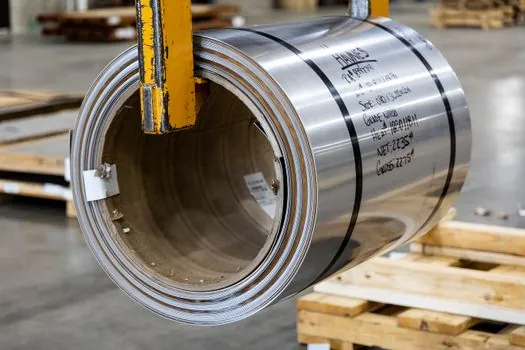
Plate thickness is the single biggest variable inside the duplex lead-time envelope. 2205 plate at 6 to 12 mm is the fastest-moving duplex product, and many service centers keep stock, so the realistic lead time is 1 to 4 weeks from a regional distributor with plate cutting and laser fusion welding capability [S5]. Once thickness crosses 25 mm, or the order needs a specific ASME SA-240 dual certification, the order almost always drops to a mill rolling slot and the lead time stretches to 16 to 20 weeks. Super duplex 2507 plate above 25 mm with NACE MR0175 / ISO 15156 sour-service certification is the worst case at 20 to 24 weeks because each heat requires a PREN test, ferrite count, and intergranular corrosion test before release [S1][S5].
Welding procedure qualification is the second hidden delay. Super duplex welding procedures require qualified welders, and the regional report flags a skilled labor bottleneck that limits how fast fabrication capacity can scale in Northern America [S5]. A fabricator with no qualified 2507 weld procedure on file cannot quote a 20 week mill lead time honestly, because the welding qualification cycle adds 4 to 8 weeks on top of material delivery. For projects that pre-qualify weld procedures in the engineering phase, the mill lead time is the binding constraint; for projects that qualify welds after material arrives, expect 24 to 32 weeks total to first welded spool. A side-by-side spec note on stainless pipe fittings should explicitly list thickness, grade, and required certifications, because that is what the vendor's planner uses to slot the order.
Who Should Order Duplex and Who Should Not
Duplex is the right call when chloride concentration, temperature, or H2S partial pressure would force 316L to a corrosion allowance that violates the design wall, and when the project schedule has 20+ weeks of float. Oil and gas was 45.6 percent of global duplex end-use share in 2025, the single largest segment, driven by offshore and sour-service applications where 316L simply fails chloride stress corrosion cracking or H2S embrittlement [S3]. Chemical processing, desalination, and marine infrastructure round out the demand base, all of which share the same logic: chloride exposure plus a multi-year asset life favors duplex even with the mill premium.
Duplex is the wrong call when the application is low-chloride water, indoor chemical service, or anything below 60 degrees C with no H2S, and when the schedule demands delivery inside 8 weeks. In those services 304L or 316L delivers equivalent life at lower cost, and the mill premium is a real loss to the project budget. The structural shift that makes this more visible in 2026 is regionalization of the supply chain: distributors in Texas, Louisiana, Alberta, and the Gulf Coast are expanding local plate cutting, laser fusion welding, and just-in-time delivery, so a fabricator that previously ordered mill-direct can now buy cut plate from stock [S5]. The catch is that cut-to-size plate, fittings, and flanges in 2205 and 2507 are the SKUs distributors actually stock; anything outside that catalog reverts to mill-direct and the 16 to 24 week clock restarts.
Lean duplex extends the "worth it" envelope into less aggressive services, but the procurement rule is the same: if schedule float is short and the corrosion model does not require PREN above 32, buy 316L and stop the clock.
Standards, Certification, and Sourcing Signals
Material certification drives as much lead time as production scheduling. Common standards for duplex plate and pipe include ASTM A240 / ASME SA-240 for plate, ASTM A790 / ASME SA-790 for seamless and welded pipe, ASTM A815 for fittings, and NACE MR0175 / ISO 15156 for sour service. Sour-service orders add a documented PREN test and often a ferrite count per ASTM E562, which the mill schedules as a lab step after rolling and before shipment, adding 1 to 2 weeks of internal queue time even when the heat is already cast [S1][S5]. Forged fittings in duplex carry a separate ASTM A182 / A815 path and a longer mill queue, typically 4 to 6 weeks longer than plate of the same grade, which is why large pipe racks are the most common source of lead-time slip on duplex projects.
The U.S. tariff measures introduced in 2025 have also reshaped sourcing: the 30 to 40 percent Northern American import dependence for finished super duplex products, sourced significantly from European and Asian mills, is now subject to a tariff overlay that has redirected some buyers toward domestic stock and just-in-time service center models [S4][S5]. The practical effect is that lead-time planning must include a tariff risk line for any cross-border PO. For an engineer building a stainless steel datasheet in 2026, the sourcing signal is straightforward: domestic distributor stock plus just-in-time cut plate covers the 1 to 4 week envelope, mill-direct domestic mills cover 12 to 16 weeks, and mill-direct imported super duplex covers 20 to 24 weeks. Picking the right column up front is what separates a 12 week project from a 24 week project.
One cross-link worth pulling into the spec conversation: the same lead-time logic that pushes pipe and plate buyers toward domestic stock in 2026 is reshaping other alloy families, including the DRI and HBI supply pipeline that feeds low-carbon steel production in 2026. For a project that also touches ductile iron or carbon steel fittings, the Ductile Iron Pipe Lead Times in October 2026 piece breaks down the analogous 4 to 12 week window for that alloy family. Where the spec calls for seawater service and a head-to-head with 6Mo super austenitic, the 6Mo Super Austenitic vs Super Duplex for Seawater spec decision article is the comparison to read first.
Track these signals in the next quarter: any mill campaign slot announcement for 2205 or 2507 plate above 25 mm, which moves lead times toward the 12 week floor; any LME nickel move above USD 22,000 per tonne, which historically triggers 2 to 4 week price holds; and any update to the 30 to 40 percent Northern American import dependence figure, which is the leading indicator of tariff-driven lead-time pressure on imported super duplex.
For the relevant spec sheets and selection criteria, see lead screw.