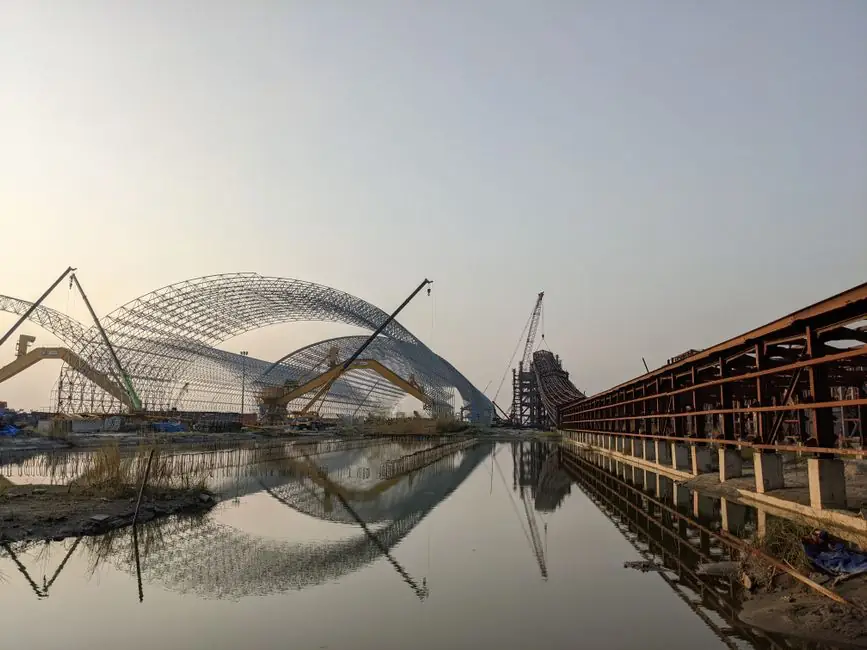
Modern duty cycle crawler cranes from Liebherr, SENNEBOGEN, Manitowoc and Mteck cover dragline and clamshell work across a 30-300 t load-capacity envelope, with lattice and telescopic boom configurations, dual winches for grab work, and diesel, electric or hybrid drive options [S1][S2][S4][S7].
Selection hinges on three axes: bucket or grab size versus machine class, boom length and digging radius, and the undercarriage / drive package that matches ground bearing pressure and site power availability. A 30 t compact class unit on tracks can dig 25 m deep with a dragline bucket and move 40-400 m³/h of material, while 300 t flagship machines target mining and large dredging campaigns [S1][S5].
What defines a duty cycle crawler crane
A duty cycle crane is a hydraulic rope excavator, sometimes called a dragline excavator, purpose-built for repetitive digging cycles with dragline buckets, clamshell grabs, or material-handling attachments rather than for one-off lifts [S1][S5]. The crawler undercarriage, as detailed in the broader crawler crane family, carries continuous ground pressure suited to soft ground and travel between dig faces without disassembly.
Cycle work stresses a machine differently from a hook crane: the hoist, drag and crowd winches see thousands of full-load cycles per shift, so the upperstructure, boom foot and track frames are reinforced compared to a telescopic crane. SENNEBOGEN describes its duty cycle range as covering 30-300 t load capacity and targeting hydraulic engineering, dredging, gravel extraction, pipe laying, and lifting work with crane attachments, with both crawler and mobile variants available for the 630 E class [S1].
Compact, mid, and large class models compared
The SENNEBOGEN 630 E sits at the compact end with a max load capacity up to 30 t and a max hook height up to 35.5 m, offered in diesel up to 186 kW and available on either crawlers or a mobile carrier for inner-city job sites [S1]. The Liebherr HS series slots into the mid-class with the HS 8070 as an allrounder for dredging, aggregates and mining with interchangeable attachments [S2].
At the large end, the Liebherr HS 8300.2 delivers a max lifting capacity of 661,380 lb (300 t), engine power of 1,006 hp, two winches each rated 2 x 500 kN of line pull, and a max main boom of 223 ft, with the option of a Pactronic hybrid energy-recovery drive that lifts turnover performance by storing and reusing surplus hydraulic energy [S4]. The HS 8300.2 is described by Liebherr as one of the largest duty cycle crawler cranes worldwide, and the uppercarriage sits on a wide, long crawler undercarriage designed for dynamic dragline and grab duty [S4].
Selection trade-off: compact 30 t units on crawlers give a narrow transport width and 40-400 m³/h conveying capacity at up to 25 m digging depth and 45 m outreach with dragline buckets, suiting quarry and small dredging sites [S5]. The 300 t class justifies its footprint on mining and deep dredging jobs where cycle count and bucket volume, not transportability, dominate the cost equation. For an overview of how duty cycle machines sit beside lifting crawlers in the wider lifting fleet, see the construction machinery and equipment reference.
Used lattice options for dragline and clamshell conversion
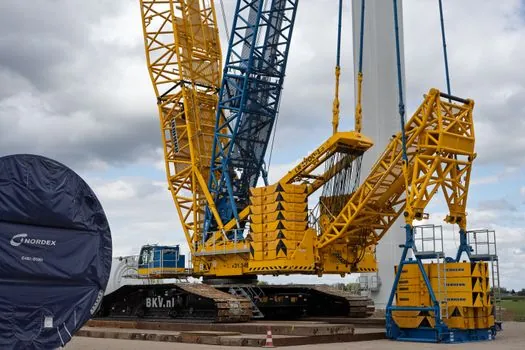
Legacy lattice crawler cranes continue to populate the second-hand market as duty cycle platforms. A 1967-vintage Manitowoc 3900B is offered for sale with a 100 USt (90,718 kg / 200,000 lb) rated capacity, 160 ft (48 m) main boom built from a 30 ft butt plus three 30 ft inserts, a 10 ft section, and a 30 ft tip on #8 angle lacing with tubular lacing, 48 in pads, and a re-powered 1978 Cummins NTC335FFC, with 785 hours on the meter [S3].
Operating manuals for the 3900B describe it as a conventional lattice crawler designed for lifting, clamshell, and dragline work with older controls, dependent on a skilled operator for cycle work [S3]. Transport splits into nine legal loads including a nine-axle house and carbody, a five-axle lowboy for inner counterweight, a five-axle flatbed for middle and outer counterweight, two flatbed loads for the tracks, and a 130 ft boom that separates into a 60 ft load and a 70 ft load on 45 ft-plus flatbed trailers [S3]. A 1969 3900B with 100 LF of #9 boom, 20 ft 4 in crawlers, and 58,500 lb of counterweight is also listed, illustrating the model line's longevity on used-lot rosters [S3].
Drive, control and hybrid options
Drive packages on duty cycle crawlers split into three families: conventional diesel-hydraulic, fully electric from a frequency drive, and diesel-electric hybrids. Mteck markets purpose-built lattice duty cycle crawler cranes with clamshell and dragline capability in either fully electric frequency drive or diesel-hydraulic combinations, positioned for work near and on inland waterways where emissions and noise restrictions bite [S7].
Liebherr fits the HS series with a reliable, easy-to-service diesel engine delivering the required hydraulic power, lower fuel consumption, and a new exhaust after-treatment system to hit emission targets; an intelligent crane control system governs the multiple functions required for cycle work [S4]. On the HS 8300.2, the Pactronic hybrid system recovers surplus energy during the swing phase and releases it during the next digging cycle, materially raising turnover per hour on heavy dragline duty [S4]. SENNEBOGEN's broader range pairs a diesel up to 186 kW on the 630 E with energy-recovery technology shared across its material-handler and duty cycle lines [S1].
Application fit: dredging, aggregates, mining, deep foundation
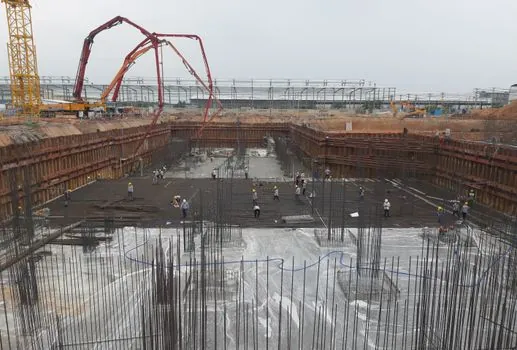
Dragline and clamshell work covers a recognisable set of jobs. Liebherr groups duty cycle crawler applications into dredging, aggregates, and mining, with the boom and attachment changed out to suit the dig method, and ties the platform into deep foundation work via slurry wall grabs, slurry wall cutters, grab drilling, impact compaction, and vibro-compaction attachments [S2].
SENNEBOGEN targets sand extraction, gravel extraction, and overburden removal in quarries, with dragline bucket applications reaching up to 25 m digging depth and 45 m outreach, and conveying capacities in the 40-400 m³/h band depending on bucket and material [S5]. The 630 E is positioned more toward hydraulic engineering, pipe laying, and inner-city lifting with crane attachments thanks to its narrow transport width and mobile variant [S1]. Used Bucyrus-Erie 88B Series Four dragline cranes, some reconditioned, also resurface on the resale market for buyers willing to rebuild an older dragline into a duty cycle conversion [S6].
Who a duty cycle crawler is and is not for
It is for: quarry and aggregate operators running steady-state dig cycles; dredging contractors needing a crawler that can sit on a soft bank and feed a clamshell or grab into a settling pond; mining outfits running dragline buckets at high cycle counts; and deep-foundation crews swapping a slurry wall grab or grab-drilling attachment onto the same base machine. The HS 8300.2 is also a fit for contractors who want one platform to cover a 661,380 lb lift case and a high-volume dragline dig case on the same job [S2][S4].
It is not for: occasional lift work where a smaller telescopic crane on a mobile carrier is cheaper to mobilise; jobs where a true mining shovel with a crowd arm outperforms a rope crowd on hard dig faces; and sites with no access to the heavy-lowboy transport split a 300 t class demands, where a 30 t compact duty cycle crane on crawlers, or a mobile undercarriage, makes more logistical sense [S1][S2][S4]. For plants and yards that occasionally need a man-basket or platform, the aerial work platform and aerial work truck reference pages cover a different spec envelope entirely.
Failure modes, limits, and selection traps
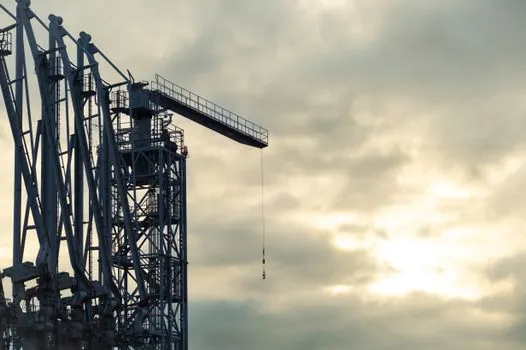
The dominant failure modes on duty cycle crawlers track the load path: hoist and drag rope wear, boom sheave and bush replacement, swing bearing fatigue, and track-frame cracking from continuous tramming. Used lattice units in the 50-100 USt class are sensitive to older control systems, and the 3900B listing explicitly flags that cycle work depends on a skilled operator due to older controls, with hour-meter readings and service intervals driving residual value more than calendar age [S3].
On hybrid and electric variants, the obvious trap is specifying an electric-frequency drive without confirming the site supply (voltage, transformer size, cable run), or specifying a Pactronic hybrid without recognising it as an energy-recovery assist rather than a battery-electric replacement, so the diesel remains the primary power source and the unit still needs the same fuel and exhaust planning [S4][S7]. Bucket sizing is the other common pitfall: oversizing the dragline bucket beyond the rated winch line pull (for example beyond 2 x 500 kN on the HS 8300.2) stalls the cycle and burns fuel, while undersizing sacrifices the 40-400 m³/h conveying target the OEM quotes for the 630 E class [S1][S4][S5]. For buyers moving aggregate or overburden in bulk, payload-versus-chassis decisions for the haul fleet downstream echo the same logic covered in the dump truck payload versus GVWR versus tare decision map.
Track recordable signals to watch: a 25 m digging depth and 45 m outreach envelope on compact duty cycle cranes; emergence of more fully electric lattice duty cycle units for waterway work where Mteck is active; and continued resale activity on legacy 100 USt lattice crawlers as buyers weigh re-powering older dragline and clamshell iron against new mid-class HS series units [S1][S2][S5][S7].