
Dynamic balancing machines in 2026 are specified across two dominant architectures: horizontal hard-bearing benches for small armatures and rotors under ~50 kg, and vertical/soft-bearing rigs for large flywheels, pump impellers, and turbomachinery shafts running above 1,000 rpm [S1][S3].
The reference BMK8 from Balance Systems S.r.l. illustrates the small-armature class: 3 kg rotor capacity, armature diameter 15-80 mm, stack lamination height 10-100 mm, two-plane cycle time 6 s, and measuring precision 0.1 g·mm/kg max, controlled by an industrial PC on 380-480 V three-phase 50/60 Hz [S1]. Buyers shopping on DirectIndustry can currently compare 49 dynamic balancing machine listings from one manufacturer family alone [S2].
Two architectures you must separate before quoting
Hard-bearing dynamic balancing machines (HBM) use the rotor's own mass on calibrated flexures and operate below the rotor's first resonance, giving stable, calibration-free results for small electric armatures, pump impellers, and fan wheels — the BMK8 sits in this class with a 6 s two-plane cycle and 0.1 g·mm/kg best-case precision [S1].
Soft-bearing balancing machines mount the rotor on very low-stiffness supports so the operating speed sits above resonance, delivering higher sensitivity at lower unbalance values; this is the standard architecture for large turbomachinery, marine propeller shafts, and turbocharger rotors [S3]. Guangzhou Zhuoxuanjin Machinery Equipment Co., Ltd. covers the 500-10,000 rpm and above range with dedicated correction and cleaning skids built around the soft-bearing approach [S3].
Buyers also need to separate drive type: belt-drive stands for general-purpose rotors up to a few hundred kg, universal joint (cardan) drives for long slender shafts where belt slip would skew the measurement, and self-drive units where the rotor carries its own motor — the BMK8 is a self-driven production cell, not a universal shop-floor stand [S1].
Key spec numbers that drive the RFQ
Five numbers dominate the RFQ conversation: max rotor weight, max rotor diameter, speed range, two-plane cycle time, and residual unbalance precision. The BMK8 publishes all five: 3 kg / 80 mm / production cell rated for armatures / 6 s / 0.1 g·mm/kg [S1].
Mass is the first filter. If your rotor exceeds ~50 kg, soft-bearing vertical or large horizontal benches take over; if it sits below 10 kg, look at small-armature cells with cam-indexed parts handling, which is exactly what the BMK8 uses for high-volume electric-motor production [S1].
Drive power and supply matter for plant integration. The BMK8 draws 380-480 V three-phase at 50/60 Hz and occupies a 3000 × 2800 × 2400 mm footprint, a useful sanity check against your cell layout before accepting any quote [S1].
Correction method is the second decision. Milling (polar or vectorial, in length and depth), as fitted to the BMK8, suits laminated armatures where material must be removed in a controlled chip; welding additive weights suit heavy cast rotors where drilling is impractical; and V-cutters or polar cutters are options for armatures where the lamination geometry forbids radial milling [S1].
Comparing the three main buyer tracks
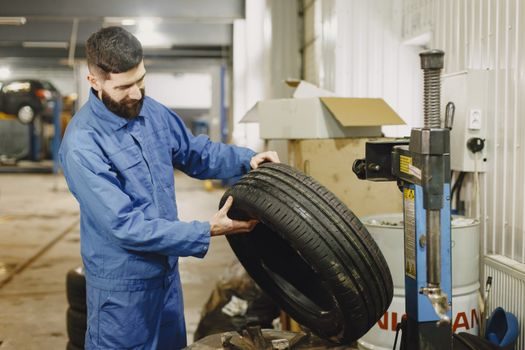
Track A is the high-volume armature cell, exemplified by the BMK8 automatic line: 6 s two-plane cycle, 0.1 g·mm/kg precision, industrial PC control, options for skewed-slot devices (-16°/+16°), reject conveyors, and SPC/printer output for closed-loop quality data [S1].
Track B is the mid-volume rotor/fan bench, where CEMB-style horizontal balancing machines distributed in North America by Dynamics Research Corp. cover general rotors with PC consoles and explicit "simple and easy to use" claims aimed at job shops and contract balancers [S6]. Nan Jung Electronic Co., Ltd. in Taiwan fills the same mid-volume slot in Asia with horizontal and vertical benches for motors, pumps, and crankshafts [S4].
Track C is the heavy-soft-bearing rig, where Guangzhou Zhuoxuanjin targets rotors from 500 to 10,000+ rpm with custom fixturing and an ISO 9001-2000 production system, typically supplied with matched dynamic-balance cleaning and correction skids [S3].
Decision criteria across the three: cycle time (A wins at 6 s, B is minutes, C is tens of minutes), capital cost (C highest, B middle, A highest per cell but lowest per part), and precision floor (all three can hit single-digit g·mm/kg on a matched rotor, but only A holds it across millions of cycles without recalibration).
Who a hard-bearing armature cell is NOT for
If your rotor exceeds the machine's calibrated mass window — say 3 kg on a BMK8 — the flexure stiffness is wrong and published precision figures no longer apply; you will read false pass results on heavy impellers [S1].
Universal soft-bearing rigs are the wrong tool for high-volume laminated armatures: cycle time collapses, fixturing becomes bespoke per part number, and the soft-bearing sensitivity advantage is wasted on parts whose only defect is gross material asymmetry.
Belt-drive stands should not be quoted for long slender shafts above their critical speed; universal-joint (cardan) or self-drive is mandatory to avoid belt-slip-induced phase errors that look like unbalance but are actually measurement artefacts.
Sourcing map: where the 2026 supply sits
European supply is anchored by Italian OEM Balance Systems S.r.l., whose BMK-series covers armature cells (BMK8), semi-automatic benches (BMK4A-B), rotor cells (DMK6-AE), and fan machines (BTK1), with confirmed 2026 show presence at TAIROS Taipei (19-22 Aug 2026) and Coiltech Italia Pordenone (23-24 Sep 2026, Hall 6 Stand C23) [S1].
North American distribution runs through Dynamics Research Corp., the CEMB balancing machine distributor for the US and Canada, supplying horizontal dynamic benches with PC consoles for general industrial use [S6].
Greater China supply is dense: Made-in-China lists grinder-rotor hard-bearing dynamic balance machines from Shanghai Jianping starting at US$1-2 per piece MOQ 1, alongside dozens of other vendors, while Guangzhou Zhuoxuanjin sells complete correction/cleaning lines for high-speed rotating workpieces and Nan Jung (Taiwan) covers the full horizontal/vertical bench range for the motor industry [S3][S4][S5].
For buyers cross-checking motor-production line cells, see the EV Process Control and Instrumentation 2026 spec map, which lines up balancing cells against EV rotor QA gates. For turbomachinery-class balancing where the rotor mass is in the hundreds of kg, the Vibration Analyzer vs Vibration Sensor decision matrix helps separate bench unbalance from in-service vibration. Plants standardising on eddy-current or proximity-probe vibration pickups next to the balancing cell can reference the Proximity Probe vs Accelerometer turbomachinery map.
Standards, calibration, and audit trail
ISO 1940-1 (now harmonised as ISO 21940-11) defines balance quality grades G0.4 to G4000 in mm/s for rigid rotors — the grade letter you specify on the RFQ drives the residual unbalance the cell must hold, not the cell's own precision number. Buyers quoting electric armatures typically target G2.5 to G6.3; large pump impellers often sit at G6.3 to G16. Always cross-check the rotor's service speed and grade against the machine's residual unbalance in g·mm, not the headline g·mm/kg figure alone. [S1]
Manufacturer quality systems vary. Guangzhou Zhuoxuanjin states production under ISO 9001-2000 [S3]; European OEMs typically hold ISO 9001 with CE machinery compliance under the Machinery Directive. For production cells, ask for the calibration interval, the master rotor used, and whether the cell logs each measured unbalance vector to SPC — the BMK8 supports SPC/SW and printer output, which is the audit trail most Tier-1 automotive buyers now require [S1].
For the underlying rotor-shaft and bearing interfaces feeding the balancing cell, the linear guide and crossed-roller guide specifications dictate the rotor support stiffness that the calibration assumes. Plants adding automatic weight correction downstream should match the cell's reject conveyor and milling-chip extraction (vacuum, swarf handling) against the dynamic compactor duty if chips are being recycled back into the foundry. Hydraulic hold-down clamps on the cell tie back to the balancing valve sizing logic for any test-oil circuit on the same skid.
Shortlist logic for a 2026 buyer

Start with rotor mass and grade: under 5 kg with G2.5-G6.3 on electric armatures puts you in the BMK8 / small-cell class with 6 s cycle time and 0.1 g·mm/kg floor [S1].
If mass is 5-500 kg on fans, pump impellers, or crankshafts, move to a horizontal universal-joint or belt-drive bench from CEMB via Dynamics Research in North America or from Nan Jung in Asia [S4][S6].
Above 500 kg or above 10,000 rpm, specify a soft-bearing vertical or heavy horizontal rig with a soft-bearing calibration rotor, and verify fixturing lead time — Guangzhou Zhuoxuanjin or a European soft-bearing specialist are the realistic 2026 sources [S3].
Final pass: confirm drive type, electrical supply (380-480 V three-phase is standard for EU cells; US plants often need 480 V 60 Hz or step-down), footprint, SPC export, and the manufacturer's service network in your region before signing the PO.