
Landfill managers who match compactor operating weight to peak-hour incoming tonnage consistently extract 10% or more compacted airspace versus sites that size on average daily tonnage alone, a delta that translates into years of additional cell life per the operating principle published by TANA [S2][S3].
Modern purpose-built landfill compactors span roughly 20,000-36,000 kg operating weight with 130-250 kW engine output, four-wheel hydrostatic or mechanical drive, and 64-tooth polygon or cleat wheel designs that knead waste rather than merely roll it [S4][S5]. Selection is governed less by marketing claims than by five operational variables: hourly tonnage by waste stream, delivery truck type, daily cover method, current versus target density, and 3-5 year intake growth.
Sizing Logic: Operating Weight vs. Peak-Hour Tonnage
Operating weight is the single most important sizing variable because it directly governs how much waste a machine can process and compact per pass [S2]. The 21,000 kg class, exemplified by the ZT821 with a 162 kW Weichai WD10G220E23 engine, 3,350 mm push-shovel width, 980 mm lift height, 1,880 mm shovel height, and 0-15.7 km/h work-speed range, suits mixed industrial and commercial MSW at sites handling 200-500 t/day with peak-hour surges [S4]. Under-sized machines force multiple passes and burn extra fuel; over-sized machines compact beyond economic gain and accelerate drum and tire wear [S8].
Hourly peak intake, not daily average, is the real sizing input, because waste streams are rarely uniform; residential loads, transfer-trailer tippers, and walking-floor deliveries have different void ratios and require different wheel-tip geometry to fracture bulky debris before compression [S2][S6]. Landfill managers who segment tonnage by stream and hour can match weight class to the 90th-percentile peak, avoiding the trap of buying for average conditions and starving at peak.
Wheel Design and Compaction Mechanism
Polygon or cleat-tipped wheels are not optional accessories; they are the mechanism that distinguishes a purpose-built landfill compactor from a converted soil compactor or wheel loader [S5]. The reference ZT821 specification lists 64 teeth per roller, 1,600 mm pressure-roller diameter at the tooth, 1,290 mm at the wheel base, and 900 mm roller width front and rear, dimensions tuned to fracture, knead, and compress in a three-stage action [S4]. The steel-cleat variant is engineered for mixed industrial dumping where bulky debris would puncture standard tires.
BOMAG's polygon-wheel system runs four independently hydrostatically driven wheels on a 30-degree oscillation frame, a layout the manufacturer credits with continuous ground contact and higher achieved density than two-drum or rigid-frame machines, with the BC 973 RB-5 quoted at up to 1,000 t/day throughput and up to 15% fuel savings via ECOMODE and ECOSTOP [S5]. Wheel scrapers, integrated wire cutters, and offset wheel positioning are recurring spec items across both the European and Chinese OEM offerings, because fouled wheels cut compaction density and accelerate tire replacement cycles.
Selection Criteria: Density Goals, Cover Method, and Truck Mix
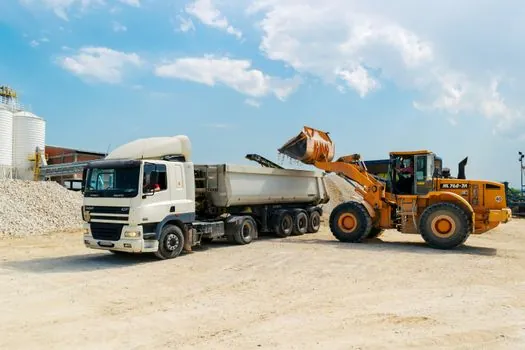
Density goal selection begins with five questions that any competent spec engineer should answer before issuing a tender: what type of truck is delivering the waste, will the compactor work alone or paired with a dozer, what is the 3-5 year waste-stream growth, what daily cover is used (soil, alternative daily cover, or tarp), and what are the current versus target compaction densities [S6]. Each answer narrows the machine class.
A criteria-based comparison of the three common configurations: (1) four-wheel hydrostatic polygon compactors at 21,000 kg / 162 kW suit municipal MSW with ADC or tarp cover and 200-500 t/day; (2) heavier 30,000+ kg mechanical-drive four-wheel units with 200+ kW engines target high-volume transfer-tipping sites with soil cover; (3) two-drum soil-compactor conversions are the lowest-capex option but consistently underperform on waste-specific density and carry higher tire-failure risk [S4][S5][S9]. The table a procurement engineer should build compares operating weight, engine power, wheel count and tip geometry, ground clearance (the ZT821 sits at 280 mm), steering angle (40 degrees articulated, plus 15 degrees lateral swing), and turning radius (6,085 mm outside front wheel) against the site's peak-hour intake and turning-circle constraints.
Airspace Economics and Density Targets
Airspace is the most valuable asset any landfill owns, because new cells require extensive permitting and stakeholder coordination, so maximizing density per cubic metre of permitted volume is the central economic driver [S10]. TANA's published claim that a compactor delivering 10% better compaction can extend landfill life by several years and reduce passes, fuel burn, and working hours is the cleanest articulation of this lever [S3].
For mixed industrial sites in regions such as Paraguay, Uruguay, and other high-volume domestic waste markets, OEM data points to high-crushing-force cleat-tooth geometry as the decisive spec for avoiding tire punctures and maintaining density in the presence of construction debris [S4].
Site Monitoring, UAV Surveying, and Compaction Validation
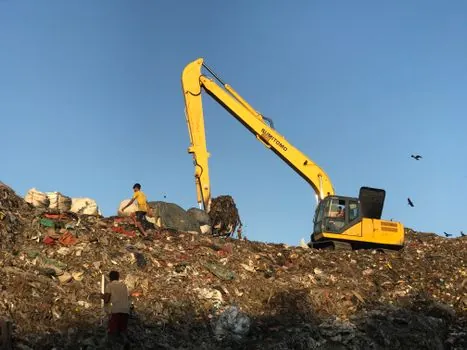
Compactor selection cannot be decoupled from how a site measures achieved density and remaining airspace. A 2026 systematic review of 70% airborne-and-spaceborne remote-sensing studies found that UAV-based volumetric monitoring has overtaken traditional ground surveying as the dominant method for landfill airspace tracking, with the literature expanding at roughly 26.3% annually and 43% of studies originating from China, the USA, and Italy [S1]. Settlement parameters effectively monitored through this integrated GIS-RS approach include landfill elevation, waste volume, gas emissions, moisture distribution, and thermal behaviour.
The integration of GIS and remote sensing into routine landfill airspace management is emerging as standard practice at sites that previously relied on quarterly ground surveys.
Operating Conditions, Limitations, and Failure Modes
Dynamic compactors are engineered for sustained low-speed work, not highway travel, and buyers who ignore ground clearance, steering angle, and turning radius find machines that cannot navigate existing cell geometry [S4]. The ZT821's 280 mm ground clearance, 40-degree articulated steering, 15-degree lateral swing, and 6,085 mm outside-front-wheel turning radius are the minimum envelope for tight working faces; sites with narrow access ramps need these numbers verified against as-built drawings before order placement.
Common failure modes include: tire punctures from construction debris when cleat-tooth geometry is underspecified, density drop-off when wheel scrapers are removed to save maintenance time, premature driveline wear on machines paired exclusively with walking-floor trailers that produce uneven load distribution, and over-compaction of cover material that wastes fuel without adding density [S4][S5][S6]. Operators running pure soil-cover programs at 400+ t/day should bias toward the heavier 30,000+ kg class, while ADC or tarp-cover sites at 200-500 t/day typically hit their economic optimum in the 21,000 kg / 162 kW segment [S4][S6].
Standards, Compliance, and Specification Anchors

No single ISO or EN standard governs landfill compactor selection, so buyers anchor specs to engine-emission tiers (the ZT821 is offered in two-stage and three-stage emission configurations with optional wet-brake axles), ISO 9001 quality management at the OEM level, and site-specific permit conditions on noise, ground pressure, and fuel storage [S4]. The remote-sensing literature that supports airspace validation cites standard geotechnical monitoring methods but does not yet prescribe a unified UAV-survey protocol, which is why 2026 review authors explicitly call for context-driven tool selection rather than a one-size-fits-all standard [S1].
For procurement, the most defensible spec pack ties operating weight, engine power, wheel count and tip pattern, ground clearance, steering envelope, and turning radius to a defined peak-hour tonnage and waste-stream mix, then validates density after commissioning with UAV-derived volumetric surveys. dynamic compactor selection is a flow problem, not a catalog purchase, because the machine that wins on a 200 t/day municipal site will starve at a 1,000 t/day transfer station and burn excess fuel at a 50 t/day industrial cell.
Trackable signals to watch over the next two quarters: OEM publication of three-stage emission + wet-brake axle options for 21,000 kg-class machines (already optional on ZT821 [S4]), wider UAV-based density-validation case studies tied to specific compactor models, and updated TANA or BOMAG documentation that quantifies the 10% airspace and 15% fuel claims at third-party audited sites [S3][S5]. flow meter and pressure sensor integration on next-generation landfill compactors for onboard density inference remains a vendor-by-vendor option rather than a standardized feature, so any spec requiring it should be called out explicitly in the tender. Operators weighing purchase against rental should revisit the comparison at each permit-cycle anniversary, because the 3-5 year waste-stream growth question that drives initial sizing [S6] is also the variable most likely to invalidate the original decision.
Related analysis: Resin Sand Molding Line Selection for Aerospace Castings: 2026 Spec Map.