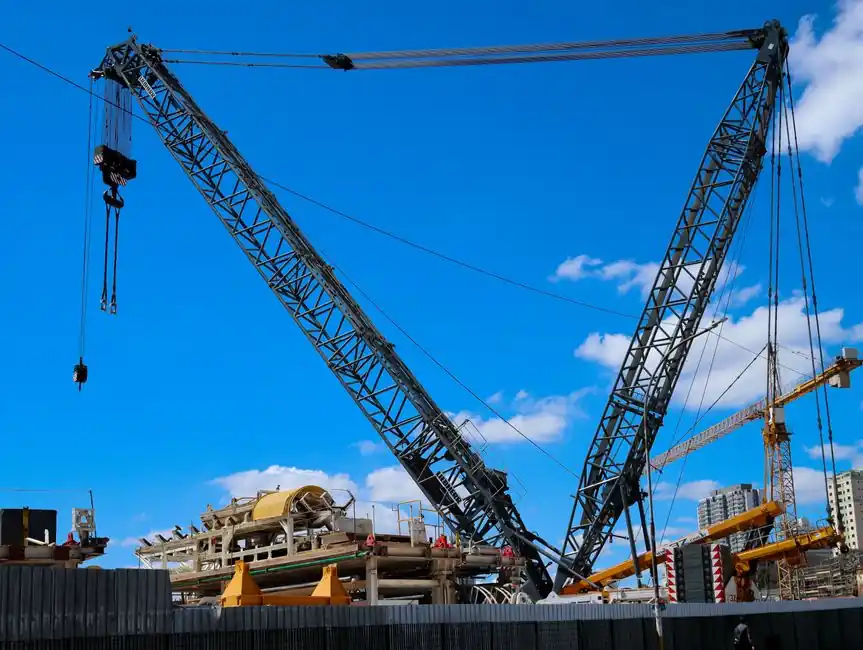
Rope-suspended hydraulic grabs in the KHD class remain the default for urban diaphragm wall packages, with Casagrande's KHD B200 through KHD B360 platform covering working depths in the 20-80 m band that AMIX Systems (2025) confirms as the operational envelope for reinforced concrete diaphragm cutoffs [S2][S3].
For dense city projects (metro stations, deep basements, cut-and-cover tunnels) the grab must satisfy four hard constraints simultaneously: trench verticality, low-vibration or vibration-free extraction, narrow-panel width to limit spoil volume, and slurry-supported stability in ground-water-charged alluvium [S1][S4].
Urban Project Profile and Why Grab Class Matters
Diaphragm walls in urban infrastructure are used to safely retain soil and water for building pits, tunnels, underground structures, and infrastructure works adjacent to roads, rail corridors, and live utility ducts [S4]. The wall typically becomes part of the permanent structure, which raises the quality bar on trench verticality, panel-joint cleanliness, and concrete cover over the rebar cage [S1][S4].
Depth is the first selector: slurry trench cutoff walls handle 10-50 m in soft to medium soils, while diaphragm wall cutoffs reach 20-80 m depending on soil conditions, per AMIX Systems (2025) [S3]. For metro stations and deep basements in the 30-60 m band, a rope-suspended hydraulic grab on a heavy carrier (KHD B300 or larger) is the common specification, because free-fall hammer grabs struggle to maintain verticality past roughly 25 m and create unacceptable vibration in built-up streets [S2][S3].
Grab Configuration: Clamp Count, Carrier, and Hydraulic Power
Single-clamp grabs suit standard trench widths and straightforward ground, with a simple operating arrangement that eases maintenance in regular foundation work [S1]. Double-clamp (twin-ram) and Kelly-mounted hydraulic grabs add closing force for stiff clay, dense sand, and weak rock, where single-clamp penetration rate drops sharply [S1][S2].
Casagrande's KHD platform illustrates the class scaling: rope-suspended hydraulic grabs are paired with dedicated carrier rigs (B200-B360 model range) where higher numbers track greater mast height, hoist pull, and rotary torque for the deeper urban panels [S2]. For most urban infrastructure bids the grab is selected as a matched package (carrier + Kelly + grab + slurry desander), not as a standalone tool, because cycle time is governed by hoisting and slurry handling rather than grab bite volume [S2].
Selection Criteria: Depth, Soil, Panel Geometry, Slurry
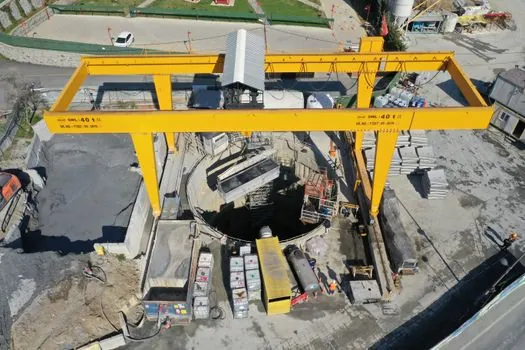
Selection is driven by six interacting variables: soil type (soft alluvium vs stiff clay vs weathered rock), groundwater table position, target depth, panel thickness (commonly 600-1200 mm for urban walls), panel length (typically 2.8-7.2 m per bite), and tolerance to noise or vibration on adjacent structures [S1][S4]. GKV Infrastructure (2026-08) frames the trade-off as: trench position and size have a direct impact on the quality of the completed wall, so equipment and operator selection must be treated as a single decision [S1].
Slurry support is non-negotiable in urban water-bearing ground: bentonite (or polymer) slurry maintains trench stability through the cut, and the same slurry train feeds the desander that processes spoil before discharge [S3][S4]. AMIX Systems (2025) cites soil-bentonite cutoff walls specified to a maximum hydraulic conductivity of 1 x 10^-7 cm/sec, a benchmark that constrains slurry density, sand content, and filtrate loss the grab operation must respect [S3].
Comparison of Main Grab Options for Urban Work
Three grab families compete on the urban bid list, and the choice is best read as a 2x2 of depth and vibration tolerance. A compact comparison against four decision criteria: [S1]
* Rope-suspended hydraulic grab (e.g. KHD class): suited to 20-80 m depths, low-vibration extraction, moderate panel width, higher daily output, higher capex [S2][S3].
* Kelly-bar mounted hydraulic grab: suited to 15-40 m, good verticality in stiff soils, slower cycle, mid-range cost; better when boulders or obstructions are expected [S1][S2].
* Mechanical / rope clamshell grab: suited to shallow walls under 25 m, lowest cost, highest vibration and tolerance risk in dense urban settings, increasingly restricted near hospitals and heritage structures [S1].
For most metro and deep-basement packages the rope-suspended hydraulic grab wins on the vibration + depth combination, while the mechanical clamshell survives only on shallow utility-duct or pile-cap wall sections where ground is proven and the surrounding buildings are insensitive to settlement [S1][S2][S3].
Use Cases in Urban Infrastructure

Metro station boxes typically combine 800-1000 mm thick diaphragm walls, 30-45 m deep, executed panel by panel under bentonite slurry, with a rope-suspended hydraulic grab as primary tool and a hydraulic cutter reserved for the occasional boulder obstruction [S2][S4]. Deep basement projects for hospital and commercial towers use a similar setup, with panel geometry adjusted to the tower-pile layout so that each panel aligns with a future column line [S1][S4].
Cut-and-cover tunnel approaches to underground stations, and shafts for utility tunnels, use diaphragm walls as both temporary retention and permanent lining, which is why Deepro's framing, "diaphragm wall is used to safely retain soil and water in the case of building pits, tunnels, underground structures, and infrastructure works," reads as the canonical urban use case [S4]. For adjacent-construction risk control the same wall also limits drawdown and settlement of neighbouring foundations, an effect the slurry-supported grab method preserves better than secant pile walls in water-bearing alluvium [S1][S3][S4].
Limitations, Failure Modes, and Sourcing Standards
Grab excavation in urban ground fails in a small number of recurring ways: trench collapse from low slurry head, panel oversize from grab swing in soft clay, verticality drift past tolerance on deep panels, and rebar-cage blockage during cage lift [S1][S3]. Each is mitigated by a specific spec: minimum slurry level 1-1.5 m above the water table, Kelly or rope-suspended guidance for verticality, and a pre-planned panel sequence that allows stop-ends at design joint positions [S1][S3][S4].
For sourcing, contractors should match the grab to the carrier OEM's published working envelope rather than a generic depth figure, and verify that the desander and slurry mixing plant can keep up with the grab's peak spoil rate [S2][S3]. Adjacent-structure monitoring (vibration, tilt, settlement) is part of the same bid package, not an optional extra, because most urban wall failures trace to ignored monitoring data rather than grab mechanics [S1][S4]. Where the project is rail-adjacent, EN 45545-2 style fire and material specifications apply to the permanent concrete and steel elements but not to the grab itself; the grab selection should still respect the rail authority's vibration and settlement thresholds during excavation [S4]. For related tooling decisions, diaphragm wall grab selection for tunneling and diaphragm wall grab selection for agricultural sites extend the same class logic into tunnel and rural-soil conditions, and a diaphragm wall grab primer anchors the wider vocabulary used in tender documents.
Track three signals over the next two bid cycles: OEM model-code refreshes on rope-suspended hydraulic grab platforms (Casagrande KHD updates through 2026), any tightening of urban vibration thresholds for grabs above 30 m depth, and the spread of hydraulic cutter attachments as standard on KHD-class carriers for boulder-prone urban ground [S2].
Component reference pages worth checking: diaphragm pump, and diaphragm valve.