
Choose E-flute, approximately 1.5 mm thick, for lightweight retail packaging that prioritizes smooth printing, compact storage, and freight efficiency; choose B-flute, approximately 3.0 mm thick, when greater cushioning, crush resistance, and stacking performance justify added cost and bulk [S1][S6].
The decision is not simply “thin versus strong”: E-flute and B-flute can use the same 32 ECT rating, but differ in thickness, flute count, panel behavior, print surface, unit cost, and finished-box dimensions [S1].
Flute specification and performance gap
Corrugated board consists of two liners bonded to a fluted medium, and the flute profile controls thickness, cushioning, and resistance to compression [S2][S3]. E-flute has approximately 90 flutes per linear foot and a typical thickness of 1.5 mm, while B-flute has approximately 47 flutes per foot and a typical thickness of 3.0 mm [S1].
A representative comparison lists both E-flute and B-flute at 32 ECT, but E-flute as lighter and less resistant to crushing while B-flute provides stronger cushioning and stacking performance [S1]. The same comparison estimates B-flute at 15–20% more per unit, 40–50% heavier, and less space-efficient when flat packed; these are planning figures, not universal quotations [S1].
Cost, printing, and retail presentation
E-flute normally wins the cost and dimensional comparison because it uses less board, weighs less, and prints on a flatter, smoother surface [S1][S9]. E-flute provides a finer print surface, while B-flute offers a slightly less refined print surface [S1][S2].
B-flute can still carry professional full-color retail graphics, but its appearance is more visibly corrugated and its panels can appear less carton-like on a shelf [S2][S8]. B-flute costs 15–20% more and is 40–50% heavier than E-flute in the representative specification [S1].
Do not treat those percentages as guaranteed savings. Carrier charges depend on packed dimensions, actual weight, destination, service level, and rate design, while printing can require creasing, coatings, inks, or a die-cut sample that changes the final economics [S1][S2].
Strength and protection by product type
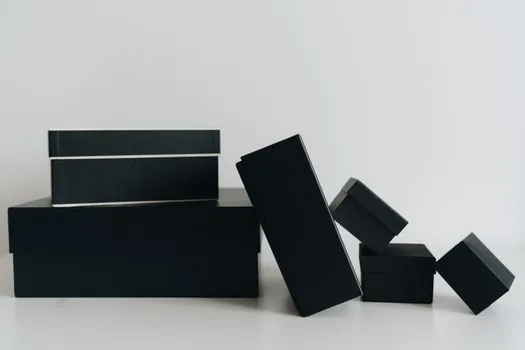
E-flute is appropriate for cosmetics, apparel, snacks, accessories, small electronics, and other lightweight or mid-weight products that do not carry substantial compression loads [S1][S2]. The representative specification describes E-flute as suitable for crush resistance with products up to 5 lb [S1].
B-flute is the thicker option and provides more crush resistance and cushioning for heavier products, bigger boxes, and longer shipping routes [S2]. The representative B-flute specification lists crush resistance for products up to 15 lb and 47 flutes per foot [S1]. These weight limits are screening guidance rather than universal certification: liner grade, ECT, box dimensions, joint design, closure, and manufacturing quality also determine finished-package performance [S5].
For engineering review, specify an edge crush test, then verify the completed carton with compression and relevant drop testing. TAPPI T811 is associated with edgewise compressive strength testing, while ASTM D642 addresses compression testing of shipping containers [S5].
Comparison by decision criterion
Against the four core criteria of presentation, protection, logistics, and procurement, E-flute leads where a smooth printed surface and a smaller package dominate, while B-flute leads where compression, cushioning, and stacking dominate. E-flute delivers approximately 1.5 mm thickness, 90 flutes per foot, 32 ECT in the cited example, lower unit cost, and a more refined retail face [S1]. B-flute delivers approximately 3.0 mm thickness, 47 flutes per foot, 32 ECT in the cited example, greater cushioning, and stronger resistance to crushing [S1][S5].
The practical recommendations are specific. Specify E-flute for a shelf-facing carton under 5 lb when print quality, compact dimensions, and low freight cost are primary concerns. Specify B-flute for a heavier or fragile product, a large box, long transport routes, high stacking, or a carton that doubles as the shipping container [S1][S2]. If neither flute provides adequate protection, evaluate a thicker single-wall flute or double-wall construction rather than forcing an unsuitable E- or B-flute box [S2][S5].
Stacking, moisture, and sample validation
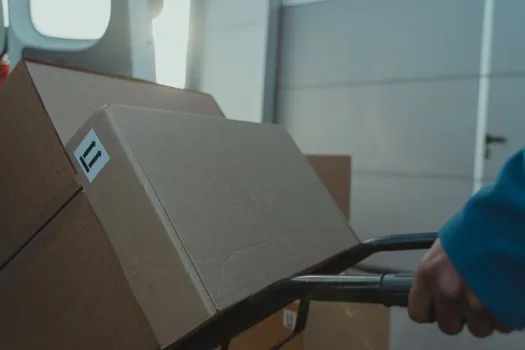
Flute selection cannot compensate for weak stacking conditions. B-flute generally performs better in palletized storage and under compression, but completed-carton capacity must be checked against pallet geometry and stacking load; the related carton BCT calculation for stacked pallet height provides the engineering context for that verification. E-flute is less suitable where the retail carton carries substantial warehouse loads, while B-flute offers a larger margin against panel deformation [S1][S2].
Moisture reduces the strength of paper-based packaging, and cold-chain exposure can add moisture and temperature effects [S5]. For a complete distribution assessment, use the packaging condition and product risk to select the applicable distribution test, such as ISTA 3A where appropriate, rather than relying on flute designation alone [S5]. Confirm print registration, flute-line visibility, folds, corner squareness, closure, compression resistance, and product fit on a production-equivalent sample before releasing a mass order [S2][S7].
Procurement specification for retail cartons
Write the decision into the purchase specification: flute, nominal thickness, ECT or other board-strength requirement, liner and flute-medium grades, finished dimensions, printing method, color coverage, closure, maximum product weight, storage configuration, and distribution-test requirement [S1][S5]. This converts a visual preference into measurable acceptance criteria and prevents a supplier from substituting a thicker board, lighter liner, or different flute profile without technical review.
Close with two tracked signals: the delivered unit price and freight or storage delta, and the damage rate for the same product and distribution route. If E-flute meets both the finished-package performance target and presentation requirement, it is the economical choice; if it fails compression or handling validation, move to B-flute or a double-wall structure rather than accepting a thinner board [S1][S2][S5].