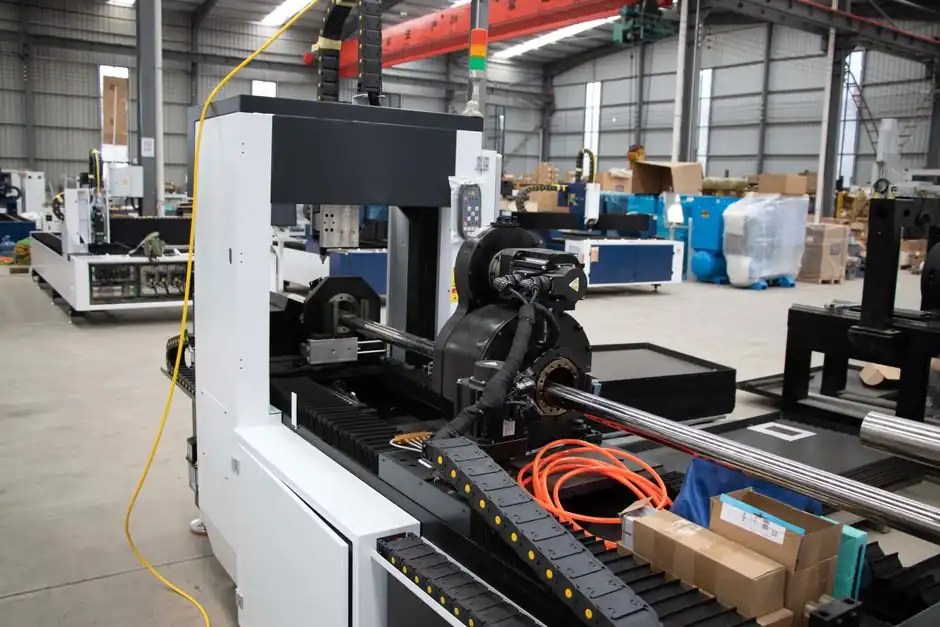
An eAxle production line in 2026 is a mixed-mode assembly system that consolidates processes common to every variant on a robotic main line while routing model-specific subassemblies into dedicated human cells, a layout AISIN calls a cell-and-line hybrid production system [S1]. The architecture was first introduced with AISIN's first-generation eAxle line in 2022 and is now in its second generation, with full integration of digital equipment verification into every station [S1].
The functional scope covers rotor and stator build, gearbox assembly, inverter integration, housing close-out, and end-of-line (EOL) testing, all sequenced to a takt time that can swing between passenger car and light-commercial variants on the same physical line. Supplier programmes that ship both 400 V and 800 V variants, such as Bosch's eAxle family, explicitly rely on a single line for both because standardized process steps let both versions share stations [S3].
Why a hybrid cell-and-line layout, and not pure FMS
A pure Flexible Manufacturing System (FMS) trades throughput for changeover headroom, and academic work on adaptive e-axle assembly notes that FMS productivity is lower than a Dedicated Manufacturing System (DMS) because production steps are no longer conducted simultaneously [S4]. The cell-and-line hybrid attacks that penalty: common processes are executed in parallel on a fixed main line, while variation handling is moved off-line into cells where the human operator absorbs the changeover cost without slowing the main takt [S1][S4].
The result is a measurable design rule: anything that does not change between SKUs (stator insertion, housing machining, bolt patterns) goes on the automated main line, while anything that does (winding variants, inverter swap, gear ratio change) goes into a cell staffed by a single worker who assembles the full sub-unit, an arrangement that also supports the traceability and ownership model that a cell system requires [S1]. From a process-engineering standpoint this is the cleanest way to keep the eAxle takt below roughly 60 seconds per station while still running three to five product variants on one floor.
Station sequence and cycle-time budget
A typical second-generation eAxle line sequences stator winding, rotor insertion, gearbox build, inverter stack-up, housing mate, and EOL test, with each major station guarded by an automated torque controller and a vision check on connector orientation [S1]. Digital equipment verification, meaning every station's PLC, torque tool, and vision camera is self-checked against a golden part at shift start, is the headline feature of the second-generation layout, replacing the manual gauge calibration that the 2022 first-generation line still required [S1].
Cycle-time budgeting follows the eAxle, not the cell, because the inverter and gearbox mate dictate the longest step. Lines built for both 150 kW and 250 kW class eAxles typically hold main-line station times between 45 and 90 seconds, with the slowest station gated by rotor magnetisation and dynamic balancing rather than by the housing bolt pattern [S1][S3]. The cell-side stations run at a slower 3 to 8 minute takt per operator, which is the deliberate trade that lets one worker own the full sub-assembly [S1].
End-of-line test architecture
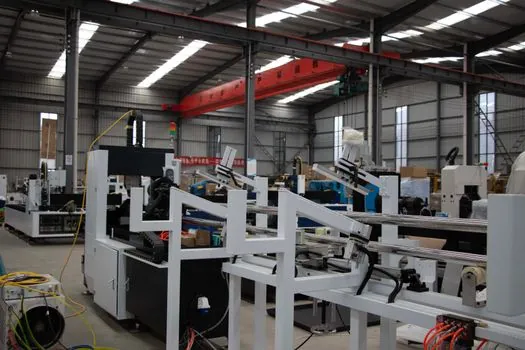
Modular EOL benches are the standard way to validate an eAxle before it leaves the line, and AVL's E-Axle TS End-of-Line tester is the publicly documented reference design for this station class [S2]. The bench is built as a modular system, so the same hardware frame can be reconfigured for NVH, dyno, insulation, and inverter-function test steps depending on the variant coming off the main line [S2]. For high-volume passenger car programmes, the typical EOL sequence is a back-to-back arrangement of an NVH cell, a dyno cell, and a high-voltage insulation test, with each cell sized to the line takt plus a 10-15% buffer for rejects.
Integration with the automatic molding line of the inverter housing is a common upstream dependency, and the EOL test cell must accept the eAxle directly from the main-line conveyor without a manual re-clamp. Lines that run a conveyor sorting line downstream of the dyno use the test result to route good units to shipment and rejects to a rework cell, which keeps the main line free of decision logic.
Variant handling and changeover discipline
Variant changeover is the metric that separates a flexible eAxle line from a glorified single-SKU line, and the published cell-and-line approach treats it as a design constraint rather than an event [S1]. Model-specific components and assembly steps are pre-grouped into cells with their own kitting trolleys, so a change from a 150 kW to a 250 kW inverter happens at the cell without touching the main line [S1]. The main line's only variant-aware hardware is the torque strategy and the vision recipe, both pulled from the build sheet at station entry.
For lines that ship commercial-vehicle eAxles in addition to passenger units, Allison Transmission's dedicated eGen Power assembly line uses automated assembly cells purpose-built around the heavier inverter and gear housing, with the line architecture trading the cell-and-line hybrid for a heavier, fully automated flow because commercial volumes do not justify the manual cell overhead [S5]. The decision rule that follows: passenger-car and light-commercial mixed programmes belong on the hybrid layout, dedicated heavy-commercial programmes belong on a fully automated line with the same EOL bench family at the tail.
Comparison: hybrid cell-line vs fully automated vs FMS
Three layout archetypes are competing for greenfield eAxle CAPEX in 2026, and the choice is governed by SKU count, annual volume, and operator availability rather than by takt alone. The hybrid cell-and-line layout wins when SKU count is high (three or more variants) and annual volume is in the 100,000 to 400,000 unit band, because the manual cells absorb changeover cost while the main line holds takt [S1][S3]. A fully automated line is the right pick when the SKU count is one or two and annual volume exceeds 200,000 units, which matches Allison's commercial-vehicle eGen Power build [S5]. A pure FMS only makes sense at the low-volume, high-variability end (under 50,000 units across many variants), where the throughput penalty is acceptable in exchange for reconfigurability [S4].
For the comparison to be useful, the layout decision should be scored against four criteria: SKU count, annual volume, operator skill availability, and CAPEX per station. Hybrid cell-and-line scores well on SKU count and operator availability, weak on raw throughput per square metre [S1]. Fully automated lines score well on throughput and repeatability, weak on variant count without major retooling [S5]. FMS scores well on reconfigurability, weak on throughput and CAPEX efficiency at scale [S4].
Constraints, failure modes, and what to verify in the RFQ
The published cell-and-line approach carries three known constraints that an RFQ should put on the table before signing. First, operator workload is higher in cells than on a main line, and the training period is longer, which the AISIN documentation explicitly flags as a downside of the cell model [S1]. Second, throughput per square metre is lower than a fully automated line because the cell footprint is not amortised across parallel stations [S1][S5]. Third, the digital equipment verification layer is only as good as the golden-part database, and any new SKU that lands without a verified golden part will block the line at shift start until the recipe is added [S1].
Two failure modes recur in the public literature. A common one is a slow bleed of takt on the main line as more variant-aware vision recipes are added, which is why station-time budgeting should reserve a 10 to 15 second overhead per station on the second-generation layout [S1]. The other is EOL bench starvation, where the dyno cell takt drifts above the main-line takt and creates a bottle; AVL's modular EOL bench design explicitly targets this by letting the same frame be redeployed between NVH and dyno duty [S2].
Signals to track over the next two quarters
Two trackable signals will mark whether second-generation eAxle lines are absorbing more variant work or stalling on the hybrid trade-off. First, watch whether Tier 1 eAxle suppliers begin disclosing the per-station takt and SKU count of their second-generation lines, which would let buyers benchmark the 45 to 90 second main-line window [S1]. Second, watch for the next-generation EOL bench family, which is likely to fold power-in-loop inverter test into the same modular frame as the dyno and NVH cells [S2]. A third, weaker signal is whether commercial-vehicle programmes follow Allison's fully automated route or move back toward the hybrid layout as commercial SKU counts grow [S5].
For component-level specifications, see molding line.
Related analysis: Mold base sizing and selection: frame, gate type, and plate stack.