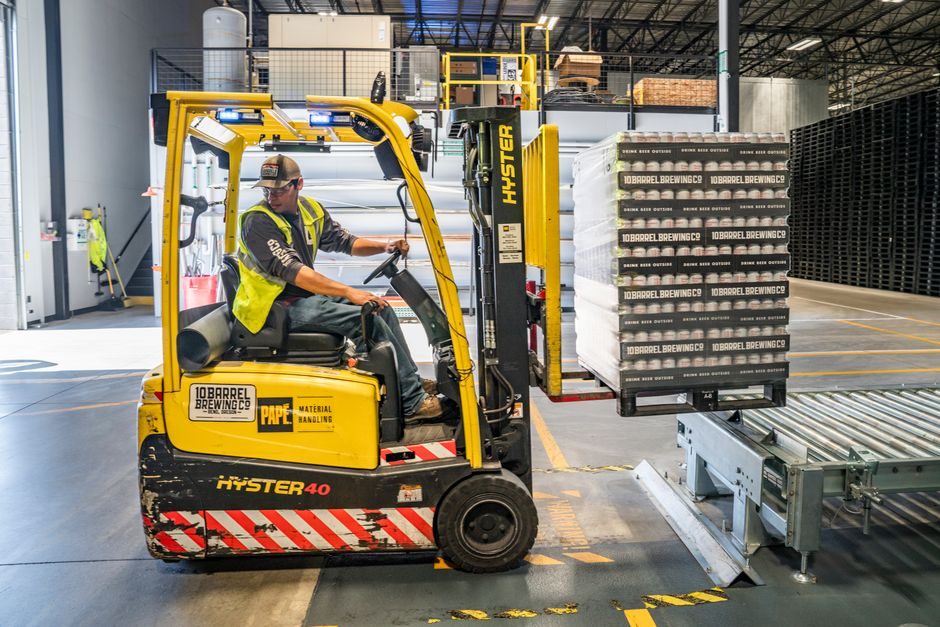
Electric forklifts in 2026 are organised around six functional families, with common load capacities from 1.0 t (narrow-aisle stackers) up to 5.0 t (counterbalanced lithium models) and lift envelopes reaching 7.5 m on 3-way pallet stackers [S1][S3].
Market listings in mid-2026 show a clear tilt toward lithium-ion battery architecture for warehouse models, while lead-acid remains common in entry-level 1-3 t counterbalanced trucks exported to Southeast Asia and the Philippines [S5][S7][S8]. Pneumatic-tyred rough-terrain electric units are still a small share of overall supply but are growing in outdoor yard and construction-logistics work [S2][S6].
Six Functional Families: What Each Electric Forklift Is Built to Do
The classification of electric material-handling trucks breaks cleanly into six operational roles: pedestrian pallet stacker, semi-electric stacker, counterbalance, reach truck, order picker, and tow tractor — each designed for a specific aisle width, lift envelope, and load class [S1][S5].
Pedestrian stackers such as the Kitairu CPD10A/B run a 1000 kg load in a narrow-aisle chassis with MOSFET AC control, curve automatic deceleration, and electronic power steering; tiller-arm steering is standard for tight spaces [S1]. A 3-way TC-series stacker, with 180° rotating forks, reaches 7500 mm lift on 1000 kg load and works in aisles as narrow as 1510 mm, making it a direct answer to high-density AS/RS-style warehousing [S1].
Counterbalanced electric forklifts are the workhorses for loading-bay and yard work; Goodsense's 3.0 t and 3.5 t high-voltage lithium-battery models, and the 3 t "oil-to-electric lithium" conversion, sit in this category alongside the diesel line [S3]. Reach trucks, order pickers, and tow tractors round out the family — Noveltek's 5 t ATT-50 advanced tow truck with EPS steering and the APT-20H high-speed suspension pallet truck being typical examples for 5-11 t drawbar-pull and 2 t order-picking duty respectively [S5].
Load Capacity and Lift Envelope: The Hard Numbers
Across the 2026 supplier catalogues, electric pallet stackers cluster at 1000 kg, 1200 kg, 1600 kg, and 2000 kg rated load, with the 0.5 t class reaching a 5.2 m max lift and the 1 t class capping at 4.5 m, while the 2 t class is limited to roughly 3 m [S1].
Counterbalanced electric forklifts are commonly quoted in 1 t, 1.5 t, 2 t, 2.5 t, 3 t, 3.5 t, and 5 t classes on Made-in-China listings, with CE-marked lithium battery options at US$1800-3800 per piece at 1-piece MOQ and tier-1 3 t units in the US$5000-6000/set band [S4]. The K-Lift Mitsubishi RBF-CA counterbalanced series, the CAT-class CLASIDIA, and the Goodsense high-voltage lithium line all sit in the 2.5-3.5 t counterbalanced window, which is the most aggressively electrified segment in 2026 [S3][S7].
For very narrow-aisle (VNA) work, the 3-way stacker is the spec ceiling: 1510 mm minimum aisle, 7500 mm lift, and 1000 kg load [S1]. For drawbar work, the Noveltek ATT-50+EPS reaches 5 t / 11,000 lb drawbar pull, and 2 t-class suspension pallet trucks such as the APT-20H+EPS+SUSPENSION cover order-picker-replacement duty in cold-store and e-fulfilment aisles [S5].
Battery Chemistry and Drivetrain: Lithium vs Lead-Acid Decision Logic
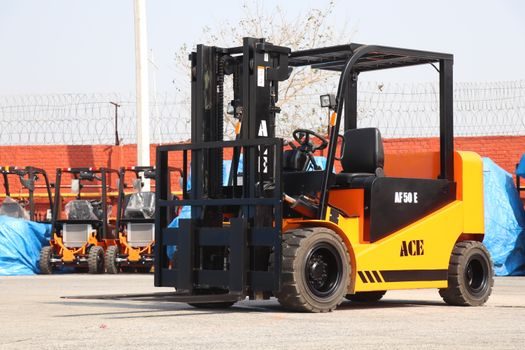
Lithium-ion (LFP and NMC) battery packs are the default for new 1-3 t electric forklifts in 2026, with 3.0 t and 3.5 t high-voltage lithium models now offered alongside legacy lead-acid lines on the same chassis [S3][S5].
Allied Forklift in Malaysia explicitly positions itself as a "pioneer in lithium-ion battery MHE" with two decades of MHE experience and a reconditioned-forklift programme that bridges lead-acid trade-ins to new lithium fleets [S8]. Tongyuan's electric-forklift product line likewise markets "zero-emission, low-noise" operation, citing warehousing, logistics, and manufacturing as the primary use cases [S6].
Entry-level pedestrian stackers still ship in semi-electric configurations — manual lift with electric drive — for budget buyers; the 1-1.5 t Noveltek MPS-10/12/15 manual pallet stacker line is the typical price-leader SKU in this segment [S5]. Lead-acid remains a common export configuration because it tolerates wider ambient-temperature swings and is cheaper to replace in markets with thin service networks [S7][S8].
Application Mapping: Which Forklift Goes Where
Electric pallet stackers and pallet trucks are specified for narrow-aisle warehouse work, supermarket backrooms, and workshop pallet handling, where zero exhaust and low noise are hard requirements [S1].
Counterbalanced electric forklifts take the loading-bay and yard-to-warehouse work that diesel traditionally owned, with Tongyuan explicitly listing warehousing, logistics, and manufacturing as primary verticals, and K-Lift positioning the Mitsubishi counterbalanced line for general Philippine industrial distribution [S6][S7]. Reach trucks and order pickers — including the Goodsense warehouse-handling and ground-support equipment lines, and the Noveltek APT series — are the answer for e-commerce fulfilment and cold-chain aisles above 4 m [S3][S5].
For explosive-mixture and hazardous-area use, electric stackers with imported electronic and hydraulic units are deployed in petroleum, chemical, pharmaceutical, textile, military, paint, pigment, and coal sites, as well as ports, railways, and freight yards with combustible atmospheres [S1]. Rough-terrain electric forklifts, while still a small slice of the 2026 catalogue, are the spec for outdoor construction yards and timber/logistics sites where diesel emissions and noise are restricted — see the forklift type reference for the broader IC-vs-electric duty split.
Selection Criteria: Matching Class, Capacity, and Chassis to Duty Cycle
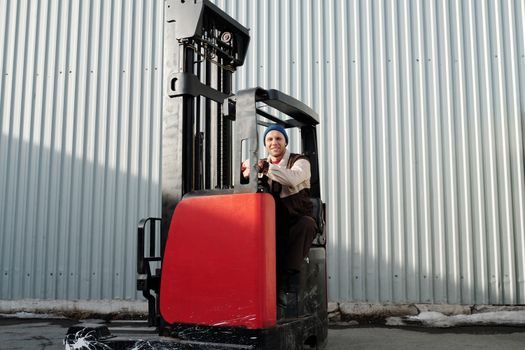
Specifiers should anchor on four criteria — rated load, lift height, aisle width, and duty environment — before battery chemistry, since each class enforces a hard envelope on the other three [S1][S5].
The decision table below maps the six families against the four criteria a buyer typically works with first:
Pedestrian stacker (1-2 t, ≤5.2 m lift, 1510 mm aisle) — best for retail backroom, supermarket, light workshop work; cheapest entry to electrification [S1]. Counterbalanced electric (1-5 t, ≤4.5 m lift, standard 3.5-4 m aisle) — the loading-bay replacement for diesel; lithium battery mandatory for multi-shift, lead-acid acceptable for single-shift [S3][S4]. Reach truck (1-2.5 t, 4-7.5 m lift, 2.6-3.0 m aisle) — the e-commerce and cold-chain workhorse; 3-way variant for VNA [S1][S5]. Order picker (1-2 t, 2.5-4 m lift, narrow aisle) — replaces ladders in fulfilment centres [S5]. Tow tractor (2-5 t drawbar pull, no lift, standard aisle) — for baggage handling and assembly-line parts delivery; the electric pallet truck class is the lighter cousin of this group [S3][S5]. Rough-terrain electric (2-3 t, 3-4.5 m lift, unpaved yard) — outdoor/yard duty, growth segment in 2026 [S2].
Who Electric Forklifts Are For — And Who They Are Not
Electric forklifts are the right call for indoor warehouses, food and pharmaceutical sites, cold stores, and any yard within reach of opportunity or fast chargers; they are the wrong call for remote outdoor sites without charging infrastructure, sustained 24/7 heavy-load (5 t+) cycles without battery-swap logistics, and very high-lift (>7.5 m) container handling that still belongs to IC-diesel or hybrid reach stackers [S1][S2][S6].
Buyers running single-shift light duty (≤6 h/day, ≤2 t load, ≤4 m lift) are well served by semi-electric or lead-acid units, and can defer lithium capex [S5][S7]. Multi-shift operations above 8 h/day or any site with cold-store or food-grade hygiene constraints should standardise on lithium from the first purchase, both for opportunity-charging and to eliminate acid venting in temperature-controlled rooms [S3][S6][S8]. For work beyond 5 t or in heavy outdoor duty, diesel still sets the cost-per-tonne benchmark in mid-2026 — see the rough-terrain forklift class for the trade-off.
Failure Modes and Specification Pitfalls
The most common 2026 spec pitfall is buying a 2 t lead-acid pallet stacker for multi-shift duty — the battery will sulphate within 18 months and the unit will be parked by year two [S3][S8].
A second pitfall is under-spec'ing aisle width: a 3-way stacker at 1510 mm minimum aisle is a real number only on flat, level floors with palletised loads; uneven floors or slip-sheet loads push the practical minimum to 1700-1800 mm [S1]. A third is specifying a standard counterbalanced chassis for explosive-atmosphere work without confirming the Ex-rated electronics and hydraulic package; non-Ex electric stackers in petroleum, chemical, or paint environments are a documented rejection cause in vendor specs [S1]. A fourth is mismatched motor controller and battery voltage on retrofit lithium conversions; Goodsense's 3 t "oil-to-electric lithium" conversion exists precisely because so many diesel-to-electric retrofits fail at the controller-and-BMS handshake [S3].
Standards, Sourcing Signals, and What to Track Next
CE marking is the visible compliance signal on 2026 Chinese export listings, with lithium battery packs shipped under UN 38.3 transport-test regimes, and EMC/EMI conformance typically per EN 12895 for industrial trucks [S4][S5].
Trackable signals for the rest of 2026: (1) lithium pack pricing per kWh continuing to drop, which will push the 1-2 t entry-level stacker to parity with lead-acid by 2027; (2) Mitsubishi and other tier-1 OEMs expanding counterbalanced lithium SKUs in Southeast Asia — K-Lift's exclusive Philippine distributorship and Allied's Malaysian reconditioned-to-lithium programme are the early indicators [S7][S8]; (3) 3-way stacker lift envelopes climbing past 7.5 m as AS/RS-style warehouses scale above 8 m clear height. For buyers comparing electric lift actuators in the mast, the electric actuator duty envelope is the right cross-reference, and the electric ball valve class is the parallel reference for any hydraulics or pneumatic-control spec running off the same truck platform.
For related coverage, see IBC Tank Types and Classifications: A Spec-Driven Selection Map.