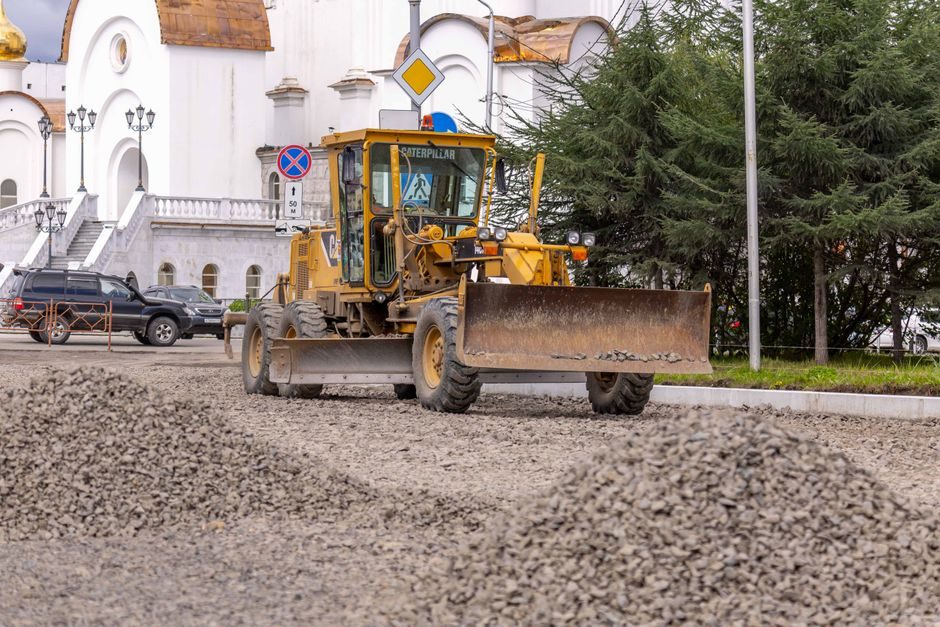
A servo motor is a closed-loop rotary or linear actuator — typically 50 W to 15 kW frame, encoder feedback, sub-arc-minute positioning — while a motor grader is a 12-25 tonne self-propelled earthmoving chassis with a 3.7-4.3 m moldboard between front and rear axles.
They share the word "motor" but live in different spec universes: precision factory automation versus heavy civil roadwork. The decision path is therefore not "which is better" but "which job are you sizing for."
Definition and Operating Scope
A servo motor is a transducing device that converts voltage/current commands into controlled mechanical motion, paired with a servo drive that closes the loop using encoder or resolver feedback [S1][S9]. Industrial servo frames span frameless torque motors below 1 kW up to 15 kW rack-mount packages, with continuous stall torque densities commonly cited between 1-3 Nm/kg for rotary units [S1].
A motor grader — in the encyclopedia sense of a construction machine, not a winding classification — is a rigid-frame articulated vehicle with a long wheelbase, a centrally mounted drawbar-pull moldboard, and a front lift group plus rear ripper/scarifier [S2]. Operating weight for production-class units sits in the 12-25 tonne band with engine power from roughly 100 kW to 250 kW.
One unit positions to micron-level repeatability inside a factory cabinet; the other shapes aggregate base course across kilometres of roadway. Specifying one to do the other's job is a category error, not a sizing question.
Selection Criteria: Power, Feedback, Environment
Servo motor selection turns on continuous torque, peak torque (typically 2-3× continuous for 1-3 s), encoder resolution (16-24 bit typical, with 23-bit multi-turn absolute units now common), bus cycle time (EtherCAT 62.5 µs, PROFINET IRT 250 µs), and IP rating for the mounting environment (IP54-IP67 are typical, IP54 confirmed on a current Taiwan-sourced SVM series [S5]).
Motor grader selection turns on moldboard length (3.7 m / 12 ft, 4.3 m / 14 ft, and 4.9 m / 16 ft tiers), blade downforce, frame articulation angle, base engine power (100-250 kW), transmission type (powershift vs. hydrostatic vs. torque-converter with lockup), and tire configuration (6×4, 6×6, all-wheel drive) [S2]. The machine's purpose is bulk earthmoving at 0.5-2 km/h working speeds, not micro-positioning.
For servo applications the driver stack is the matched servo drive and feedback device; for motor graders the "drive" is the operator, the hydraulic valve bank, and the joystick control electronics interfacing with a CAN-bus or J1939 network on the chassis.
Who Each Platform Is For — and Who It Is Not For
A servo motor is built for OEM machine builders who need deterministic, repeatable motion: CNC spindles and feeds, packaging indexers, semiconductor wafer handlers, pick-and-place gantries, robotic joint actuators, and laboratory automation [S3][S6]. It is not for any application that only needs a spinning shaft at roughly constant speed — that is a standard induction AC motor job, and a servo will burn budget for no benefit.
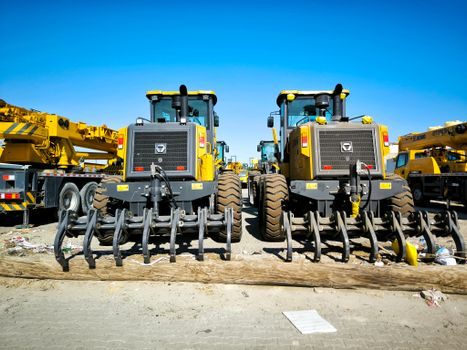
A motor grader is built for civil contractors, mining haul-road maintenance crews, and county/public-works road departments who need to cut, mix, and finish a road surface to a designed crown and cross-fall [S2]. It is not for trenching, large bulk excavation, or finish paving — excavators, scrapers, and asphalt pavers own those slots. Putting a grader in a confined urban site where a skid-steer belongs wastes fuel and steel.
Match the platform to the operating envelope: deterministic closed-loop motion at sub-arc-minute accuracy inside a cabinet calls for a servo; shaping kilometres of unbound aggregate or asphalt base under open sky calls for a motor grader.
Direct Comparison: Spec Dimensions Side by Side
Four decision criteria line the two up cleanly. (1) Power band: servo motors commonly run 50 W to 15 kW per axis; motor graders run 100 kW to 250 kW of diesel engine power. (2) Control resolution: servo positioning is sub-arc-minute with 16-24 bit encoders; grader blade position is set by hydraulic valve and operator feel, repeatable only to the centimetre. (3) Feedback mechanism: servo drives close the loop at 8-32 kHz current loop and 1-8 kHz position loop with encoder/resolver feedback; graders use manual hydraulic proportional valves with no closed-loop blade control. (4) Environment: servos are IP54-IP67, mounted in cabinets, ambient 0-40 °C typical; graders are IP-rated at the cab electronics only and run in dust, rain, and -20 to +45 °C ambient. [S1]
A 7.5 kW AC servo with a 23-bit absolute encoder and EtherCAT bus will deliver roughly 48 Nm continuous torque at 1500 rpm with repeatability inside ±5 arc-seconds. A 200 kW motor grader will move roughly 4 m³ of material per pass at 0.8-1.2 km/h with blade positioning repeatable only to operator skill level — call it ±10 mm on a good day, ±25 mm in production. The two numbers are not comparable: they answer different questions on different job sites.
Use Cases and Real Applications
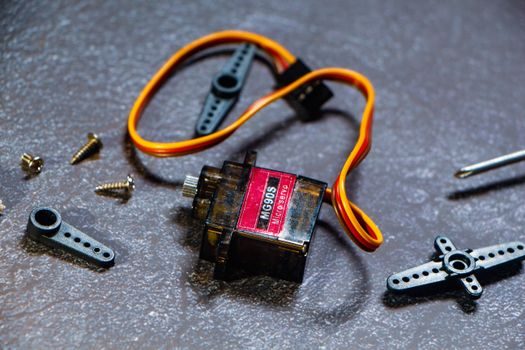
Industrial servo applications confirmed in current vendor and reference material include AC and DC brushless servo motors rebuilt by long-standing North American motor repair shops [S3], small-format hobby and educational servos documented on the LEGO Power Functions 88004 retired part page [S2], IP54-rated SVM-series industrial servos listed in a 2026-07-13 Taiwan sourcing catalogue [S5], and MATLAB/Simulink block-set support for Raspberry Pi pulse-width control of small servos in the 1-2 ms pulse range [S6]. The shared trait is closed-loop position or velocity under electronic command.
Motor grader applications are road construction and maintenance: fine grading of sub-base, finishing of gravel roads, snow removal with a front-mounted plow, ditch cutting, and mining haul-road maintenance. The chassis family spans rigid-frame (older designs) and modern articulated frames with ±25° articulation and ±35° front-wheel lean for crown work [S2].
Construction equipment spec reading can be cross-checked against a broader piece on earthmoving-platform selection, such as the Backhoe Loader Types, Spec Tiers, and Field Applications reference for adjacent machine categories.
Limitations, Failure Modes, and Standards Anchors
Servo motor failure modes centre on feedback-device degradation (encoder contamination, resolver winding failure), bearing fatigue from high-cycle indexing, and insulation breakdown in humid or oily cabinet environments. The ChapCo-style rebuild workflow for AC and DC servos, brushless DC, and stepper motors documented since 1935 [S3] exists precisely because bearing and feedback parts wear before the stator stack does. Standards anchors for industrial servos include IEC 60034 rotating-machine standards, IEC 61800 for adjustable-speed drives, and ISO 13849 for drive safety functions.
Motor grader failure modes centre on drawbar fatigue, moldboard wear-edge consumption, hydraulic cylinder seal failure, and articulation-pin wear under cyclic loading. There is no encoder watching the blade; the operator's eyes and a grade-control GNSS/laser retrofit (add-on, not standard on all units) are the blade-position feedback channel. Standards anchors for motor graders include ISO 6014 for machine performance, ISO 6393/6394 for operator sound and vibration, and ISO 12100 for general construction-machine safety.
A useful adjacent spec map for energy and cost trade-offs on the drive side of a servo installation lives at Variable Speed Drive TCO: Cost Drivers, Savings Levers, and Spec Gates, which lines up cost levers around the servo drive envelope.
Sourcing, Parts Availability, and Standards Reference

Industrial servo sourcing runs through OEM-direct channels (Siemens, Fanuc, Yaskawa, Mitsubishi, Beckhoff, Bosch Rexroth, Delta, Tamagawa) and rebuild shops handling AC, DC, brushless DC, and stepper lines [S3]. Off-the-shelf 24 VDC hobby servos for the 1-2 ms pulse-width control class are documented in the MathWorks blockset reference for Raspberry Pi [S6], and the LEGO Power Functions 88004 listed at $24.99 sits in the educational/hobby tier [S2]. Taiwan-sourced IP54 SVM series is one mid-volume industrial option visible in the 2026-07-13 supplier listing [S5].
Motor grader sourcing is dominated by Caterpillar, John Deere, Komatsu, Volvo CE, Case CE, and LiuGong, with both OEM-direct dealer networks and used-equipment remarketing channels. Reference sites such as ServoMotor.co carry application notes on speed-mode versus position-mode behaviour and induction-motor efficiency topics adjacent to the drive electronics question [S8]. Standards anchors for any procurement decision should be confirmed against the latest edition of ISO 6014, ISO 12100, and IEC 60034 — never against cached spec sheets that pre-date the latest revision.
Where the engineering team also has to size a generator or transformer upstream, a practical spec-first check on adjacent heavy equipment can start with a motor grader capability sheet, then move to the hydraulic motor or linear motor reference for the actuator level — and only then pick a servo or a hydraulic solution on real power and resolution requirements, not on brand familiarity.