
Electric pallet trucks captured approximately 42% of the global pallet jack market in 2026, leaving manual hydraulic jacks as the dominant remainder but losing share in any high-throughput facility [S1]. Powered pallet jacks in the 1500–3500 kg capacity band are the workhorses inside distribution centers, where horizontal ground-level transport outnumbers vertical-lift cycles by a wide margin [S5].
For automation projects in 2026, the truck is no longer a standalone asset; it is a node on the WMS, with telematics, lithium-ion battery data, and pallet-rack interaction defining the spec. Buyers comparing walkie, rider, and AGV-tethered models now weigh duty cycle, charge window, and aisle turning radius before they ever look at lift height [S3][S4].
Capacity, Power Source, and Build Tier Compared
Manual hydraulic pallet trucks still cover 2000–5000 kg at the lowest cost, while battery-powered electric pallet trucks cluster in the 1500–3500 kg range, with high-lift variants dropping to 1000–1500 kg to pay for added lift stroke [S5]. Stainless-steel and low-profile specials run 1000–3000 kg depending on frame geometry, and weigh-scale jacks add an integrated load cell at the same 2000–3000 kg tier [S5].
For warehouse-automation buyers, the meaningful axis is not capacity alone; it is capacity paired with battery chemistry. Lead-acid still wins on upfront dollar per kWh, but lithium-ion packs support opportunity charging during breaks, which is the single biggest lever for multi-shift fleets [S3]. Toyota's 2026 electric product line explicitly markets reduced maintenance and lower fleet fuel cost against IC-engine forklifts, with lithium-ion positioned as the default for high-uptime operations [S3].
Build tier drives everything else: entry-level walkies suit retail back-of-house and light restock, mid-tier riders cover dock-to-stock routes above 4 hours per shift, and automation-ready trucks add CAN-bus telemetry, LiDAR bumpers, and API hooks for WMS task assignment [S2][S4]. Used and refurbished electric pallet trucks remain a viable path for budget-bound facilities, with European resellers like Relevator explicitly buying and selling warehouse-automation equipment including used electric units [S2].
Duty Cycle, Aisle Geometry, and Automation Fit
A walkie electric pallet truck typically needs 1500–2500 mm aisle width to turn cleanly with a 1200 × 800 mm EUR pallet, while a stand-on rider can hold a tighter 1400–1800 mm envelope thanks to its shorter wheelbase. The Canadian dealer network explicitly markets electric pallet jacks as a distinct category from forklifts, with separate model codes, separate telematics subscriptions, and separate service intervals [S4].
Duty cycle sets the real cost-of-ownership boundary. A single-shift warehouse running 3–5 hours of powered travel per day will struggle to justify lithium-ion against lead-acid; a three-shift operation running 15+ hours of truck time will see payback inside 24 months once opportunity charging is in place [S3]. Battery voltage is the next filter: 24 V systems cover most walkies to about 2000 kg, 48 V systems handle the 2500–3500 kg rider class, and anything above 5000 kg steps into forklift territory rather than pallet-truck territory [S5].
For automation fit, buyers in 2026 should look for trucks that publish a documented CAN or REST API, support remote fault codes, and accept WMS task dispatch without proprietary middleware. Crown's North American catalog markets operator-focused design and warehouse automation as a combined value prop, a useful marker when a vendor refuses to disclose its data interface [S4]. Johnston Equipment and similar full-line Canadian dealers push automation solutions alongside the truck sale, which is a practical signal that the unit was specced with WMS hooks from the factory rather than retrofitted [S4].
Lithium-Ion vs Lead-Acid: The 2026 Decision Boundary
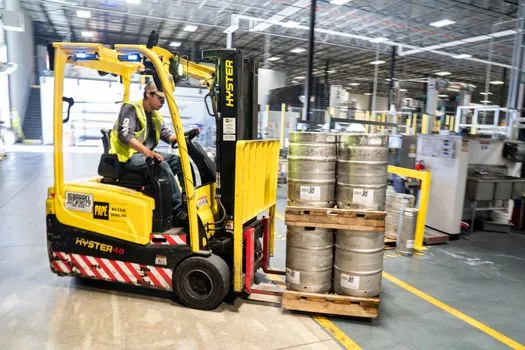
Lithium-ion (typically LFP chemistry in this category) tolerates opportunity charging at 1C to 2C rates, weighs 25–40% less than an equivalent lead-acid pack, and removes the acid-spill and equalize-charge maintenance burden. Lead-acid still wins on unit cost and on cold-storage tolerance when ambient holds below -20 °C, a known weakness of LFP if the pack lacks a self-heating BMS [S3].
Charge window dictates the real comparison: a lead-acid pack needs an 8-hour cool-down plus an 8-hour charge, so a three-shift fleet effectively needs two battery sets per truck. Lithium-ion accepts partial state-of-charge cycling without memory effect, which lets a single pack ride through a multi-shift day on top-up charges during operator breaks [S3]. For cold-chain and food-grade operations, stainless-steel electric pallet trucks with sealed lithium packs are increasingly specified to pair with hygienic pallet rack wash-down regimes, where acid leaks from lead-acid would be a compliance issue rather than a maintenance issue.
Energy cost is the sleeper variable. Electricity to move 1 ton over 1 km on an electric pallet truck is roughly 0.05–0.08 kWh, so a 10-truck fleet running 20 km per shift lands in the 10–16 kWh per day band, well within a single 30 kW charger array.
Safety, Standards, and Operator Ergonomics
Electric pallet trucks in warehouse-automation duty cycle fall under the same ANSI/ITSDF B56.1 (US) and EN ISO 3691-1 (EU) umbrella as their IC cousins, with electric-specific clauses on battery venting, creep speed on ramps, and emergency reverse. Operator-presence sensing on the tiller arm and a belly-button reverse switch are now baseline, not options, on every mid-tier 2026 model [S3][S5].
Ergonomics is where electrics justify the premium over manual. A 2000 kg load pushed manually takes roughly 200 N of sustained pull force, which is past the NIOSH recommended limit for a single operator over a full shift. An electric walkie cuts operator effort to steering only, which is why insurance carriers increasingly surcharge manual-jack operations in any facility with documented musculoskeletal claims [S5]. Anti-fatigue mats, tiller-mounted status displays, and electric steering on rider units are the three ergonomic upgrades that consistently show up in operator surveys.
For a broader plant view, electric pallet trucks are one node in a wider electrical automation stack that includes conveyor VFDs, AS/RS shuttles, and WMS task dispatch. Buyers who spec the truck in isolation, ignoring the WMS API and the rack interface, end up retrofitting within 18 months. A practical spec-front integration with pallet rack upright protection, floor flatness (FF25/FL20 minimum per ACI 117), and charger placement keeps the truck on its duty cycle instead of in the service bay.
Selection Criteria Cheat-Sheet for 2026 Buyers
Use this four-axis filter when comparing shortlisted models: capacity and load center, duty cycle and shift count, battery chemistry and charge window, and automation interface. A 2000 kg walkie with lead-acid and no API fits a single-shift retail back room; the same SKU will fail inside a month in a three-shift distribution center where opportunity charging and WMS dispatch are non-negotiable [S1][S3].
Lead with vendor transparency: refuse any quote that does not disclose battery kWh, charge profile, controller protocol (CANopen, CAN J1939, or proprietary), and service interval hours. The Canadian dealer channel is a useful benchmark, since full-line suppliers like Mobile Industries, Liftow, Johnston Equipment, Leavitt Machinery, Wajax, Crown, and Toyota Material Handling Canada all carry electric pallet jacks alongside forklifts, and all publish service-level commitments in writing [S4]. Smaller specialists often undercut on price by stripping telematics and using sealed lead-acid packs, which is fine for the right use case but disqualifying for an automation-grade spec.
For a deeper look at adjacent automation hardware, this warehouse-automation spec map for electric pallet trucks covers the e-commerce fulfillment angle, while this food-and-beverage spec guide addresses hygienic-build variants. For facilities weighing rack upgrades alongside truck refresh, this mining and heavy-duty rack spec map shows where standard pallet rack ends and heavy-duty upright systems begin.
Trackable next signals: lithium-ion pack price per kWh crossing the $140/kWh threshold in 2026–2027 (which flips the lithium vs lead-acid math for single-shift fleets), and WMS vendors shipping native pallet-truck dispatch APIs as standard rather than as a $20k+ integration project.
Spec-level background on the components involved: electric pallet truck.