
Electroslag pressure welders divide into two machine families that procurement engineers routinely conflate: portable rebar EPW heads that forge vertical bars end-to-end with axial upset force, and stationary plate ESW gantries that deposit consumable wire into a molten slag pool between water-cooled copper shoes, with no forging stage.
Both processes share a conductive molten flux bath that generates resistive heat, but only the rebar variant applies upset pressure, and the two are governed by different AWS codes (D1.4 versus D1.5). A rebar EPW power source in 2026 typically runs at 200-650 A welding current and 35-45 V arc voltage, accepting bar diameters from 16 mm up to 40 mm without a separate filler wire. A plate ESW rig such as the Lemar RS15 single-cantilever machine targets box beams up to 15 m long and plate thickness above 30 mm, with slag pool temperature held at 1600-2000 °C and a 1.6 mm wire feed. The machine families, current ranges, and code paths are the four hard facts to lock before any quote goes out.
Two Process Families Sharing a Slag Bath
Electroslag pressure welding for rebar (EPW) and electroslag welding for plate (ESW) both run current through a conductive molten flux pool, but only the rebar process applies axial upset pressure to forge a bar-to-bar joint inside a flux-filled mold [S2]. The EPW process works on vertical or inclined bars within roughly a 4:1 gradient and joins diameters from 16 mm up to 40 mm without a separate filler wire, producing a visible weld collar that is later ground flush before concrete placement.
Plate ESW, in contrast, deposits consumable wire between water-cooled copper shoes to join plate thicknesses historically reaching 75 mm and beyond, with the modern narrow-gap variant (NGI-ESW) operating in an approximately 19 mm gap [S2]. The Wuxi Lemar RS15 box-beam rig listed at cautop.com carries a 1.5 m rail width, 3 m/min maximum cantilever travel, an 8 L/min water-cooling flow, and 1.6 mm applicable wire diameter, with stated export markets including Russia, India, Dubai, Pakistan, and Kuwait [S4]. Heat input, slag-pool volume, and the absence of a forging stroke are the three engineering differences a spec writer must internalise before picking a machine class. For wider welding-process context, see the electroslag welding process family in the welding encyclopedia.
Classification by Machine Architecture
Plate ESW rigs themselves split into wire- electroslag welding and plate- electroslag welding variants, with the Wuxi Lemar product line explicitly tagged "Classification: Wire Electroslag Welding, Plate Electroslag Welding" [S4]. The same catalog page lists the machine as a submerged-arc / fuse-ESW hybrid designed for box-beam production lines, with the welding head clamped to a cantilever frame and wire fed through a non-consumable electroslag torch and contact tip.
Rebar EPW heads classify by upset mechanism and power-source topology. A practical 2026 procurement map looks like this: (1) manual clamp, AC transformer welder, 16-32 mm bar range, lowest cost and light head, but operator skill drives weld-collar quality; (2) manual clamp, inverter DC welder, 16-40 mm range with programmable arc-to-upset timer, higher first cost, more repeatable collars, preferred on tall piers; (3) semi-automatic dual-operator rig, 25-50 mm range with hydraulic upset, best collar consistency on large-diameter bars, heavier, needs crane lifts [S2]. The Qingdao Hua Yushun ZX7-630 portable EPW welder sold via the China Manufacturer Directory carries a 200-650 A current range and 35-45 V arc voltage at 16-32 mm rebar diameter, matching the manual-clamp AC/DC tier [S3].
Selection Criteria: Bar Diameter, Current, Upset Force, Code Path
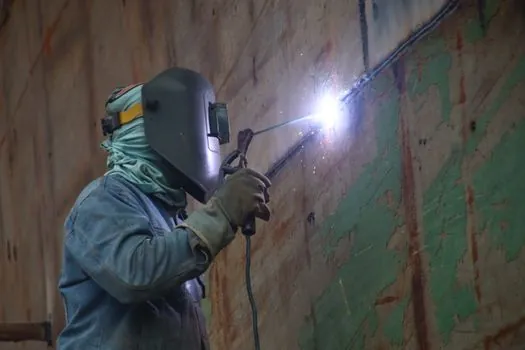
For rebar EPW on bridge columns, four specifications must be locked before quoting: maximum bar diameter the welding head accepts (commonly 16, 20, 25, 32, 40 mm), welding current rating and duty cycle of the power source, the upset (forging) force the head can deliver, and the control sequencing of arc stage, electroslag stage, and upset stage [S2]. JGJ 18-2012 governs rebar EPW in China; AWS D1.4/D1.4M governs the same work in the US, while plate ESW falls under AWS D1.5 (Bridge Welding Code) and is constrained on fracture-critical members by the FHWA memorandum dated 2018-05-10 [S2].
Weld-collar quality limits in JGJ 18-2012 set axial offset, bar diameter mismatch, and visible defect thresholds that the equipment must be able to hit under production rate, not just in the lab. The 1600-2000 °C slag-pool temperature window in the Lemar RS15 datasheet is the thermal floor below which the resistive heating in the molten flux collapses and the joint will not coalesce, so any plate-ESW tender should spec a slag-pool thermocouple or pyrometer port, not just a voltmeter [S4]. For a deeper look at how the slag bath governs weld metallurgy, the electroslag pressure welder encyclopedia entry covers heat-input control and upset forging ratios.
Comparison of the Main Equipment Options in 2026
For rebar splicing on bridge piers, the option set is manual AC transformer EPW, inverter DC EPW, and semi-automatic hydraulic-upset EPW. On the four decision criteria a bridge QA engineer actually weights, the comparison is: bar range (16-32 mm / 16-40 mm / 25-50 mm), weld-collar repeatability (operator-dependent / repeatable / most repeatable), first cost (lowest / mid / highest), and required labor (one operator / one operator / two operators with crane). [S2]
For plate splices in built-up girders, the option set is NGI-ESW (AWS D1.5 accepted for non-fracture-critical members), submerged arc welding (SAW) for horizontal plate, and shielded metal arc welding (SMAW) for short or field repair joints [S2]. NGI-ESW restores process acceptance for non-fracture-critical tension members in AASHTO temperature zones 1 and 2 by lowering heat input, eliminating electrode oscillation, and adding fixed guide and travel-speed control. The RS15 rig's 380-440 V supply, 2 kW total auxiliary power (excluding the welding power source), and water-cooling head of 10 m define the site-utility envelope a contractor must supply before the truck rolls.
Who Should Use EPW or ESW, and Who Should Not
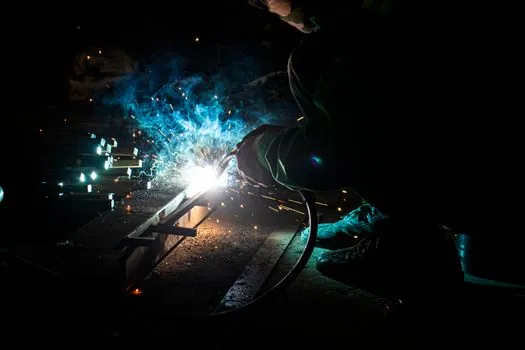
EPW is the right tool for vertical column rebar in cast-in-place concrete piers, abutment stems, and retaining walls where bars run true and the crew can stage a clamp head on the bar. It is the wrong tool for horizontal splices in beam cages, for bar diameters above 50 mm where hydraulic upset rigs become uneconomic, and for any joint where the bar-to-bar axis cannot be held within roughly 4:1 [S2].
Plate ESW is the right tool for thick-plate splices in built-up bridge girders, box-beam fabrication, and cross-frame plates above 30 mm, where the single-pass deposition rate of wire ESW (the Lemar RS15 quotes a high current density giving deposition up to 140 g/min) beats multi-pass SAW on labor cost. It is the wrong tool for fracture-critical main tension members where FHWA has rescinded tolerance, for plate under roughly 19 mm gap where NGI-ESW loses its advantage, and for field repair joints where a SMAW stick rod is faster to deploy than a cantilever gantry. A common spec trap is using a plate ESW power source to weld rebar, or vice versa: the slag-pool physics overlap, but the upset stage and code path do not, and AWS D1.4 inspectors will reject a plate-ESW weld collar on a column bar.
Limitations, Failure Modes, and Sourcing Signals
Classic ESW used high heat input with oscillating wire and was linked to brittle fracture on a fracture-critical I-79 member near Pittsburgh, which is why FHWA rescinded its tolerance on main structural tension members in notice N 5040.23 dated 1977-02-16 [S2]. The NGI-ESW refinement addresses that failure mode, but a procurement engineer who sees "ESW" without the NGI prefix in a 2026 bid should treat the weld as suspect for any tension member and request the AWS D1.5 fracture-critical clause before signing.
Other failure modes worth tracking: bar-axis offset above the JGJ 18-2012 collar limit produces eccentric load paths under seismic cycling; slag-pool temperature below 1600 °C produces lack of fusion at the bar interface; and inverter DC EPW heads without a programmable arc-to-upset timer tend to over-upset small-diameter bars, which thins the cross-section below the parent-bar area. For broader jobsite power-tool context that an EPW crew shares a trailer with, the pneumatic nail gun selection guide covers the adjacent fastener toolchain. Two trackable signals for the next 6-12 months: any AWS D1.5 ballot that re-opens ESW on fracture-critical members, and any Chinese JGJ 18 revision that raises the upper bar-diameter limit above 40 mm for inverter-class EPW heads.
For component-level specifications, see construction machinery and equipment.