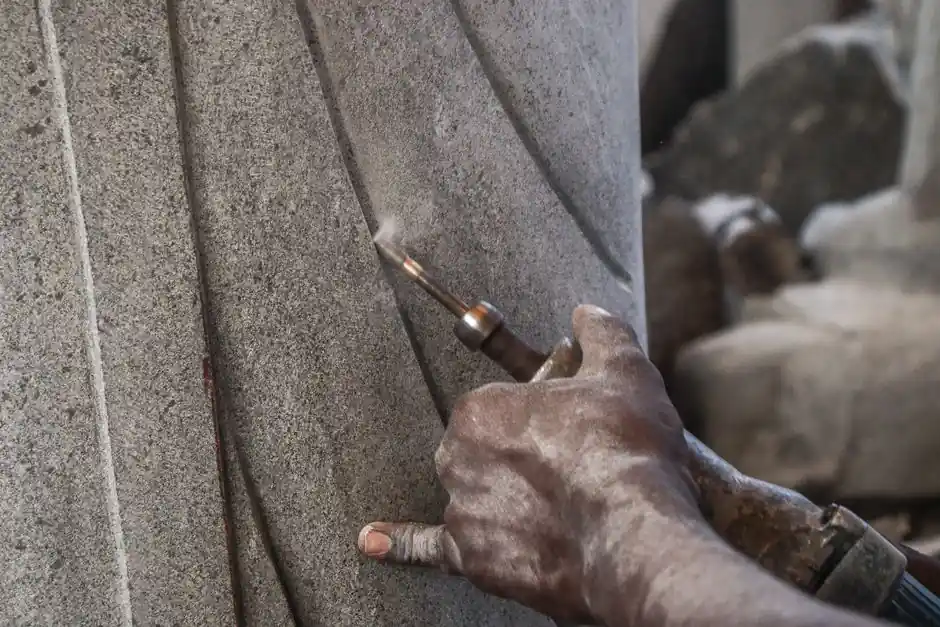
Hand-held 110–125 mm marble cutters, like the 1450 W 220-240 V~50/60 Hz Tolsen 79533 unit, plug into a standard single-phase outlet provided the plug is unmodified and a residual current device sits upstream [S1].
Industrial bridge and block saws jump two classes: the 22 kW Shengda XZQQ-625 bridge cutter needs a 380 V three-phase 50 Hz feed, 4 m³/h cooling water, and a 6000×5000×2600 mm installation bay weighing roughly 7200 kg [S3]; the QSQJ-1600-B block cutter escalates to 75 kW or 90 kW main-motor options, 20 m³/h water, and a 6628×5500×5935 mm footprint at 12,000 kg [S4].
Electrical Supply: Single-Phase Versus Three-Phase Decision
Hand-held 110 mm class machines run on 220-240 V~50/60 Hz single phase, with the Tolsen 79533 1450 W and INGCO MC140068 1400 W units both shipping into that band, and the instruction manual states that "power tool plugs must match the outlet" and that no adapter plug may be used with an earthed tool [S1][S6]. For any damp or outdoor site the same manual mandates a residual current device (RCD) on the supply to limit shock risk [S1]. Industrial bridge and block saws, by contrast, list 3 Phs 380 V 50 Hz as the only accepted power requirement, which rules out a domestic three-phase feed and pushes the install toward a dedicated MCC drop [S3][S4]. A site that already runs a 22 kW XZQQ-625 bridge cutter cannot drop in a 90 kW QSQJ-1600-B on the same circuit without re-calculating breaker sizing and cable cross-section, because main motor power steps from 22 kW to 75 kW or 90 kW between the two machines [S3][S4]. The compliance envelope on Shengda's bridge cutter is declared against EN 60204-1:1998 (electrical equipment of machines) and the EU Machinery, Low Voltage, and EMC directives, which is the baseline for CE-marked stone machinery in the EU [S3].
Floor Loading, Footprint, and Anchor Pattern
Installation space, not blade size, is usually the gating constraint for stone-shop builds. The XZQQ-625 bridge cutter occupies 6.0×5.0 m of floor and tips the scale at 7200 kg, which on a standard 150 mm reinforced concrete slab works out to roughly 2.4 kPa distributed load, well inside the 5 kPa office-grade limit [S3]. The QSQJ-1600-B block cutter needs 6.6×5.5 m and 12,000 kg, pushing distributed load to about 3.3 kPa, still tolerable for industrial slabs but a problem for mezzanines not designed for stone-yard duty [S4]. Hand-held cutters have no floor-loading concern but the working slab still needs to be flat, stable, and free of stored offcuts before the tool is unpacked, per the marble cutter assembly flow that begins with "unpack all parts and lay them on a flat, stable surface" and verify the delivery contents are complete [S2]. For slab-edge work, the Sino Star MCQJ series shows how the same 3200×2000 mm table size covers four model widths from 450 mm up to 800 mm blade capacity, with vertical stroke scaling from 230 mm to 580 mm, so a shop already built around a 3200 mm table can swap cutter classes without re-grouting the floor [S9].
Water Supply, Drainage, and Slurry Handling
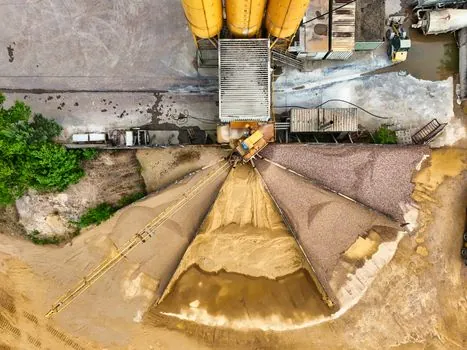
Bridge-saw water draw is 4 m³/h on the XZQQ-625, modest for a single machine but worth a dedicated 1-inch feed with a shutoff and a floor drain that can carry slurry without clogging [S3]. Block-cutter water draw jumps to 20 m³/h on the QSQJ-1600-B, which is roughly the flow of a small pool pump and forces a hardened sump or a flocculant settling tank before the drain reaches the site sewer [S4]. Where water feed is impractical, dry cutting is acceptable only when paired with an M-class vacuum on a sealed dust port, and the tool body itself should carry at least IP5X on the motor housing to keep silica fines out of the brush area, a discipline shared across the rebar cutter category for the same dust-load reason [S5]. On the consumable side, continuous-rim diamond blades are the default for marble, granite, and porcelain because they leave a chip-free edge and run cooler against the matrix, important when cuts sit near embedded services [S5]. Segmented blades cut faster but chip the edge and run hotter, so they belong on masonry, not finished stone.
Dust Extraction, IP Rating, and Site Hygiene
Crystalline-silica dust from stone cutting is the dominant occupational-health risk on a marble-cutter install, and the 110 mm hand-held class is the one that most often runs indoors where dust cannot vent. The selection map for electrical-installation duty specifies a sealed dust port matched to an M-class extractor, with a 32 mm or 38 mm hose cuff as the common fitment, and an IP5X-rated motor housing as the minimum brush-area ingress protection [S5]. A 1400 W motor at roughly 12,000 rpm no-load will pull a continuous 25–30 mm cut in granite without bogging down, while a sub-1100 W unit stalls inside the first 10 mm of the same stone, so under-spec'd machines tend to be the ones that get forced harder, generating more heat and more fines per cut [S5]. For shops that already run a crossed-roller guide table on a precision saw, the same dust discipline applies because the linear bearings will swallow fines and lose preload if the shroud leaks. Compared to a plasma cutter or concrete groove cutter, the marble cutter produces a much finer, sharper particulate that stays airborne longer, so extraction airflow per kW of spindle power has to be higher.
Unpacking, Blade Fitment, and First-Run Checks
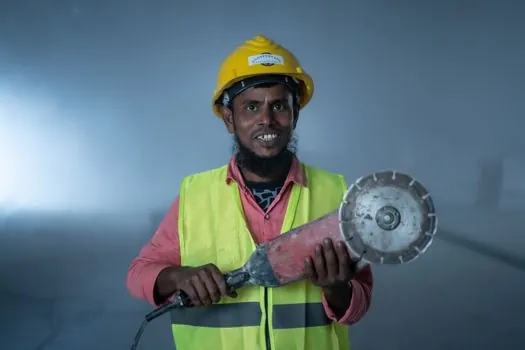
The mechanical install follows a tight sequence: unpack all parts onto a flat stable surface, confirm the delivery contents against the packing list, then fit the blade before any power connection [S2]. Bore size is fixed by the tool: 110 mm class blades run a 20 mm or 22.23 mm bore depending on regional spec, with a maximum peripheral speed printed on every reputable disc and the spindle no-load speed typically 11,000–13,000 rpm for the 110–125 mm hand-held class [S5]. Before power-on, the operator must verify the switch is in the off-position, the adjusting wrench is removed, and any dust extraction is connected, since the personal-safety clauses in both the Tolsen 79533 and the IBL MC10-30 manuals treat a stray key in the rotating group as a guaranteed injury [S1][S2]. For the industrial class, the equivalent first-run check is the laser alignment on the bridge saw and the inverter parameter entry on the switchboard, which the XZQQ-625 uses to set cut dimensions via terminal input before the first automated pass [S3].
Comparison: Hand-Held Versus Bridge Versus Block Cutter Install
Three install profiles line up cleanly against four decision criteria. Hand-held 110–125 mm tools win on outlet simplicity (220-240 V single phase), footprint (zero floor space), install time (under 30 minutes), and capital cost, but lose on cut depth (34 mm max on the INGCO MC140068) and continuous-duty rating [S6]. Bridge saws like the XZQQ-625 win on cut accuracy (laser-aligned, PLC-controlled with up to 2000 repeatable programs) and slab capacity (3200×2000 mm, 600 kg), at the cost of 380 V three-phase power, 4 m³/h water, and 7200 kg of floor load [S3]. Block cutters like the QSQJ-1600-B win on raw throughput (75 kW or 90 kW main motor, 1600 mm blade, 630 mm max cutting height) but require the largest install envelope at 6.6×5.5×5.9 m and the heaviest water draw at 20 m³/h [S4]. For a fabrication shop taking delivery of full marble blocks, the block cutter is non-negotiable; for a tile trim-out or countertop installer, the hand-held 1400 W class is the right tool and the marble cutter encyclopedia entry covers the bore, RPM, and dust-port geometry that drive that decision.
Acceptance Test, Common Failure Modes, and When to Escalate
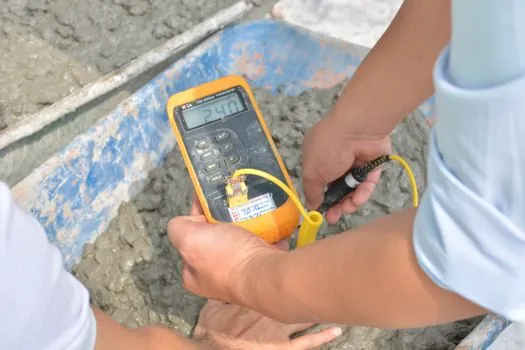
Acceptance on a hand-held cut is a chip-free edge on porcelain at full 34 mm depth in a single pass, with the dust shroud showing negative pressure at the hose cuff and the motor housing staying below 60 °C surface temp after a 5-minute continuous run [S5][S6]. Acceptance on a bridge saw is dimensional: the first automated program should reproduce a programmed length within ±0.5 mm across 2000 cycles, the figure Shengda publishes for the XZQQ-625 repeatable-cut count [S3]. Common failure modes cluster into three buckets: electrical (RCD trips on first start, almost always a missing ground or a wet-cut water path leaking onto the brush housing), mechanical (blade runout greater than 0.1 mm, traced to a worn arbor or an under-torqued flange nut), and process (chip-out on marble edges, traced to a segmented blade where a continuous-rim was specified) [S1][S5]. Escalate to the OEM or a qualified repair person using only identical replacement parts when the armature or stator fails, when the spindle bearing develops radial play, or when the bridge-saw inverter throws a ground-fault code that does not clear after a re-seat, since the personal-safety clauses in both reference manuals explicitly require qualified service for those paths [S1][S2]. For shops adding a linear guide bed to an existing cutter, the same dust discipline applies, and a leaking shroud will eat the rail in a season.
Trackable signals for the next planning window: EN 60204-1:1998 is the electrical baseline cited on Shengda's CE declaration, and any shop specifying a new bridge saw after the next Machinery Directive revision should confirm the declaration has been refreshed against the current harmonised standard [S3]. For hand-held 110 mm class users, the watch-item is M-class extractor mandate enforcement on indoor stone cuts, which is tightening across EU jobsites and already drives the IP5X-plus-sealed-shroud pattern on every professional-grade 110 mm unit currently shipping [S5].
Related analysis: How to Choose a Coordinate Measuring Machine: 2026 Spec and Selection Map.
