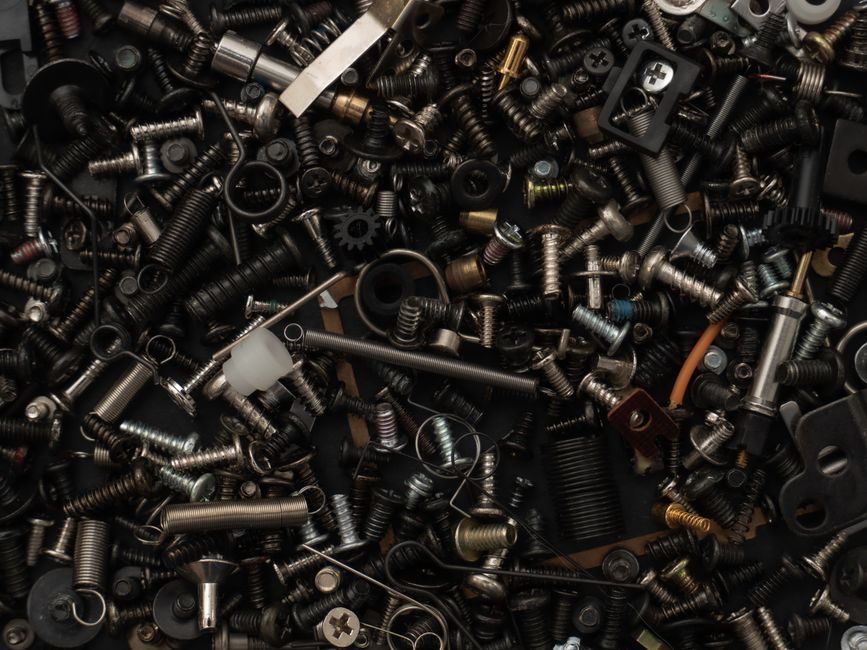
An embedded part is any functional element — threaded insert, captive nut, knurled brass bushing, self-tapping stud or dowel pin — installed during molding or assembly so the host structure carries the load rather than the fastener alone. Specifying one is a chain of six gates: host material, load case, install method, thread class, corrosion regime, and QA evidence. Skipping any one gate is the most common cause of an RFQ that has to be re-quoted in week three.
The market sits inside a wider industrial fastener-and-fitting segment that buyers also touch when they spec linear guide blocks or crossed roller guide carriages — the same gate logic (load, tolerance, environment, evidence) applies, just with different physics. This guide maps that logic to embedded parts for 2026 sourcing.
Host Material and Molding Method: The First Gate
Embedded parts are most commonly installed in thermoplastic injection molding (insert molding) or in cast metals and concrete (post-poured anchors). The host material dictates the insert's boss diameter, wall thickness, and the surface treatment needed to lock against rotation and pull-out [S1]. For thermoplastics, knurled or barbed brass inserts with an outer diameter roughly 1.5–2× the nominal thread size are the baseline; for cast iron and aluminum, larger-diameter headed studs with a hex or knurl shank are typical.
For thermoset composites and carbon-fiber-reinforced polymers, embedded inserts usually need a boss area that distributes the clamp load — a 3:1 boss-to-insert diameter ratio is a common starting point to prevent fiber washout at the bearing surface. Buyers running aerospace or motorsport composites should also specify whether the insert is over-molded (cleanest, lowest void risk) or post-installed (cheaper, higher reject rate on CT scan).
Load Class: Axial Pull-Out, Torque-Out, and Push-Through
Every embedded insert fails one of three ways under load: axial pull-out (tension along the fastener axis), torque-out (rotational slip in the host), or push-through (host-wall shear). Spec sheets for captive nuts and threaded inserts should quote all three numbers in Newtons and N·m, not just one. A typical M6 brass knurled insert in ABS pulls out at roughly 1,500–2,500 N on first load [S1]; the same insert in glass-filled PA66 climbs above 3,500 N thanks to higher shear strength of the host.
For dynamic or vibration-loaded joints, captive nuts with a load-bearing flange and a press-fit shank outperform plain knurled inserts — the flange acts as a clamp face, not a thread-extension. Buyers specifying against MIL-STD-810 vibration or IEC 60068-2-6 should require a torque-out figure that holds after the test sequence, not a single static value at room temperature. This is also where the embedded part family overlaps with industrial valve bonnet fasteners: same physics, different host.
Thread Class, Standard, and Re-Work Strategy
Coarse metric (M2.5–M16) dominates plastic-hosted inserts; unified (UNC/UNF) is the default for North-American metal castings. Buyers should fix the thread standard (ISO 261, ASME B1.1) and tolerance class (6H/6g for general industrial, 4H5H for safety-critical) on the RFQ before price is discussed — loose thread tolerance is the most common hidden discount path. For parts that may be re-worked in service, a captive nut or helical insert lets a damaged thread be replaced without scrapping the host; for one-shot molded assemblies, a one-way barbed insert is acceptable. [S1]
Forged-in-place thread inserts (e.g., the self-tapping or ultrasonic-insert family) require a separate spec: the parent thread in the host, the install equipment class, and the post-install proof torque. Many aerospace and medical OEMs reject these unless install is on a controlled, logged machine with a documented pull-test sample. If the buyer is new to insert molding, pressure transmitter process connection fittings (NPT, BSPP, flanged) follow the same spec-frame logic and are a useful cross-reference for thread-class thinking.
Material Family: Brass, Stainless, Aluminum, and PEEK
Four material families cover roughly 95% of 2026 embedded-part sourcing: brass (C36000, the default for plastic insert molding), stainless (303/304/316, for corrosion and medical), aluminum (6061/7075, for weight-sensitive castings), and PEEK or other high-temp polymers (for electrically isolated or chemical-resistant hosts). Brass C36000 machines cleanly, is non-magnetic, and is the most cost-stable for volumes above 50,000 pieces/year [S1].
Stainless 316 is specified where chloride exposure is expected (marine, chemical, medical) and where the insert doubles as a wear-bearing face. PEEK and similar high-temp polymers are niche — typically used in aerospace composites where a metal insert would create a galvanic or CTE mismatch with the carbon layup. For a high-level view of how material choice flows through adjacent components, the flow meter wetted-material selection logic (corrosion, temperature, certification) maps almost one-to-one onto insert selection in chemical-plant builds.
Corrosion Regime, Plating, and Galvanic Pairing
Galvanic corrosion between an insert and a through-fastener is the silent killer of an embedded joint. Brass insert + zinc-plated steel bolt is benign in dry indoor air; the same pairing in a salt-fog test (ASTM B117, typically 96–500 h) will pit the zinc and loosen the joint. Specify the bolt finish to match or be nobler than the insert — stainless insert with stainless bolt, brass with tin or nickel-plated steel at minimum. For parts that will see NACE MR0175 sour-service exposure, 316L or higher nickel alloys are the floor, not the ceiling [S1].
Surface finish is not cosmetic. A bright tin, nickel, or zinc-nickel plating on a brass insert can change its outer diameter by 5–15 µm per side — enough to swing a press-fit from slip to crack. Buyers should require the finish to be called out on the drawing with a thickness range (e.g., "Sn 5–10 µm per ASTM B545"), and the supplier to measure the post-plated OD on the CMM sample, not the pre-plated blank.
Sourcing, Standards, and Quality Evidence
The 2026 sourcing frame for embedded parts is straightforward: fix the spec (host, load, thread, material, finish), fix the evidence (PPAP, FAI, torque-out, pull-out, salt-fog hours), then fix the commercial terms (MOQ, lead time, country of melt, RoHS/REACH, conflict-mineral disclosure). A reasonable FAI pack on a custom insert should include a torque-out and pull-out test per a defined sample size (often 5 pcs/lot), a CMM dimensional report against the print, and a material certificate back to the melt. For safety-relevant parts, IATF 16949 or AS9100 supplier certification is increasingly required by the buying OEM [S1].
Lead time for a custom insert in 2026 runs 6–10 weeks for tooling + sample, then 4–8 weeks for production after PPAP sign-off, so engineering must lock the spec early. Buyers comparing two or more suppliers on the same gate set should require each to fill an identical datasheet (host, load, thread, material, finish, evidence) — a side-by-side review is the only way to keep price from being a proxy for spec. The same six-gate frame used in Steel Pipe Selection in 2026: Five Gates Buyers Run Before RFQ applies almost unchanged here, and the supplier-comparison logic in Ball Screw 2026 Buying Guide: Spec, Grade, Support and Sourcing is a clean parallel for build-to-print industrial hardware.
Trackable next signals for buyers: (1) the insert supplier's current melt-country disclosure and REACH/RoHS statement dated within 12 months; (2) a recent PPAP or FAI package on a part of similar geometry, not a generic company brochure; (3) the supplier's stated lead time for the specific thread size and finish, not a generic catalog number. If any of these three is missing or older than 12 months, the spec is not yet locked enough to issue a binding RFQ.