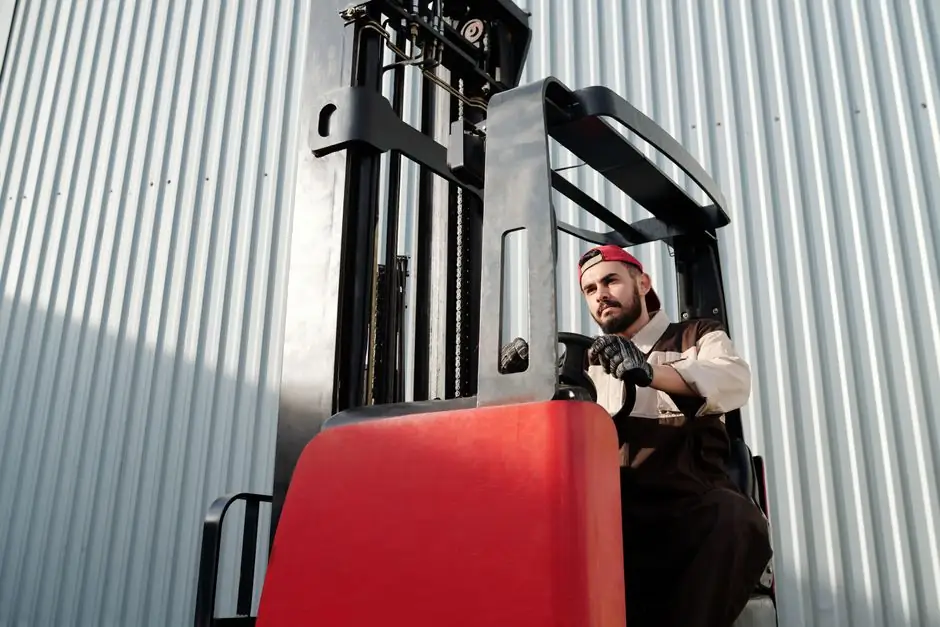
EN 15095:2007+A1:2008 is the harmonised European standard covering safety requirements for power-operated mobile racking, shelving, storage carousels, and storage lifts, classified under ICS 53.080 (Storage equipment) [S1][S4]. The base text was approved by CEN on 23 September 2007, with Amendment A1 approved on 9 November 2008 and published as the consolidated EN 15095:2007+A1:2008 in December 2008 [S4][S5].
The standard's scope explicitly lists three equipment classes: storage carousels (vertical and horizontal), storage lifts, and power-operated mobile racking and shelving, all driven by an electric or other power source rather than manual effort [S1][S7]. Annex ZB maps the clauses to the Essential Health and Safety Requirements of EU Machinery Directive 2006/42/EC, making the document the typical route to CE marking under the Machinery Regulation for this equipment class [S4].
Scope, equipment classes, and the assumptions baked into the text
EN 15095 assumes a specific operating envelope: only trained staff operate, repair, or maintain the machine, components not given bespoke rules are sized to good engineering practice covering all failure modes, and the equipment is fed from a power supply that is itself reasonably stable [S4]. The scope is intentionally narrower than EN 15620 or EN 15629 (industrial racking) because the standard addresses powered motion, not just static load-bearing.
Equipment falls into distinct classes with different hazard profiles. Vertical carousels use chains or belts to rotate carriers in a closed loop, covered in Annex E (informative) for chain selection [S4]. Storage lifts raise and lower a carrier between floor levels inside a closed enclosure, a topology that overlaps with light-goods lifts but stays under Machinery Directive scope rather than the Lifts Directive 2014/33/EU because they carry goods, not people. Mobile racking moves entire rack frames on rails, with Annex C (informative) defining rail tolerances that the system integrator must respect on the floor [S4].
For any specifier comparing fixed industrial shelving against the powered systems that EN 15095 governs, the trade-off is footprint versus control complexity: mobile bases reclaim aisle space by condensing access aisles into a single moving aisle, but the safety engineering must address pinch points, runaway bases, and access-zone interlocks that a static rack never has, which is why EN 15095 exists as a separate document from racking-only standards. The storage rack ecosystem therefore sits adjacent to, but not inside, the EN 15095 risk envelope.
Hazard list and the engineering controls that follow
Clause 4 enumerates seven hazard groups that the safety requirements in Clause 5 are designed to neutralise: mechanical, electrical power, ergonomic, power-supply / component-failure, safety-system design failure, electromagnetic, plus a consolidated hazard list in Table 1 [S4][S5]. Each hazard class is mapped to one or more specific protective measures, and the standard's normative Annex D pins down rack-and-pinion geometry (pinion diameter, rack tooth profile, engagement length) for designers who choose that drive topology for mobile bases [S4].
Mechanical-hazard controls in 5.2 cover crushing, shearing, cutting, entanglement, drawing-in, and impact; for storage lifts this drives the requirement for enclosed cabins or light-curtain / pressure-mat access protection at every operator station, and for carousels it forces consideration of the pinch zones between moving carriers and the fixed frame. Electrical hazards under 5.3 follow the typical EN 60204-1 machinery-electrical rules, with the additional requirement that the equipment must fail safe if the power supply drops, which is why 5.5 mandates braking, anti-runaway, and controlled-decay logic for vertical carriers that could otherwise free-fall if the drive loses torque. A useful spec-side reference for the broader handling-equipment context is the storage handling taxonomy, which sets out where EN 15095 equipment sits versus conveyors, AGVs, and stacker cranes.
Verification, commissioning, and the three checkpoints
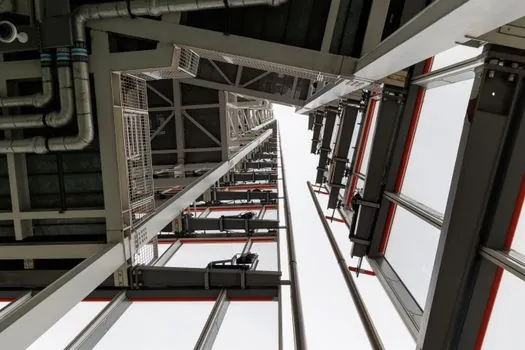
Clause 6 splits conformity work into four gates: design/manufacturing conformity, on-site checks before power-on, commissioning, and user information [S4][S5]. The on-site pre-energising check is a common source of project friction, because the rail-tolerance values in informative Annex C must be met by the floor that the host site provides, not by the equipment vendor, and rail deviations outside the Annex C band will cause mobile bases to bind or skew, even on a unit that passed factory acceptance.
Annex B (informative) sketches the typical power-operated mobile storage system layout, useful for tender drawings because it gives the OEM a common reference for naming subsystems, and it ties back to the safety-related control functions in 5.5. For projects that pair an EN 15095 unit with adjacent material-flow equipment, the practical comparison set is found in elevator vs rail-guided mast stacker cranes, which sit in adjacent but distinct standards regimes under EN 14502-series crane rules rather than EN 15095; the spec trade-offs between the two are laid out in a stacker crane comparison.
User information, training, and the post-installation lifecycle
Clause 7 obliges the manufacturer to deliver an instruction handbook covering intended use, foreseeable misuse, residual risks, commissioning data, and the maintenance / inspection schedule [S4]. Because the standard's preface explicitly assumes only trained staff operate, repair, or maintain the machine, the burden of operator competence is shared between the supplier (training material) and the host site (competency assessment and record-keeping under typical national WHS rules).
For lift-type units, the maintenance regime typically dovetails with periodic inspection of chains (Annex E chains in vertical carousels), pinion engagement (Annex D), and the electrical safety functions; a missed chain-elongation check is a frequent root cause of vertical-carousel incidents in published HSE summaries. Because storage lifts move only goods and never people, they are explicitly out of scope of the Lifts Directive 2014/33/EU, and the conformity route runs through the Machinery Directive 2006/42/EC, with EN 15095:A1 cited in the Official Journal as the harmonised route to presumption of conformity [S4]. Procurement teams that also handle industrial storage cages for parts storage will recognise the same directive-cascade logic in the storage cage standards, where EN 15635 etc. cover static installations and EN 15095 picks up where powered motion begins.
When EN 15095 applies and when it does not
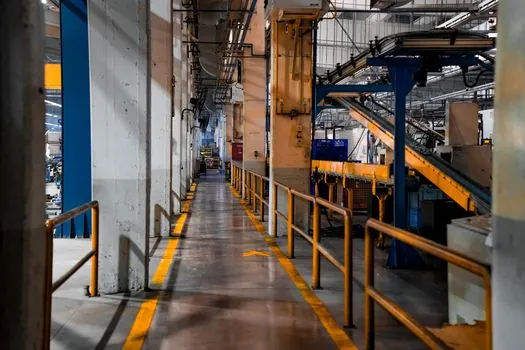
EN 15095 applies to power-operated mobile racking, power-operated shelving bases, storage carousels (vertical and horizontal), and storage lifts that carry goods, all with rated speeds and loads defined by the manufacturer. It does not apply to lifts covered by the Lifts Directive 2014/33/EU, to cranes covered by EN 14502 / EN 15011, to conveyors under EN 618 / EN 619, or to static shelving governed by EN 15620 / EN 15635. A picker crane that travels on a rail to deliver totes to a workstation is governed by crane rules, not EN 15095, even though the two can look superficially similar to a buyer. [S1]
Procurement signals to track: revisions to Annex C rail-tolerance values, any change to the OJEU citation under the recast Machinery Regulation (EU) 2023/1230, and the publication status of any new work item under CEN/TC 147 / WG 6 that splits storage lifts from mobile racking. For teams standardising on EN 15095 alongside adjacent material-flow kit, the construction machinery and equipment reference page documents where the directive-cascade differs for site-machinery use cases versus in-plant storage use cases.