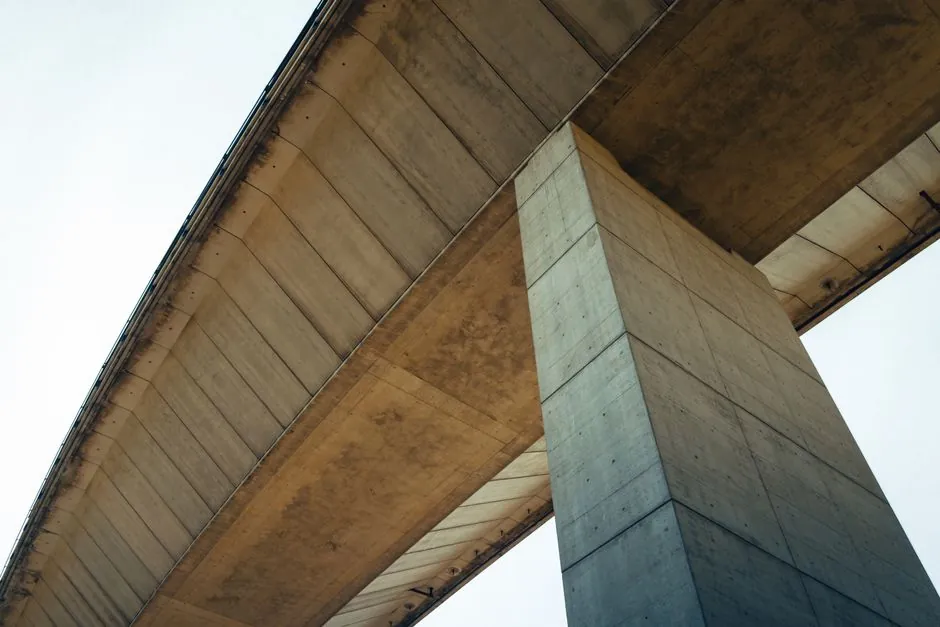
An encapsulated underdeck platform is a suspended, fully sheeted work envelope hung beneath a bridge deck, used to confine abrasive blasting debris and overspray while crews prepare steel and apply protective coatings. These platforms combine a load-rated scaffold deck, perimeter containment fabric, dust collection ports, and access hoists into one unit, replacing the older practice of open-air blasting over traffic or water [S2][S4].
Two technology threads now drive the 2026 market: encapsulated overcoat systems that bond aged lead-based paint in place rather than removing it, and trailer-mounted under-bridge inspection-and-rehab platforms such as the HP35 (35 ft platform extension, more than 18 ft maximum drop depth, 1,000+ sq ft of under-bridge area per deck placement) that carry blasting pots and paint spray rigs directly to the work face [S1][S5]. Together they cut containment cost, lane-closure time, and environmental discharge on steel-truss and concrete-girder rehabs.
What "Encapsulated" Actually Means on a Bridge
Containment on a bridge rehab job is rated by the fraction of dust, abrasive, and removed coating it keeps out of the air and water below the deck. A fully encapsulated underdeck platform sheaths the underside of the work zone with reinforced fabric or rigid panels, seals to the bridge soffit, and ties into a dust collector sized to the blasting pot feed rate [S2][S3].
Three containment levels appear in current U.S. bridge-painting practice. Class A containment handles abrasive blasting with full sealed enclosure and negative pressure, sized to the dust collector CFM. Class B wraps debris but allows controlled ventilation. Open blasting with no enclosure is now rare on lead-paint bridges because of EPA Renovation, Repair and Painting (RRP) and OSHA 1926.62 lead-in-construction exposure triggers [S2]. When the structure crosses navigable water, barge-mounted lifts add another layer, and the encapsulation envelope must include a debris catch beneath the suspended deck [S2].
For comparison, an under-bridge inspection unit (UBIU) like the HP35 reaches 35 ft out and drops 18 ft from the curb line, but ships without sheeting; the contractor adds containment to make it a rehab platform, not an inspection one [S5].
Encapsulation vs. Removal: the Lead-Paint Decision
Encapsulation overcoats existing lead-based paint with a penetrating, moisture-cure polyurethane that locks the lead layer into the new film; abrasive removal strips the lead to bare steel and disposes of it as hazardous waste. SPI Coatings' RUST GRIP®, an aluminium-metallic, moisture-cure polyurethane, is the documented commercial example, used on the Gadsden Truss Bridge over the Coosa River (200 m / 660 ft span) to encapsulate lead-based paint without a full removal campaign [S1].
On the Gadsden project the contractor caught the lead-based paint in tarps for U.S. Army Corps of Engineers release back into the river, then shipped containerized waste to an Alabama state-approved hazardous-waste hauler. The job finished in 30 days with minor traffic disruption and zero environmental or safety violations, a result attributed directly to the encapsulation spec rather than open abrasive removal [S1]. Encapsulation does not eliminate blasting entirely; surface preparation still requires abrasive media to reach SSPC-SP 6 (commercial blast) or SP 10 (near-white blast) on corroded zones, but it removes the lead-disposal line item that typically runs 20 to 40 percent of a lead-paint bridge rehab budget.
Where abrasive blasting is mandatory (active corrosion pitting, pack rust, section loss), the platform still has to be fully encapsulated and vented to a dust collector with CFM matched to the blast pot. Rapid Prep's bridge-blasting line pairs blast pots from Schmidt 8-ton units up to 28-ton systems with dust collectors in the 2,500 to 40,000 CFM range, and adds climate-control dehumidifiers (DH/AC 5,000, DH Industrial Desiccant) to hold dew point during coating application [S3].
Underdeck Platform Specs Engineers Actually Compare
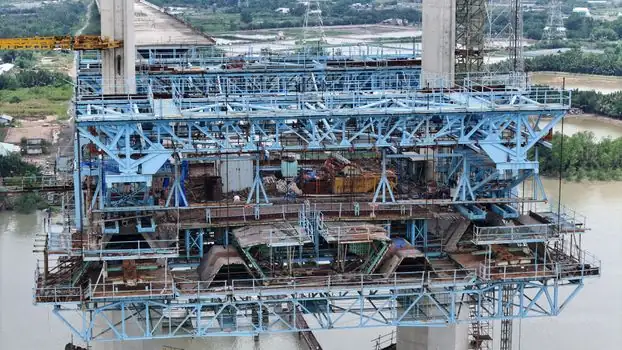
Specifiers weigh four platform types against a fixed set of criteria: reach, drop depth, deck area, power, and containment integration. A direct comparison using the HP35 as the trailer-mounted benchmark and typical snooper/barge platforms as the heavier alternatives shows the trade space [S2][S5].
Platform reach governs which girder lines a single setup can service. The HP35 platform extends 35 ft out from the curb, enough for two to three lanes of traffic per setup, and drops more than 18 ft below deck [S5]. Snooper and Hydra Platform trucks reach further (typical 40 to 60 ft horizontal, up to 180 ft vertical on boom lifts per 1 Priority's published fleet range), but they need a clear shoulder and cannot deploy where the bridge crosses water with no road access below [S2]. For navigable-water crossings, contractors shift to barge-mounted lifts and engineered suspended cable scaffolding hung directly off the bridge members, which carry the encapsulated deck without ground support [S2].
Power and hydraulics separate inspection units from rehab platforms. The HP35 uses an 18 HP V-twin gas engine for its hydraulic system and tows on a pintle hitch behind a truck rated for 18,600 lb trailer weight [S5]. A rehab platform for blasting must add compressor power (diesel rotary screw, typically 375 to 1,600 CFM at 100 to 150 psi for a 8-ton blast pot), dust collector feed (2,500 to 20,000 CFM depending on pot count), and lighting (400 W LED area light towers are now standard on Rapid Prep bridge packages) [S3]. Deck payload climbs accordingly: 1,000 sq ft of staging per placement is a useful rule of thumb for the HP35 family, while heavier suspended platforms drop that to 400 to 600 sq ft because the cable rigging carries both crew and consumables [S2][S5].
Containment integration is the discriminator. An overhead bridge crane has nothing in common with a bridge-painting underdeck platform, but the rigging principles (load-rated steel cables, redundant hoists, fall arrest) overlap, and specifiers often borrow the same load-chart discipline for both. The platform deck must integrate a dust port sized to the dust collector inlet, viewing ports for the blaster, and air-fed blast hood connections fed by a Radex airline filter for breathing air [S3].
Surface Prep and Abrasive Choices Inside the Envelope
Inside the encapsulated envelope, surface prep drives both productivity and dust load. Recycled crushed glass, steel grit, garnet, copper slag, JETMAG, and 10X Superoxalloy are the abrasive families Rapid Prep lists for bridge work, each with a different profile, recycle count, and dust signature [S3]. Garnet and recycled glass produce the cleanest SSPC-SP 6 / SP 10 anchor profiles at 2 to 4 mils, with low free silica, which matters when dust is being filtered rather than released. Steel grit is recyclable in a Schmidt Blast Recovery System or VB 2400/1200 vacuum-and-recovery loop, cutting abrasive consumption 60 to 80 percent on long truss runs, but it adds weight to the platform deck and demands more hoist capacity [S3].
Wet and slurry blasting (Amphiblast, Dust Free Greener Blaster, HoldTight® salt remover) cut visible dust by 90 percent or more and are commonly specified over open water or active rail corridors where dry containment is impractical. They trade a clean dry profile for a flash-rust window of minutes, so the platform usually carries a desiccant dehumidifier (DH Industrial) and the coating crew is staged on the same deck to lay primer before the dew point closes in [S3]. Sandblasting machines configured for bridge work tend to use pressure-hold systems (Contractor/High Production Blast Package, Pro Blast Package) over pressure-release pots because they hold a steadier nozzle pressure at the blaster's hands inside the enclosed deck.
Climate control on the deck is now standard. The C40 climate-control device and GX4 four-gas monitor (LEL, O2, CO, H2S) ride on the platform so the abrasive feed, ventilation, and crew air supply stay inside their spec windows during the shift [S3].
Coating Application and Inspection After Prep
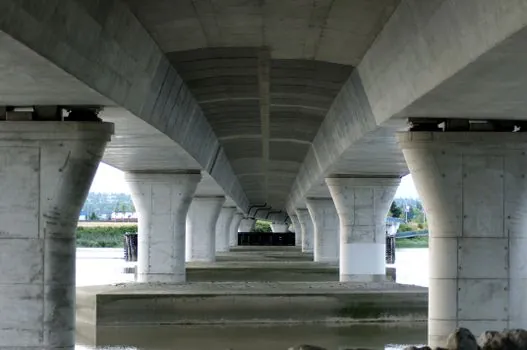
Once the deck hits profile, coating application moves in the same shift. The platform carries airless spray rigs fed by 5,000 to 20,000 CFM dust-free ventilation, with dehumidified air holding steel temperature at least 5 °F above dew point per standard coating supplier data sheets. For lead-paint encapsulation overcoats like RUST GRIP®, the spec is application directly over the prepared, existing coating system, with full encapsulation of any remaining lead, rather than full removal to bare metal [S1].
Inspection after overcoat uses a combination of dry film thickness gauges, adhesion pull tests (typically ASTM D4541), and visual comparison against the Mississippi River Bridge CorrTech report referenced in SPI's documentation [S1]. The report concluded that RUST GRIP® is a suitable coating for steel superstructures already coated with lead-based paint in fair to poor condition, provided the substrate is prepped correctly and the coating is mixed and applied per the manufacturer's data sheet [S1]. That single field trial is the most cited U.S. reference document for the encapsulation-overcoating approach on a through-truss bridge.
For traditional three-coat zinc/epoxy/polyurethane systems over near-white blast, the platform also serves as the staging for the shot blasting machine if the specifier chose recycle-blast surface prep, and for the final stripe-coat pass on weld terminations and rivet heads. Most U.S. state DOTs require a stripe coat by brush on all edges, welds, and fasteners before the full spray coat, and a self-leveling deck with a horizontal crossover platform (as on the HP35) speeds that step [S3][S5].
Who the Encapsulated Underdeck Platform Is, and Is Not, For
These platforms fit steel-truss and steel-girder bridge rehabs over traffic, rail, or water where lead-based paint or full removal is in scope and a 30 to 90 day window is available. They also fit concrete-girder bridges needing soffit repair, coating, or carbon-fiber strengthening, because the same containment envelope that catches abrasive catches concrete dust and resin volatiles [S2][S3].
They are not a fit for short-night closures on urban arterials, where a 35 ft platform cannot deploy and strike in a 6-hour window. They are also wrong for new bridge construction in the construction machinery and equipment fleet sense, where under-bridge access is built into the falsework rather than added later, and for cable-stayed or suspension bridges where the geometry rules out under-deck rigging. Finally, they are not the right tool for a pure inspection contract with no blasting, where a lighter UBIU like the HP35 without sheeting is faster and cheaper per shift [S4][S5].
Failure Modes, Safety Hooks, and Standards to Watch
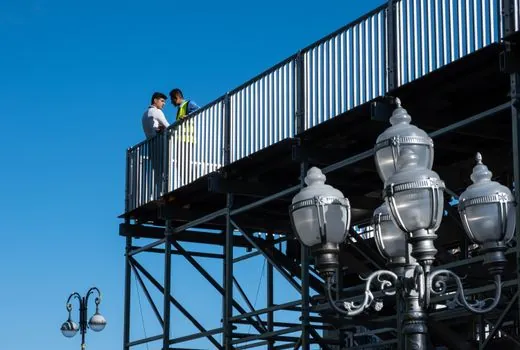
The recurring failure modes on these platforms are well known to state DOT bridge crews: dust collector undersized for the blast pot (visible dust plume at the deck-fabric seal), platform cable wear from chafing against girder edges without protective padding, dehumidifier failure leading to amine blush on fresh epoxy, and inadequate fall arrest on the crossover platform. Abrasive blast lights rated for dust ignition (Class I Div 2 or ATEX equivalent, depending on jurisdiction) and air-fed blast hoods with redundant breathing air are mandatory inside the envelope [S3].
Standards that govern the work, in approximate hierarchy: SSPC-SP 6 / SP 10 for surface preparation profiles, OSHA 1926.62 for lead-in-construction worker exposure, EPA RRP for renovation activities that disturb lead-based paint, and the AASHTO/NSBA steel bridge coating guide for system selection. For the rigging side, OSHA 1926.451 (scaffolds) and 1926.500 (fall protection) apply to the suspended platform, with ANSI A10.28 for the platform itself on most state-funded work [S2]. Lighting equipment inside the deck must be dust-ignition rated and supplied with filtered breathing air when fuel-fired heaters run in cold weather to keep cure windows on schedule.
Two trackable signals over the next 12 months: state DOTs adding encapsulated-overcoat systems like RUST GRIP® to approved-products lists for lead-paint bridges, and OEM releases of higher-reach (>40 ft) under-bridge platforms that retain the HP35-class self-leveling deck. A third signal worth watching is wider adoption of wet/slurry blasting on lead-paint bridges over inland waterways, where dry containment is hardest to keep closed against wind and water movement [S1][S3][S5].
Background reading: Battery Cell Lead Time 2026: What Industrial Buyers Should Plan For.