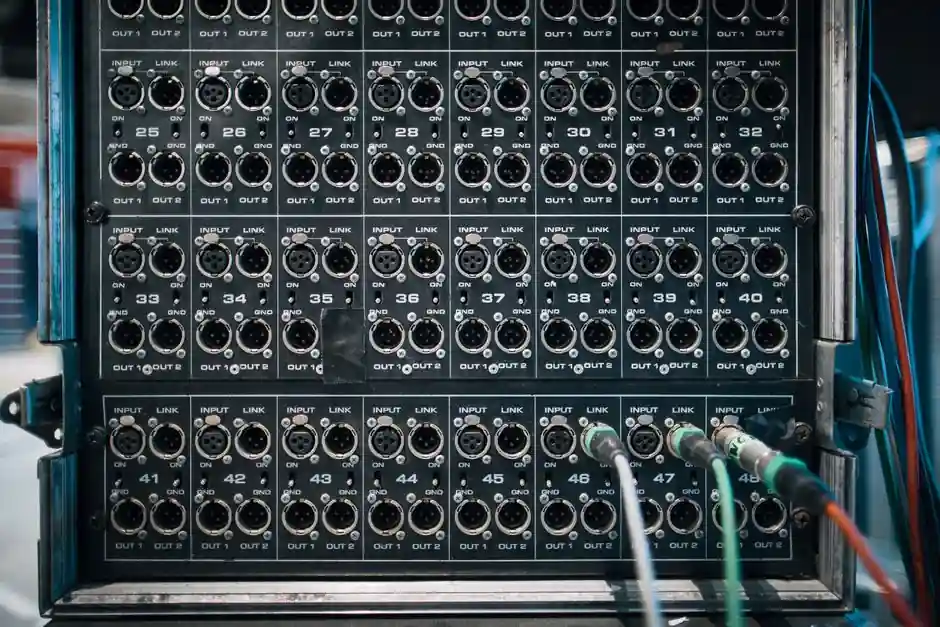
For new industrial Ethernet remote I/O deployments the protocol decision is binary at the system level: PROFINET modules for Siemens controllers, EtherNet/IP modules for Rockwell controllers, and Modbus TCP only where a mixed-vendor or wireless edge justifies the simplicity [S2][S3].
Industrial Ethernet carried roughly 79% of new installed network nodes globally in HMS Networks' 2026 Industrial Network Market Shares Report, with PROFINET at 30% and EtherNet/IP at 25% market share, while Modbus TCP sat at 5% as the universal fallback [S2]. Remote I/O modules are the most numerous nodes on those networks, so the choice of protocol cascades into GSDML versus EDS file provisioning, switch selection, and motion-class determinism [S2][S5].
Protocol Stack and Real-Time Behaviour
PROFINET remote I/O modules expose two real-time classes: PROFINET RT for soft real-time cyclic I/O, and PROFINET IRT for hard isochronous motion with sub-millisecond determinism, which is why high-speed Siemens cells standardise on IRT-capable I/O [S3][S5].
EtherNet/IP remote I/O modules use the Common Industrial Protocol (CIP) over standard Ethernet, with CIP Sync and CIP Motion available for tighter timing on supported hardware, but the default cyclic class is soft real-time comparable to PROFINET RT [S5]. Modbus TCP remote I/O is purely polled client/server with no isochronous class, so it is rejected by any control loop needing deterministic update under 10 ms [S2][S5]. Engineers specifying remote I/O modules for motion should treat IRT availability as a hard filter, not a preference. PROFINET segments also expect LLDP topology discovery and traffic-prioritised managed switches, which raises the bar for switch selection versus a generic EtherNet/IP ring [S5].
Topology, Redundancy, and Cabling
PROFINET remote I/O modules are typically daisy-chained and supported by MRP (Media Redundancy Protocol) on managed switches, giving 200 ms class failover in a ring, while EtherNet/IP modules use DLR (Device Level Ring) at the device level for ring recovery without managed switch configuration [S3][S5].
Both protocols run on standard RJ45 Cat 5e or Cat 6 cabling with M12 or M12-D coded connectors in the field, so the physical layer is interchangeable; the difference is at the application layer and how devices negotiate the link [S5]. Lumberg's LioN-M I/O Standalone is a 60 mm metal-enclosed multiprotocol block offering 16 digital outputs with galvanic isolation and field-selectable PROFINET, EtherNet/IP, or EtherCAT personalities, demonstrating that the same IP67 hardware can serve either camp if the OEM exposes the protocols [S6]. ifm's decentralised Ethernet modules (AL4202 PerformanceLine and StandardLine) use L-coded M12 power ports rated at 2 x 16 A for daisy-chain supply and 4 A A-coded variants for lower-power branches, with standardised M12 signal ports shared with the IO-Link master family [S1].
Configuration, Diagnostics, and Integration Effort
PROFINET remote I/O requires a GSDML device description file imported into TIA Portal or a third-party configuration tool, while EtherNet/IP modules use EDS files imported into Studio 5000 or RSLogix; Modbus TCP modules need only a register map, which is the lowest integration cost but the worst diagnostics [S2][S5].
Channel-level diagnostics is a real differentiator: PROFINET modules surface slot, channel, and module status with explicit error codes per device, and EtherNet/IP modules return CIP explicit messages plus DLR ring status, while Modbus TCP nodes usually expose only a heartbeat and a handful of status coils [S3][S5]. For brownfield expansions where a single Ethernet network must carry 200+ I/O points per drop, both PROFINET and EtherNet/IP beat Modbus TCP on diagnostic granularity and configuration audit trail. Engineers who standardise on Siemens controllers should look at PLC CPU firmware version compatibility with the targeted GSDML, because PROFINET conformance classes (CC-A, CC-B, CC-C) gate which features the I/O block will actually expose at runtime.
Hardware Cost and Lifecycle Considerations
PROFINET and EtherNet/IP remote I/O modules from major vendors typically price within 10-20% of each other per digital channel, with PROFINET carrying a small premium on IRT-capable motion blocks; Modbus TCP nodes are commonly 30-50% cheaper per channel because there is no device-description license and no conformance-test gate [S2].
Total installed cost shifts when the managed-switch requirement is included: PROFINET IRT cells usually need PROFINET-aware managed switches that can prioritise traffic and act as MRP managers, while EtherNet/IP DLR rings can be built with lower-cost unmanaged switches because redundancy is handled at the device level [S3][S5]. Phoenix Contact's Inline remote I/O system supports both PROFINET and Modbus/TCP from the same controller head with an integrated web server, and the I/O terminals extend the bus in 1- or 2-channel slices, which lowers the granularity cost versus fixed 8- or 16-channel blocks [S7]. Lifecycle planning should also account for the 2-3 year product discontinuation cycles typical of decentralised I/O, with PROFINET modules from European vendors generally staying in production longer than their EtherNet/IP equivalents in motion-grade SKUs.
Decision Matrix: Which Protocol for Which Project
Use PROFINET remote I/O when the controller is a Siemens S7-1500 or ET 200SP CPU, when the application needs IRT motion synchronisation under 1 ms, and when the plant is in Europe where PROFINET's 30% market lead reflects deepest local support [S2][S3][S5].
Use EtherNet/IP remote I/O when the controller is a ControlLogix or CompactLogix, when the plant is in North America where ODVA ecosystem support is densest, when DLR ring redundancy is preferred without managed switches, and when CIP Motion is sufficient for the axis count [S3][S5]. Use Modbus TCP remote I/O only at the network edge for non-deterministic monitoring, wireless telemetry where PROFINET and EtherNet/IP drop out under packet loss, and mixed-vendor cells where the CapEx delta of 30-50% per channel outweighs the loss of channel-level diagnostics [S2]. Avoid Modbus TCP inside any control loop tighter than 50 ms, and avoid PROFINET or EtherNet/IP over consumer Wi-Fi where the 802.11 retransmission profile breaks cyclic determinism [S2]. Cross-protocol bridging via multiprotocol blocks such as the LioN-M is acceptable as long as each segment is engineered as a single-protocol island with a documented protocol converter at the boundary [S6].
Standards, Cybersecurity, and Sourcing Checklist
PROFINET conformance is governed by PI (PROFIBUS and PROFINET International) and certified against conformance classes A, B, and C, with CC-C required for IRT motion, while EtherNet/IP conformance is certified by ODVA against CIP standards, and Modbus TCP remains an open specification maintained by the Modbus Organization with no formal certification gate [S2][S5].
For zone-1 and zone-2 hazardous-area deployments, specify remote I/O modules with ATEX category 3 or IECEx certification matched to the gas group, and verify the M12 connector sealing (typically IP67) is consistent across the signal and power ports; ifm's ecolink M12 family and Lumberg's LioN-M at IP67 are typical reference points [S1][S6]. For brownfield retrofits, prefer modules that accept firmware-based protocol switching (PROFINET, EtherNet/IP, EtherCAT) so a single SKU can follow the plant's PLC standardisation roadmap without re-wiring. Specifiers should also confirm the controller's GDSML or EDS library is current to the module's firmware revision before issuing a purchase order, because a one-version mismatch is the single most common cause of commissioning delays on multi-vendor Ethernet I/O projects [S2][S5].
For an unrelated but methodologically useful comparison of standards-driven component selection, the EN 50288-7 shielded instrumentation cable spec sheet walks through how a single IEC or CENELEC standard reshapes a buy decision. Network architects building heterogeneous Ethernet I/O should treat the SCADA licensing decision matrix as a useful analogy: per-node versus unlimited-tag pricing distorts the same underlying hardware trade-off as per-channel versus per-block remote I/O pricing. For safety-rated I/O adjacent to either protocol, the Type 2 vs Type 4 safety light curtain decision map shows how conformance category (PL/SIL) sets the same kind of hard filter that PROFINET CC-C and CIP Safety impose on motion and safety I/O selection.
Spec-level background on the components involved: pressure transmitter.